

Today’s Market Recap: Israel-Lebanon Talks Plan Boosts Ceasefire Expectations, S&P 500 and Nasdaq Rise for Seventh Day, Semiconductor Index Hits New High

Source Tradingkey

TradingKey - Planned Israel-Lebanon talks boosted hopes for maintaining a US-Iran ceasefire, and US stocks rose once again. The three major indices closed at highs not seen in over a month, with the S&P 500 and Nasdaq recording their seventh consecutive session of gains; memory chip stocks led the chip index up more than 2%, outperforming the market for the seventh straight day.

After the Israeli Prime Minister announced he had instructed negotiations with Lebanon, US Treasury yields turned lower during the session, hitting fresh daily lows; the US Dollar Index accelerated its decline, nearing a four-week low.

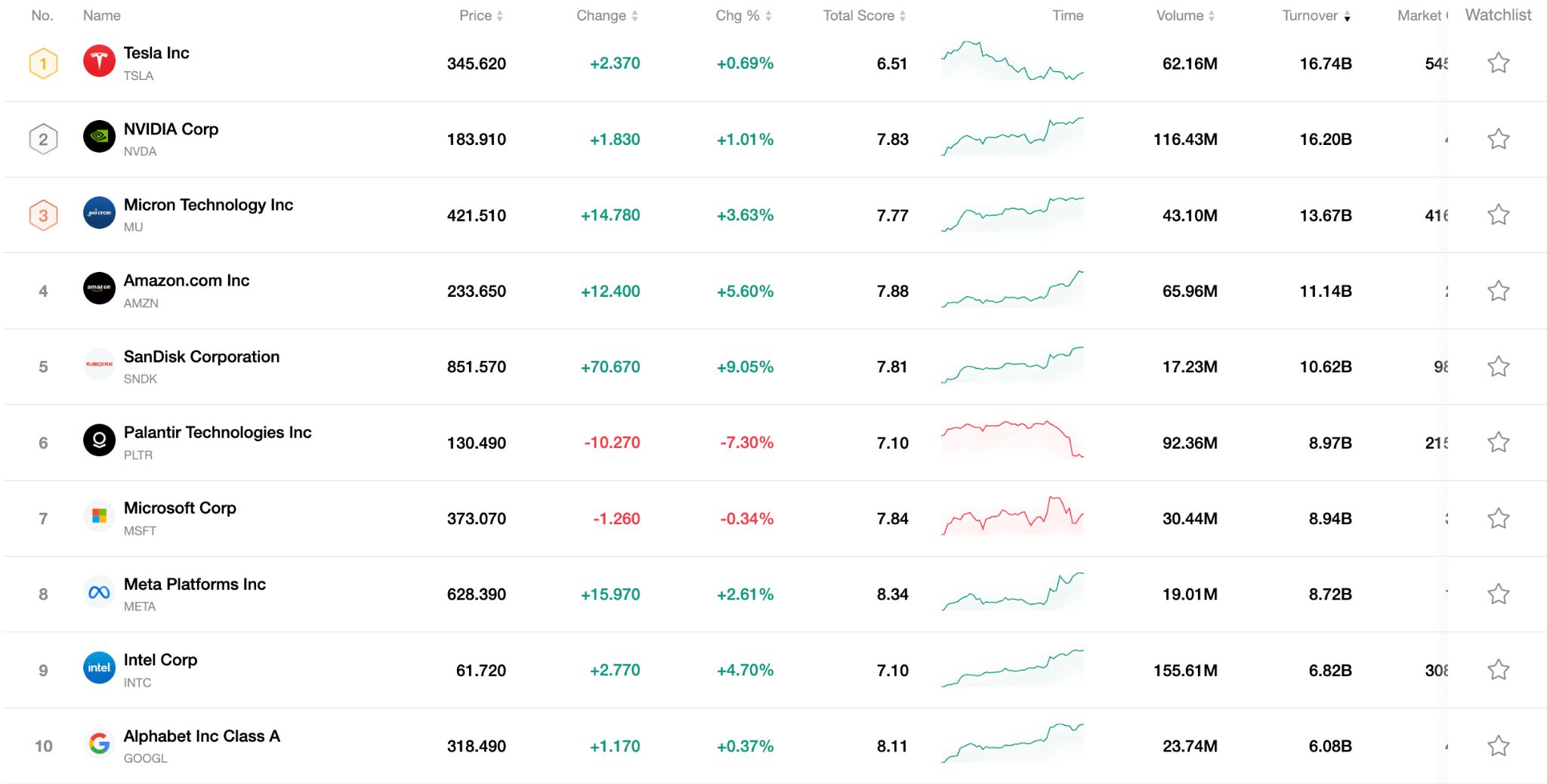
In individual stocks: Western Digital rose more than 9%; Amazon closed up 5.6%, leading tech giants after its CEO's shareholder letter confirmed the company's AI potential and provided the rationale for AI investment; conversely, software stocks slumped against the market trend, with Microsoft being the sole decliner among the "Magnificent Seven," while ServiceNow dropped nearly 8% and Palantir fell over 7%.

In commodities: Crude oil rebounded, with WTI rising nearly 9% and Brent gaining 5% intraday, before paring more than half of those gains following the Israeli Prime Minister's instruction for negotiations with Lebanon; gold and silver continued to climb, with spot gold rising nearly 2% and spot silver up over 4% during the session.

Market Headlines

The Israeli Prime Minister has instructed the immediate commencement of direct negotiations with Lebanon. Trump has requested that Israel scale back its strikes on Lebanon, stating he is "very optimistic" about reaching a peace deal with Iran soon. Trump wants Israel to maintain a "lower profile" in its military operations in Lebanon. However, the Israeli Prime Minister reiterated that the ceasefire agreement does not cover Lebanon, emphasizing that Israel will not cease hostilities in Lebanon until Hezbollah is disarmed. Israel and Lebanon are set to begin negotiations in the United States next week; Lebanon has proposed a temporary ceasefire first to create conditions for dialogue with Israel.

The U.S. Core PCE Price Index rose 3% year-on-year in February. U.S. core PCE in February eased from the previous reading of 3.1%, while consumer spending remained nearly flat month-on-month. Services inflation slowed significantly during the month, but a jump in non-durable goods prices posed a potential disturbance. Consumption data showed clear divergence: real spending grew by only a slight 0.1%, bordering on stagnation; personal income unexpectedly fell 0.1% month-on-month, and the savings rate dropped sharply to 4.0%.

Amazon is considering selling its proprietary AI chips externally, with potential annualized revenue reaching $50 billion. CEO Andy Jassy revealed in his annual shareholder letter that Amazon's chip division has already surpassed $20 billion in annualized revenue, and could reach $50 billion if it expands to external sales. Previously, Amazon only provided chip capabilities by "renting" computing power via the AWS platform; it may directly sell Trainium chip racks in the future.

Google and Intel announced an expansion of their AI chip partnership, committing to the adoption of Intel Xeon processors. Google is bringing Xeon 6 into AI training and inference, signaling a resurgence of CPUs in AI infrastructure to address computing bottlenecks in the era of AI agents. This move provides Intel with a new opportunity to penetrate a market dominated by Nvidia; meanwhile, combined with U.S. government investment, industrial capital support, and advancements in advanced manufacturing processes, market confidence in Intel is gradually recovering. Notably, while strengthening its collaboration with Intel, Google remains committed to its TPU and proprietary CPU strategies, as diversified positioning accelerates the escalation of competition in AI computing power.

CoreWeave with Meta signed a five-year computing power agreement. CoreWeave has secured its computing power supply to Meta from 2027 to 2032 in a contract worth as much as $21 billion. This major deal will help CoreWeave reduce its high dependency on Microsoft and significantly enhance customer diversification. Microsoft’s capital expenditure plan for this year is between $115 billion and $135 billion, double that of 2025. Against the backdrop of pressure on Meta's current AI model competition, CoreWeave expects the partnership to continue deepening. Subsequently, CoreWeave plans to issue $1.25 billion in bonds maturing in 2031 to raise funds.

Top 10 Most Actively Traded Stocks

The chart below illustrates the ten most actively traded stocks in the current market. Driven by massive trading volume and high liquidity, these assets have become critical benchmarks for tracking global market dynamics.
top10-stock-0409-3366a7cd89e34d7d9163f89c3b68e8ac

Disclaimer: For information purposes only. Past performance is not indicative of future results.
placeholder
Bitcoin CME gaps at $35,000, $27,000 and $21,000, which one gets filled first?Prioritize filling the $27,000 gap and even try higher.
Author  FXStreet
Aug 22, 2023
Prioritize filling the $27,000 gap and even try higher.
placeholder
Pinduoduo Earnings Incoming: Morgan Stanley Sees Long-Term Profit Potential​Insights – On November 21, Chinese e-commerce giant Pinduoduo (PDD) will release its Q3 2024 earnings.
Author  Mitrade
Nov 20, 2024
​Insights – On November 21, Chinese e-commerce giant Pinduoduo (PDD) will release its Q3 2024 earnings.
placeholder
Elon Musk’s xAI and Neuralink Launch New Funding Rounds​Billionaire Elon Musk recently raised funds for his two high-profile tech companies, xAI and Neuralink.
Author  Insights
Jun 03, 2025
​Billionaire Elon Musk recently raised funds for his two high-profile tech companies, xAI and Neuralink.
placeholder
Bitcoin briefly loses 2025 gains as crypto plunges over the weekend.Bitcoin experienced a sharp decline this weekend, briefly erasing its 2025 gains and dipping below its year-opening value of $93,507. The cryptocurrency fell to a low of $93,029 on Sunday, representing a 25% drop from its all-time high in October. Although it has rebounded slightly to around $94,209, the pressures on the market remain significant. The downturn occurred despite the reopening of the U.S. government on Thursday, which many had hoped would provide essential support for crypto markets. This year initially appeared promising for cryptocurrencies, particularly after the inauguration of President Donald Trump, who has established the most pro-crypto administration thus far. However, ongoing political tensions—including Trump's tariff strategies and the recent government shutdown, lasting a historic 43 days—have contributed to several rapid price pullbacks for Bitcoin throughout the year. Market dynamics are also being influenced by Bitcoin whales—investors holding large amounts of Bitcoin—who have been offloading portions of their assets, consequently stalling price rallies even as positive regulatory developments emerge. Despite these sell-offs, analysts from Glassnode argue that this behavior aligns with typical patterns seen among long-term investors during the concluding stages of bull markets, suggesting it is not indicative of a mass exodus. Notably, Bitcoin is not alone in its struggles, as Ethereum and Solana have also recorded declines of 7.95% and 28.3%, respectively, since the start of the year, while numerous altcoins have faced even steeper losses. Looking ahead, questions linger regarding the viability of the four-year cycle thesis, particularly given the increasing institutional support and regulatory frameworks now in place in the crypto landscape. Matt Hougan, chief investment officer at Bitwise, remains optimistic, suggesting a potential Bitcoin resurgence in 2026 driven by the “debasement trade” thesis and a broader trend toward increased adoption of stablecoins, tokenization, and decentralized finance. Hougan emphasized the soundness of the underlying fundamentals, pointing to a positive outlook for the sector in the longer term.
Author  Mitrade
Nov 17, 2025
Bitcoin experienced a sharp decline this weekend, briefly erasing its 2025 gains and dipping below its year-opening value of $93,507. The cryptocurrency fell to a low of $93,029 on Sunday, representing a 25% drop from its all-time high in October. Although it has rebounded slightly to around $94,209, the pressures on the market remain significant. The downturn occurred despite the reopening of the U.S. government on Thursday, which many had hoped would provide essential support for crypto markets. This year initially appeared promising for cryptocurrencies, particularly after the inauguration of President Donald Trump, who has established the most pro-crypto administration thus far. However, ongoing political tensions—including Trump's tariff strategies and the recent government shutdown, lasting a historic 43 days—have contributed to several rapid price pullbacks for Bitcoin throughout the year. Market dynamics are also being influenced by Bitcoin whales—investors holding large amounts of Bitcoin—who have been offloading portions of their assets, consequently stalling price rallies even as positive regulatory developments emerge. Despite these sell-offs, analysts from Glassnode argue that this behavior aligns with typical patterns seen among long-term investors during the concluding stages of bull markets, suggesting it is not indicative of a mass exodus. Notably, Bitcoin is not alone in its struggles, as Ethereum and Solana have also recorded declines of 7.95% and 28.3%, respectively, since the start of the year, while numerous altcoins have faced even steeper losses. Looking ahead, questions linger regarding the viability of the four-year cycle thesis, particularly given the increasing institutional support and regulatory frameworks now in place in the crypto landscape. Matt Hougan, chief investment officer at Bitwise, remains optimistic, suggesting a potential Bitcoin resurgence in 2026 driven by the “debasement trade” thesis and a broader trend toward increased adoption of stablecoins, tokenization, and decentralized finance. Hougan emphasized the soundness of the underlying fundamentals, pointing to a positive outlook for the sector in the longer term.
placeholder
Gold edges lower below $4,750 amid fragile Middle East ceasefire Gold price (XAU/USD) trades in negative territory around $4,705 during the early Asian session on Thursday. The precious metal edges lower amid a temporary two-week ceasefire between the US and Iran.   
Author  FXStreet
17 hours ago
Gold price (XAU/USD) trades in negative territory around $4,705 during the early Asian session on Thursday. The precious metal edges lower amid a temporary two-week ceasefire between the US and Iran.   
goTop
quote