




Australia’s AI boom just hit a power bottleneck — what does NextDC’s 42% crash mean for data-centre stocks?
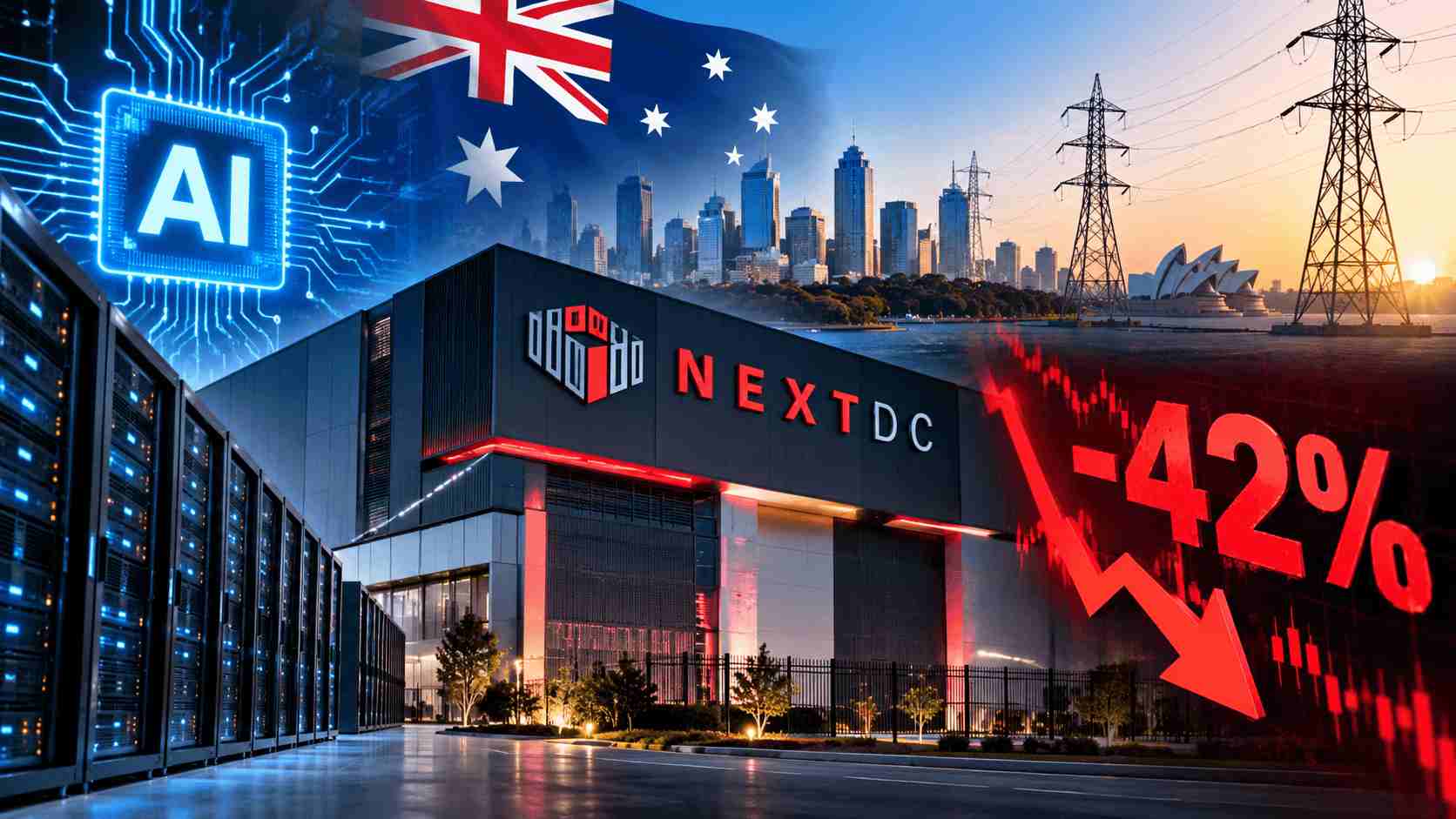
Australia’s AI infrastructure boom has run into a problem that has nothing to do with demand for artificial intelligence: getting enough electricity to the data centres that power it.
NextDC shares crashed roughly 42% in a single session, wiping around A$3 billion from its market value after delays to electricity infrastructure at its M3 Melbourne data centre forced the company to defer about A$140 million of contracted revenue.
The setback also prompted NextDC to slash FY27 revenue and EBITDA guidance, pause new developments and land purchases, review capital spending and consider selling selected development sites.
That is a dramatic reversal for a company that entered 2026 with demand surging. NextDC finished FY26 with 740MW of contracted utilisation, up sharply as cloud providers and AI customers raced to secure capacity.
For investors, the lesson is becoming clearer: demand for AI computing capacity can be enormous without automatically producing revenue. Data-centre operators still need power connections, approvals, financing and construction to arrive at the right time.
That makes NextDC’s problems relevant well beyond one stock.
NextDC has customers — but not enough power
NextDC’s M3 facility in West Footscray was designed specifically for large-scale cloud and AI workloads, with planned IT capacity of 225MW.
The problem is not finding customers for that capacity. It is delivering the electricity required to switch it on. Power-network delays mean a major capacity increase at M3 is now not expected until 2028, pushing contracted revenue further into the future. NextDC consequently cut FY27 net revenue guidance to A$475–500 million from A$615–640 million and underlying EBITDA guidance to A$245–265 million from A$385–410 million.
That is what makes the sell-off more important than a normal earnings disappointment. The contracts themselves have not suddenly proved that AI demand was exaggerated. Instead, infrastructure constraints have pushed the revenue attached to those contracts further away.
Earlier this year, NextDC was accelerating investment precisely because customer demand was so strong. In April, pro-forma contracted utilisation reached 667MW and the forward order book climbed to 544MW, prompting the company to forecast around A$5 billion of FY27 capital expenditure.
The problem has shifted from winning demand to delivering capacity.
Power is becoming the scarce asset in the AI boom
AI data centres consume extraordinary amounts of electricity because thousands of high-performance chips need to run continuously while being cooled.
That makes a secured electricity connection almost as important as the land or building itself.
Australia has plenty of potential data-centre demand, helped by cloud growth, AI investment and the need for companies to keep data closer to domestic users. But connecting very large facilities to the electricity grid can require new substations, transmission infrastructure and approvals that take years.
NextDC shows what happens when the timelines do not align. A company can sign a customer contract and start spending on construction, yet still be unable to recognise the expected revenue if the required electricity arrives late.
Community opposition adds another constraint. Large data centres are facing increasing resistance over electricity consumption, noise, water use and their effect on surrounding infrastructure. Goodman Group recently withdrew plans for a A$1.2 billion Sydney data centre after opposition to the proposed development.
For investors, those risks change how data-centre growth needs to be assessed. A large development pipeline is valuable only if the power, approvals and capital needed to build it are actually available.
NextDC and Goodman offer two different AI infrastructure trades
NextDC and Goodman are both exposed to growing data-centre demand, but they approach the opportunity differently.
Goodman has made securing power a central part of its data-centre strategy. At June 2026, the group had a 6.4GW global data-centre power bank, including about 2.1GW across Australia and New Zealand. It also had 0.8GW of stabilised capacity and 0.5GW under development.
Its Sydney SYD01 development illustrates the approach. The site has 90MW of secured power, with the first phase expected to become operational in 2028.
That does not make Goodman immune to delays. Its abandoned Sydney project demonstrates that planning and community opposition can still stop developments even when demand exists.
The difference is diversification. NextDC is more directly exposed to data-centre operating revenue and therefore offers stronger upside if contracted capacity comes online quickly, but individual delays can have a much larger effect on earnings expectations.
Financing is becoming part of the AI infrastructure test
Power is only one constraint. Data centres also require enormous amounts of capital before they start producing meaningful revenue.
NextDC has spent aggressively to build capacity ahead of contracted customer demand. Earlier in 2026, it raised equity and secured additional debt commitments as its forward order book surged, lifting pro-forma liquidity to about A$8.4 billion at the time.
That model works particularly well when facilities open on schedule because contracted customers begin generating revenue against infrastructure that has already been funded.
Delays change that equation. Capital may be committed before expected revenue arrives, while interest and development costs continue.
The risk becomes more important when borrowing costs are high. AI infrastructure may have powerful long-term demand, but investors still need to consider how much debt and equity are required before that demand turns into cash flow.
NextDC’s decision to pause uncontracted developments and review capital spending is therefore significant. Management is no longer simply asking how quickly it can build. It is reassessing which projects justify the financial commitment under more difficult delivery conditions.
For traders, capex guidance could become almost as important as new customer contracts.
The AI infrastructure trade is becoming more selective
NextDC’s collapse does not mean Australia’s data-centre opportunity has disappeared.
Its contracted utilisation actually demonstrates the opposite. Hyperscalers, cloud providers and AI companies still want substantial amounts of Australian capacity.
The market is instead starting to distinguish between AI demand and the ability to monetise that demand.
A developer with secured power, approvals, financing and customer contracts may become more valuable as those resources become harder to obtain. A company holding land without reliable electricity or planning certainty may find that its apparent development pipeline is worth much less.
That could benefit businesses capable of securing infrastructure early, while putting more pressure on companies relying on future grid connections or speculative developments.
It also means investors may become less impressed by headline measures such as total megawatts planned. The more useful questions are how much power is secured, how much capacity is contracted, when customers start paying and how much capital is required to reach that point.
Those measures can produce very different outcomes even when two companies are exposed to exactly the same AI boom.
NextDC now faces a credibility test
The M3 delay has also become a governance issue. Shareholders were already scrutinising executive remuneration, and the scale of the guidance downgrade has increased pressure on the board. CEO Craig Scroggie has now given up his FY27 bonus opportunities, while the company is reviewing its leadership and governance arrangements.
That puts more weight on NextDC’s upcoming capital and development review. Investors will want to see which projects remain priorities, which developments are paused or sold and whether the company can protect liquidity while still delivering contracted capacity.
The long-term demand story remains intact, but the market is likely to demand more evidence before assigning the same value to future megawatts that have not yet been powered.
For the share price, restoring confidence may therefore depend less on announcing another huge AI contract and more on proving existing contracts can be converted into revenue on predictable timelines.
What should traders watch next?
Power availability is now the first issue. Any improvement in the M3 timetable could bring deferred revenue forward again, while further delays would reinforce concerns that grid infrastructure is becoming a structural bottleneck.
NextDC’s capital review is another major catalyst. Reducing speculative development spending could strengthen the balance sheet, but aggressive cuts could also reduce future growth.
Goodman provides a useful comparison. Continued progress across sites where power is already secured would strengthen the case that early control of electricity infrastructure is becoming a competitive advantage.
Traders should also watch whether similar delays appear elsewhere in Australia. If grid connections, planning disputes and financing problems start affecting more projects, NextDC’s setback could prove to be an industry warning rather than a company-specific failure.
Trading Australian data-centre shares with Mitrade
The NextDC sell-off shows why AI infrastructure stocks can move sharply even when underlying demand remains strong.
Eligible Australian clients can use Mitrade CFDs to take long or short positions on available ASX shares, allowing traders to respond to project delays, new contracts, guidance changes and capital-spending announcements without owning the underlying shares.
That flexibility is particularly relevant when companies exposed to the same AI trend face different execution risks. Stronger power access or project delivery can support one stock while delays or funding pressure weigh on another.
Stop-loss and take-profit orders can be used to define exit levels, while pending orders allow positions to open when a selected price is reached.
Mitrade is regulated in Australia by ASIC. Share CFDs are leveraged products, so both potential gains and losses can be magnified.
Start trading Australian shares in three simple steps
You might be interested in…
1. Could NextDC recover if the M3 power delay is resolved?
Potentially. A clearer timetable for M3 could bring deferred revenue back into investors’ forecasts and improve confidence in the development pipeline. The bigger issue is whether the delay proves isolated or exposes wider problems with power access and project execution.
2. Does NextDC’s sell-off make the stock cheap?
Not necessarily. A lower share price can improve valuation, but investors still need to reassess revenue timing, capex requirements and the value of projects that may take longer to reach operation. The key question is whether earnings expectations have fallen faster than the share price.
3. What would be the clearest sign that Australia’s data-centre problem is becoming sector-wide?
More project delays, reduced development guidance, cancelled sites or rising costs across multiple operators would suggest the issue extends beyond NextDC. Continued progress at well-powered projects would point instead to execution differences between companies.
Disclaimer: The content presented above, whether from a third party or not, is considered as general advice only. CFD trading involves significant risk of loss. Past performance does not guarantee future results. This article serves informational purposes only and does not constitute financial advice. Consider your risk tolerance before trading.


