




BHP, Rio Tinto and Fortescue Quarterly Reports: What October’s Updates Mean for ASX Iron Ore Stocks
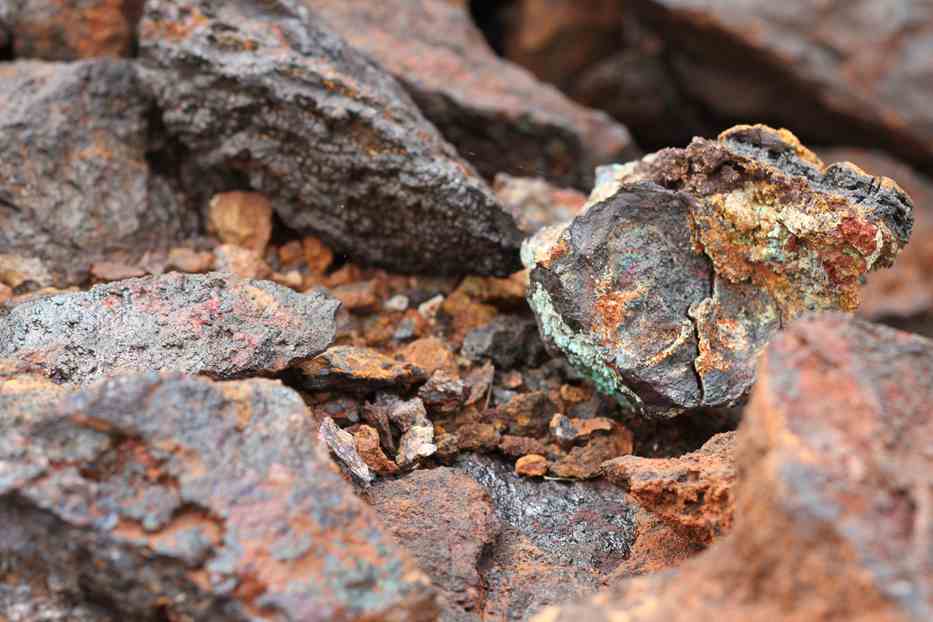
This October, the BHP, Rio Tinto and Fortescue quarterly reports land at a difficult moment for iron ore. The steelmaking ingredient has slipped below US$90 a tonne for the first time since 2024, and China is pushing harder than ever on price.
Fortescue reported first, and its numbers were a warning. It sold fewer tonnes than it shipped, received a lower price for each tonne, and saw its net debt more than triple in three months.
Rio Tinto reported on October 14, and BHP follows on October 20. For traders, the question is whether the pressure stays with Fortescue or spreads to the two diversified giants. Mitrade, regulated by ASIC, lets Australian traders go long or short on all three miners from one account.
Why October’s Quarterly Reports Matter for ASX Iron Ore Stocks
A quarterly operational review is a production update in which a miner reports how much it mined, shipped and sold over the past three months, along with the prices it received and any change to its full year guidance.
These reports carry no profit figure, but they often move share prices more than the annual results. They are the first hard evidence of how a miner is coping with the market in real time.
This quarter, three numbers matter more than any others. Traders should watch the gap between tonnes shipped and tonnes sold, the price received as a share of the benchmark index, and any change to cost guidance.
Those three numbers reveal how much bargaining power has shifted from the miners to their Chinese buyers. That shift is the defining iron ore story of 2026.
Where the Iron Ore Price Stands
Iron ore has been in a slow decline for most of the year. The fronet month SGX contract has now dropped below US$90 a tonne for the first time since 2024.
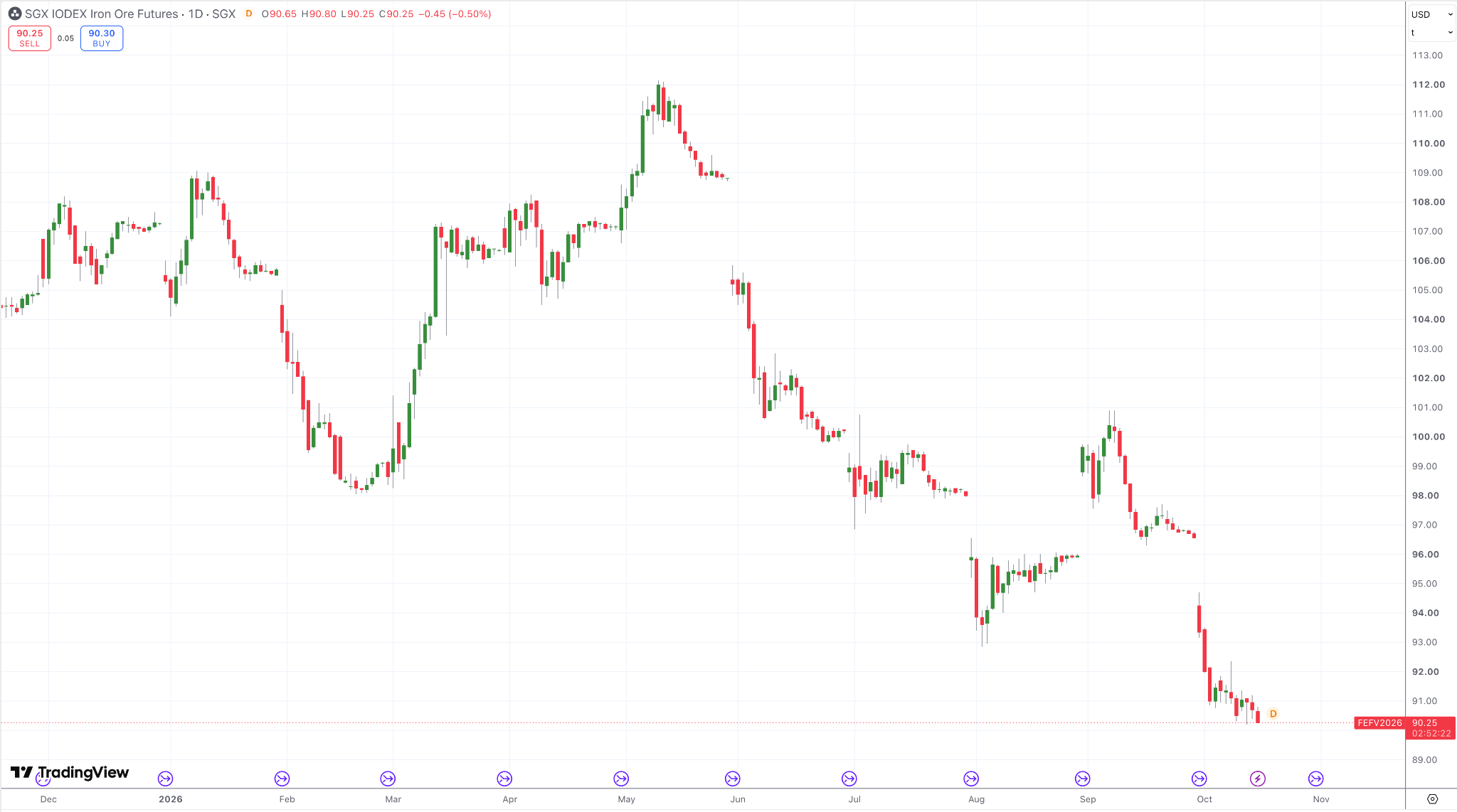
Image: TradingView (SGX Iron Ore Futures Daily Chart)
The chart shows two failed rallies in 2026. Iron ore climbed to around US$109 in January and then to roughly US$112 in May, but both moves faded quickly.
From June, the price stepped lower in a series of sharp drops. A brief bounce toward US$101 in September failed, and the sell off resumed in early October.
According to Trading Economics, iron ore is down almost 9% over the past month and more than 12% over the past year. That puts pressure on every miner, but not equally.
Three Forces Squeezing Iron Ore in 2026
China’s single buyer
China Mineral Resources Group, or CMRG, is a state backed buyer that negotiates iron ore purchases on behalf of Chinese steel mills. It was created to give China, the world’s largest iron ore consumer, more control over price.
CMRG’s first major test came against BHP. After a long dispute that included Chinese bans on some BHP cargoes, BHP agreed a new contract in April that reportedly adds a Chinese price index to how its Jimblebar fines are priced.
Rio Tinto and Fortescue have also switched indices on some contracts with CMRG. Each concession shifts a little more pricing power toward Beijing.
Simandou’s new supply
The second force is new supply from Guinea. The Simandou project holds the world’s largest high grade iron ore deposit and can eventually ship around 120 million tonnes a year once fully optimised.
High grade ore suits the cleaner electric arc furnaces China is building. Lower grade Pilbara ore faces more competition as that supply ramps up.
Forecasts for Simandou’s 2026 shipments vary widely, from a few million tonnes to more than 20 million. Even at the low end, the market is already pricing in a future with more high grade supply and less need for Pilbara tonnes.
Fortescue chairman Andrew Forrest has warned that Pilbara ore is less suited than Simandou’s to electric arc furnaces. That concern hangs over the whole sector, but it bites hardest for miners selling lower grade products.
The cost curve
The third force is cost. BHP and Rio Tinto sit among the lowest cost producers in the world, while Fortescue sits further up the cost curve but remains profitable around US$90 a tonne.
That leaves Fortescue with the thinnest buffer if prices keep falling. It also explains why the market has treated the three stocks so differently this year.
Fortescue (FMG): The First Warning Sign
Fortescue (FMG) is the purest iron ore play of the three, with almost all of its revenue tied to the steelmaking ingredient. That made its October 8 update the first real test of the quarter.
The company shipped 46.8 million tonnes in the September quarter, down 6% on a year earlier, including 2.5 million tonnes from its Iron Bridge magnetite project. It sold only 42.9 million tonnes, citing ongoing negotiations with CMRG.
The price it received fell to US$80 per dry metric tonne, or 82% of the benchmark index. That was down from US$89 in the June quarter.
Net debt jumped to US$2.8 billion from US$0.9 billion, after a US$1.0 billion final dividend and US$0.9 billion of capital spending. Fortescue kept its full year guidance, but only subject to its talks with CMRG.
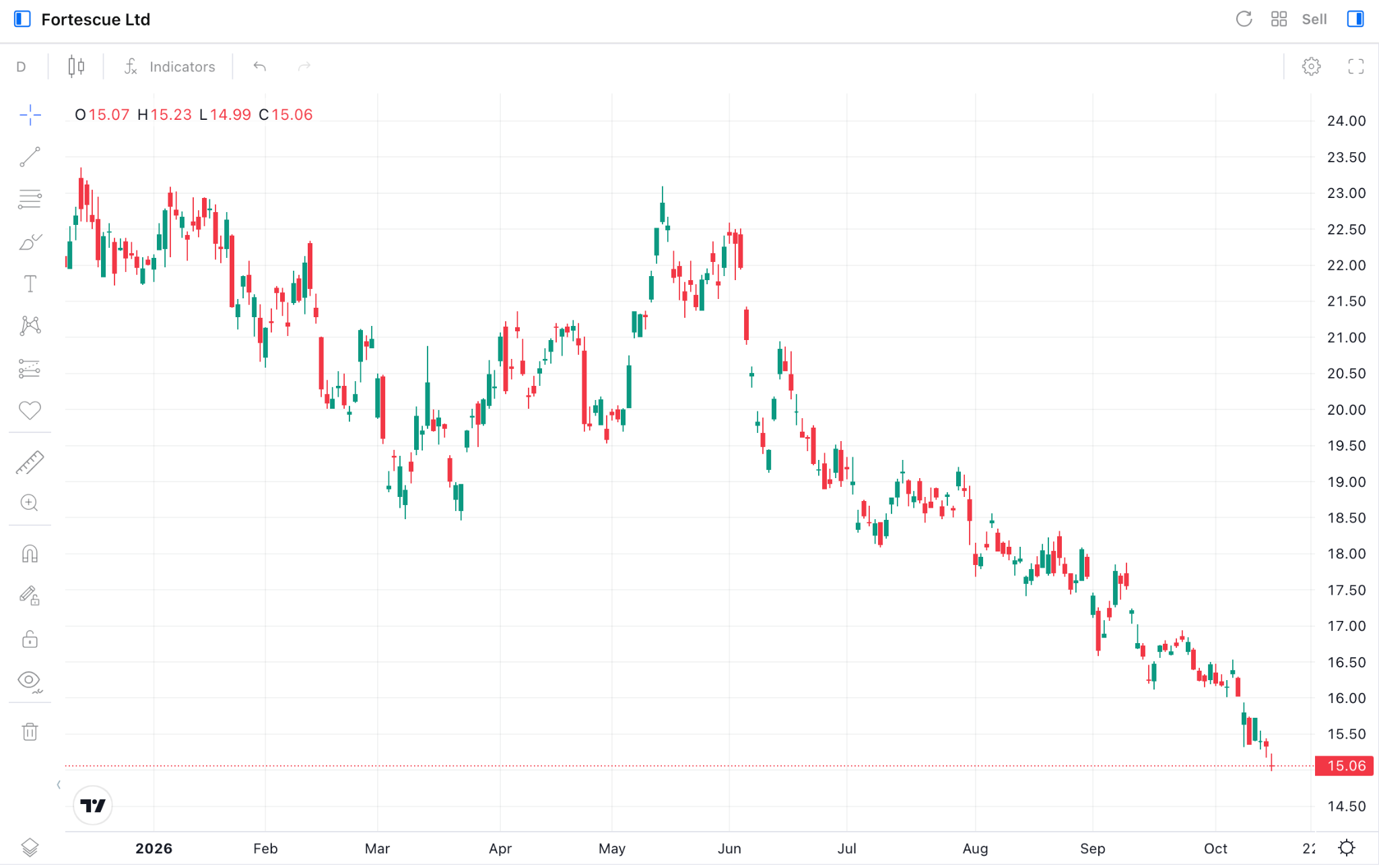
Image: Mitrade (FMG.AU Daily Chart)
The Mitrade chart shows how heavily the market has punished Fortescue. The stock is down 29.84% year to date and 24.25% over six months, with a steady slide since its May peak.
Shares fell more than 3% on the day of the update and have kept drifting lower. Fortescue releases its full quarterly report on October 22, which should add cost and pricing detail.
BHP (BHP): Copper Has Changed the Story
BHP (BHP) is still one of the world’s largest iron ore miners, but it is no longer mainly an iron ore company. Copper has quietly taken over.
In FY26, copper made up 54% of BHP’s underlying EBITDA, the first full year it passed half. Group underlying EBITDA rose 27% to US$ 32.9 billion, while iron ore EBITDA was broadly flat at US$14.5 billion.
That shift matters because copper and iron ore are moving in opposite directions. Copper trades near US$6.72 a pound, up around 35% over the past year and close to its September record.
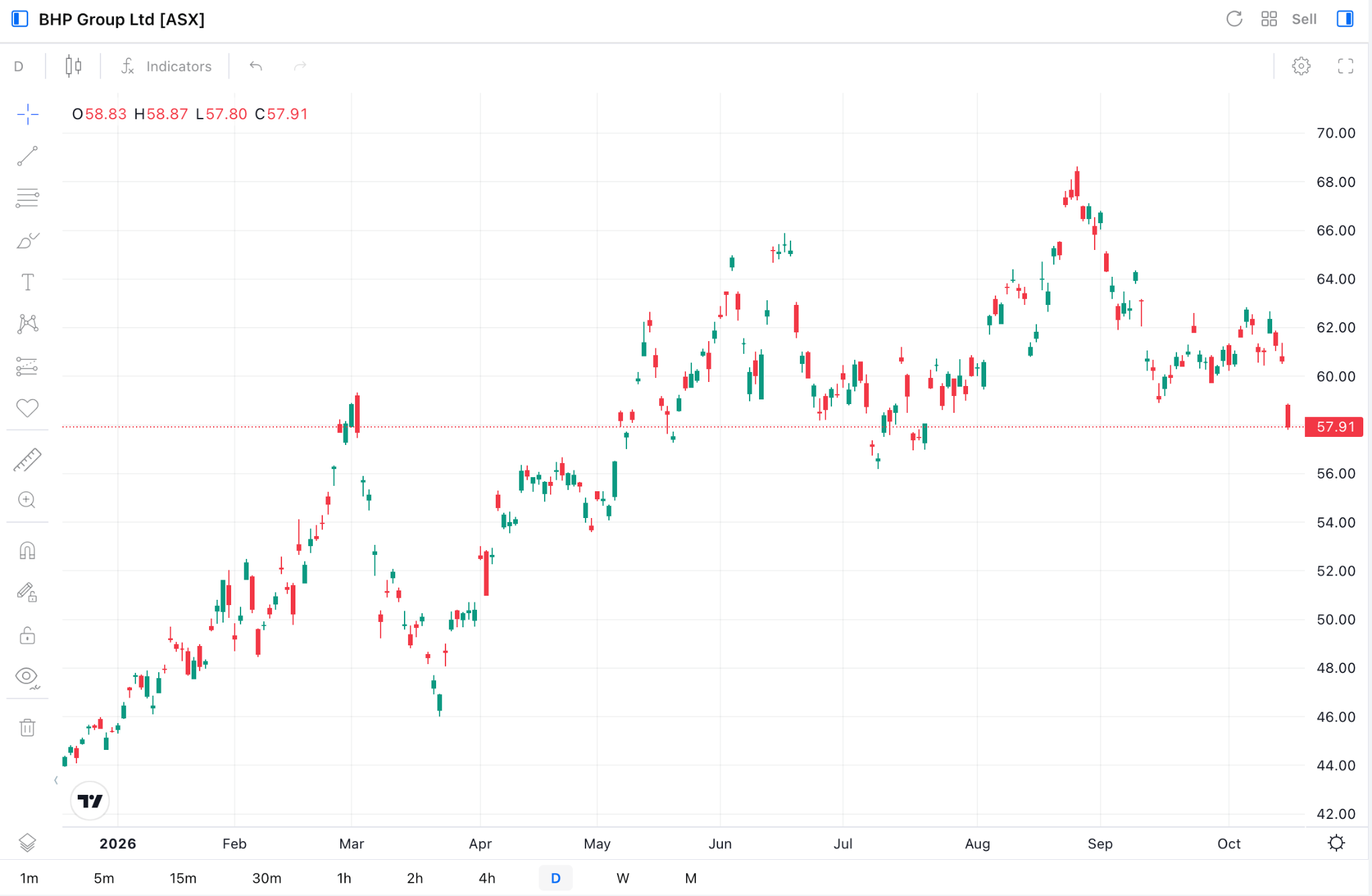
Image: Mitrade (BHP.AU Daily Chart)
The chart reflects that split clearly. BHP is up 34.77% year to date and 43.95% over the past year, even as iron ore has slid.
The stock peaked in late August and has traded sideways since, so the October 20 report could decide its next move. Strong copper volumes could restart the uptrend, while weaker iron ore pricing could cap it.
Rio Tinto (RIO): Caught in the Middle
Rio Tinto (RIO) sits between BHP and Fortescue. It remains heavily exposed to Pilbara iron ore, but its copper, aluminium and lithium businesses are growing fast.
In the first half of 2026, Rio’s underlying EBITDA rose 28% to US$14.8 billion, and free cash flow climbed 75%. Copper, aluminium and lithium together contributed more than half of EBITDA.
Rio also has a foot on both sides of the Simandou story. It achieved first high grade sales from Simandou in April, so new supply that pressures the Pilbara also builds a new revenue stream for Rio.
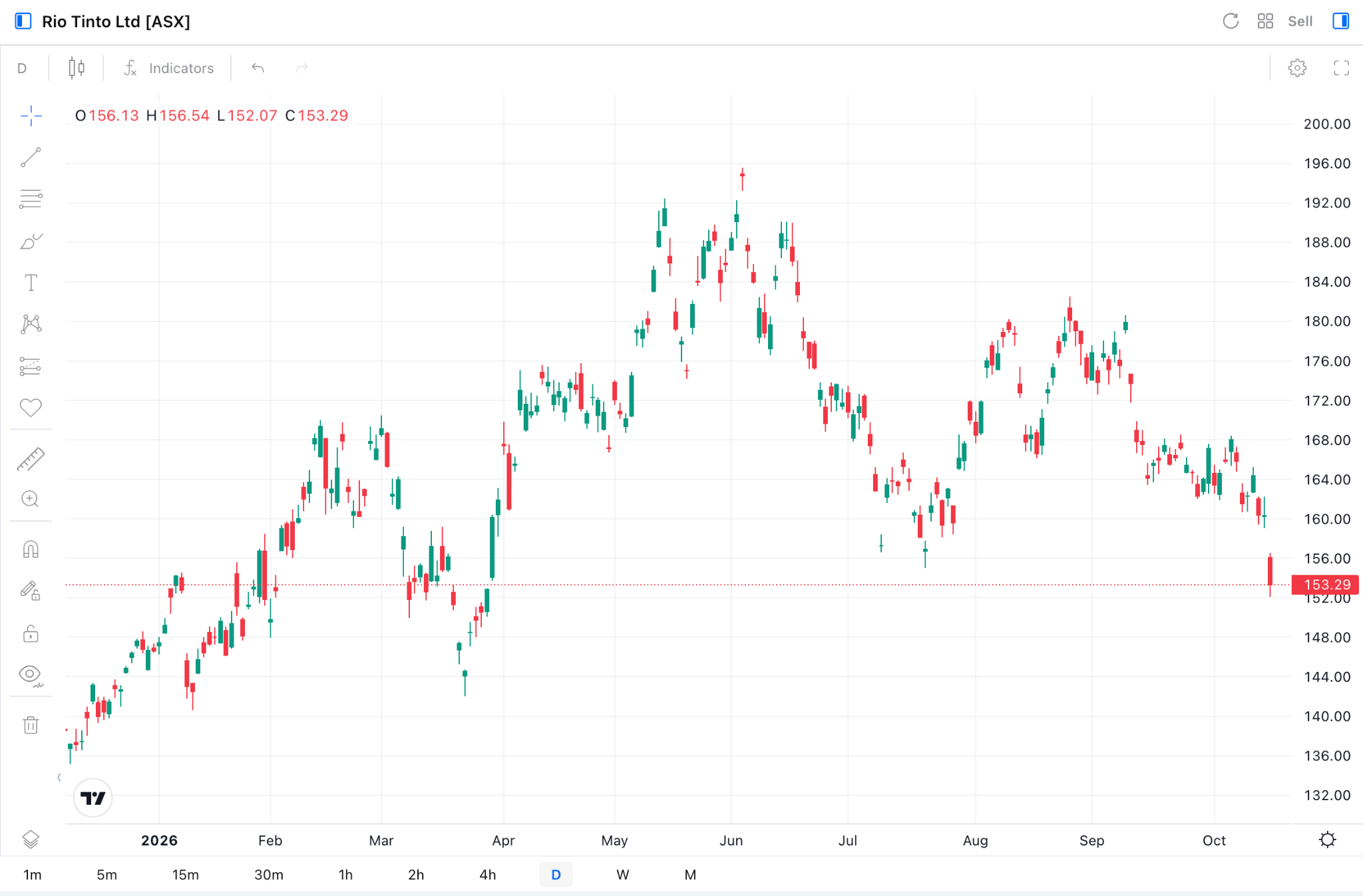
Image: Mitrade (RIO.AU Daily Chart)
The chart shows Rio has given back much of its gains. The stock is up 8.96% year to date, but down 5.12% over the past month and 6.16% over six months.
Shares peaked in early June and have made lower highs since. Rio’s third quarter update on October 14 showed Pilbara sales up 2% to 85.7 million tonnes, while copper output was flat on a year earlier at 205,000 tonnes. Simandou reached an annualised run rate of around 10 million tonnes, and Rio kept its full year guidance unchanged.
The 2026 Scorecard: Why the Three Stocks Have Split
Put side by side, the year to date numbers tell the whole story. BHP is up almost 35%, Rio is up about 9%, and Fortescue is down nearly 30%.
The gap tracks each miner’s reliance on iron ore. The more a company earns from copper and other metals, the better its shares have held up.
This matters for traders who treat the three as one trade. In 2026, owning “the iron ore miners” has meant owning very different exposures to China, copper and the cost curve.
The split could narrow if conditions change. A fresh round of Chinese stimulus or a settlement between Fortescue and CMRG could lift iron ore, and Fortescue would likely rebound fastest from its lower base.
A pullback in copper would hit the other side of the trade. BHP’s strong run leaves it more exposed to any cooling in copper prices than its iron ore results alone might suggest.
What to Watch in Each Report
Traders can use a simple checklist when each update lands. These five points often decide whether shares rise or fall on the day.
Shipments versus sales, which shows whether Chinese buyers are delaying purchases.
Price received as a share of the benchmark index, which shows bargaining power.
Unit costs, since rising costs squeeze margins when prices fall.
Any change to full year guidance, especially if linked to CMRG.
Copper output for BHP and Rio, which now drives a large share of their earnings.
A miner that ships and sells similar volumes at a steady discount to the index is coping well. A widening gap on either measure is a red flag.
Key Dates for ASX Iron Ore Stocks
October brings a tight cluster of events for the sector. Traders should plan positions around these dates.
October 20: BHP’s operational review for the September quarter.
October 22: Fortescue’s full September quarter report.
October 14: Rio Tinto’s third quarter production results (released).
October 28: Australian September CPI, which can move the AUD and the RBA outlook.
The AUD matters because miners sell in US dollars but pay many costs locally. A weaker AUD lifts their local earnings, while a stronger one does the opposite.
How to Trade ASX Iron Ore Stocks on Mitrade
Mitrade offers CFDs on BHP, Rio Tinto and Fortescue, so traders can go long or short around each report. That flexibility suits a sector where the three stocks are moving in different directions.
Some traders pair positions to isolate the copper story. A long BHP and short Fortescue position, for example, profits if diversified miners keep outperforming pure iron ore exposure.
Report days can bring sharp gaps at the open. Mitrade lets traders set a stop loss and take profit on the order screen before placing each trade.
Under ASIC rules, leverage on share CFDs is capped at 5:1. That still magnifies losses as well as gains, so position sizing matters around volatile events.
New traders can practise on a free demo account before risking real money. Testing a strategy on BHP’s October 20 report is a low risk way to learn how miners react to quarterly updates.


You might be interested in…
1. What is CMRG and why does it matter for iron ore?
CMRG is a state backed Chinese buyer that negotiates iron ore purchases for Chinese steel mills. It is using its scale to push Australian miners for better prices and terms.
2. When does BHP release its September quarter report?
BHP releases its operational review for the September quarter on October 20. Fortescue follows with its full quarterly report on October 22.
3. Why have Fortescue shares fallen so much in 2026?
Fortescue relies almost entirely on iron ore, which has fallen toward US$90 a tonne. Its latest update also showed lower sales, a lower price received and higher net debt.
4. Why is BHP up while iron ore is down?
Copper now makes up more than half of BHP’s underlying EBITDA. Copper prices are near record highs, which has offset weaker iron ore.
5. Which ASX miner is most exposed to China’s buying power?
Fortescue is the most exposed, because it earns almost all of its revenue from iron ore. BHP and Rio Tinto have larger copper and metals businesses that cushion the impact.
6. Can I trade BHP, Rio Tinto and Fortescue on Mitrade?
Yes. Mitrade is regulated by ASIC and offers CFDs on BHP, Rio Tinto and Fortescue, with a free demo account for practice.
Disclaimer: The content presented above, whether from a third party or not, is considered as general advice only. CFD trading involves significant risk of loss. Past performance does not guarantee future results. This article serves informational purposes only and does not constitute financial advice. Consider your risk tolerance before trading.


