




Best ASX Dividend Stocks in 2026: The Banks Are Struggling to Grow Payouts. Here Is Where the Real Income Is
The Reserve Bank of Australia has raised its cash rate to 4.35%, the highest level since 2012, and Australian term deposits are now offering between 4% and 4.5% per year. For the first time in over a decade, income investors have a genuine alternative to dividend stocks that requires no equity risk, no market timing, and no concern about a company cutting its payout.
That is the question every income investor in Australia is asking right now, and it deserves an honest answer. Morningstar published a piece this week titled "Australia's Dividend Drought", pointing out that the largest ASX companies have delivered little meaningful dividend growth since 2022. The ten largest stocks, which represent approximately 50% of the index by market capitalisation, are largely struggling to grow payouts at a rate that justifies holding them over a term deposit.
But the drought is concentrated in the wrong places. Some ASX companies are growing dividends at 7% to 10% per year, paying fully franked distributions that gross up well above the cash rate on an after-tax basis, and compounding capital alongside income in ways no fixed deposit can replicate.
This guide covers the franking credit calculation that most investors miss, and five ASX dividend stocks that are making the income case in 2026.
Why Franking Credits Change the Calculation
Franking credits are tax credits attached to dividends paid by Australian companies that have already paid corporate tax at 30%, which Australian resident investors can use to offset their personal tax liability, effectively grossing up the dividend yield significantly above what the headline figure suggests.
A fully franked dividend of 3% does not actually deliver 3% to an Australian investor in a 30% tax bracket. The franking credit grosses the yield up to approximately 4.3% before considering the tax refund or offset. For a self-managed superannuation fund in accumulation phase, the effective after-tax yield is even higher because the fund's tax rate is only 15%.
Term deposits cannot offer this. A 4.2% term deposit pays 4.2% before tax, and for most Australian taxpayers in the 32.5% or 37% marginal bracket, the after-tax return falls to around 2.8% to 2.6%. A fully franked 3% dividend from a quality ASX company can deliver a comparable or better after-tax outcome before any capital growth is factored in. The average ASX 200 dividend yield sits at approximately 4%, and when fully franked dividends across the index are grossed up, the comparison against term deposits is far closer than the headline numbers suggest.
What to Look for Before Buying a Dividend Stock
Three things separate reliable dividend payers from dividend traps on the ASX.
The first is consistency. A company that has paid and grown its dividend across multiple market cycles, including the COVID period in 2020, demonstrates a management team committed to income generation rather than one paying a high yield only when times are good.
The second is the payout ratio. If a company is paying out 100% or more of earnings as dividends, that payout is mathematically unsustainable unless earnings grow consistently. A payout ratio between 60% and 80% leaves room to absorb an earnings miss without cutting the dividend.
The third is the franking level. A fully franked dividend is significantly more valuable to an Australian resident investor than an unfranked one at the same headline yield. Always check whether a company's franking has been consistent or whether it has been declining, which can signal a shift in the business model or geographic earnings mix.
Commonwealth Bank
Commonwealth Bank (CBA.AU) is Australia's largest bank by market capitalisation and one of the most consistent dividend payers in the history of the ASX.
CBA reported unaudited cash net profit after tax of $2.7 billion in the third quarter of FY2026, up 4% on the prior corresponding period, with lending and deposits continuing to grow despite a softer economic backdrop. The bank also paid a fully franked interim dividend of $2.35 per share for the first half of FY2026. The forward dividend yield sits at approximately 2.89%, which looks modest against the RBA cash rate in isolation. Grossed up for franking credits, the effective yield for a 30% tax rate investor moves to approximately 4.1%, putting it broadly in line with the cash rate before any capital appreciation.
CBA's three-year average dividend growth rate of 8.24% is the more compelling number for income investors with a medium-term horizon. A dividend growing at 8% per year doubles in approximately nine years, a trajectory no term deposit can offer. CBA rules off its financial year at the end of June and hands down its full-year result and final dividend decision in August 2026, which is the next major catalyst for shareholders.
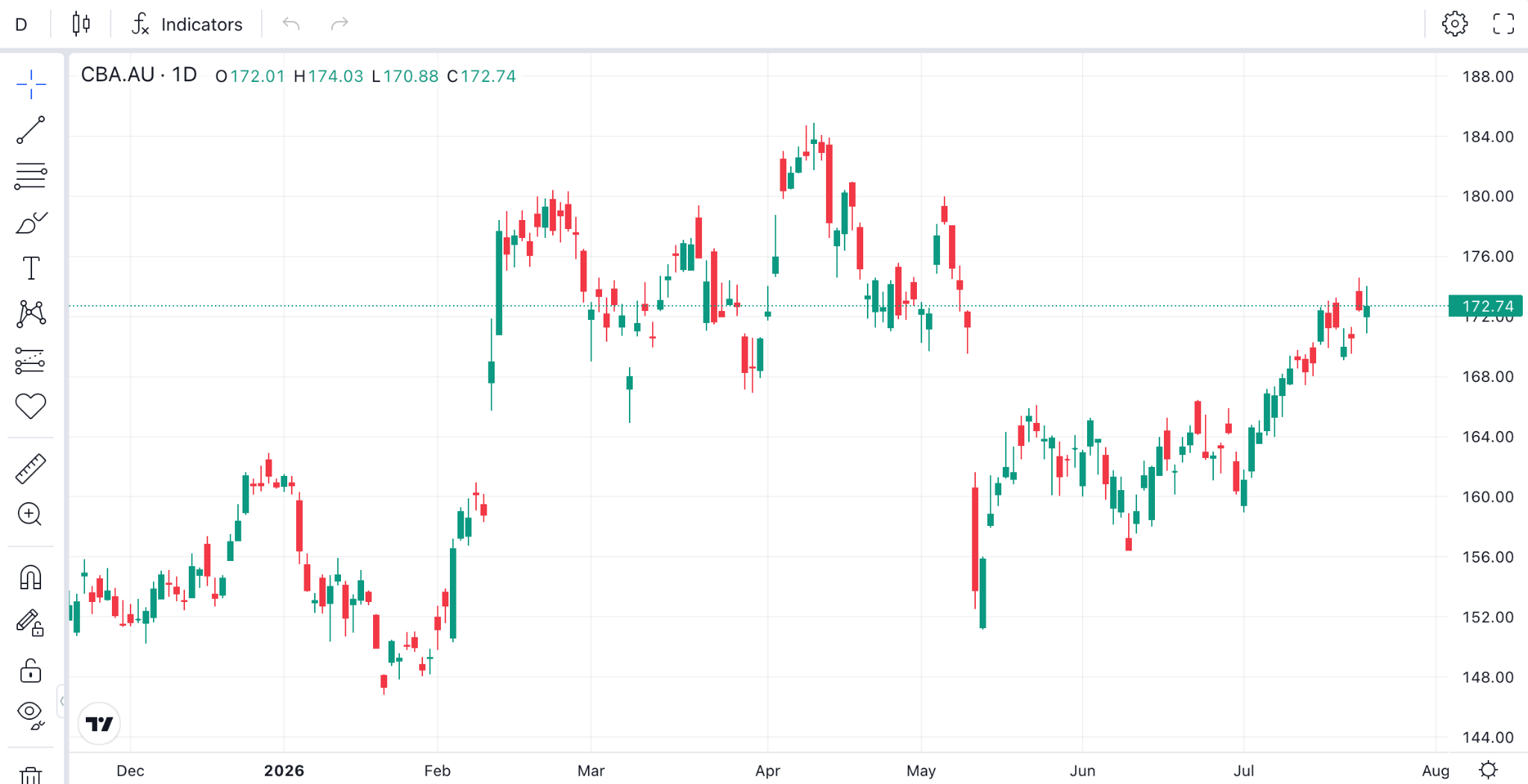
Image: Mitrade (CBA.AU)
“Trade Dividend Stocks with an ASIC-regulated broker. Fast AUD funding via PayID. ”
Wesfarmers
Wesfarmers (WES.AU) is one of Australia's most consistently profitable conglomerates, operating Bunnings, Kmart, Target, Officeworks, and an expanding chemicals and industrial division.
Wesfarmers generated net profit after tax of $1.603 billion in the first half of FY2026, up 9.3% on the prior corresponding period. Revenue of $24.2 billion was up 3.1%. Bunnings and Kmart continued delivering strong sales growth. The group lifted its fully franked interim dividend by 7.4% to $1.02 per share, highlighting confidence in cash generation and balance sheet strength.
That 7.4% dividend increase is the key figure for income investors. It is not a one-off. Wesfarmers has built a reputation for growing its dividend in line with earnings rather than maintaining an artificially high payout ratio that leaves the business financially stretched. Bunnings' dominant position in Australian hardware retail and Kmart's value-focused consumer appeal give the business earnings resilience across the economic cycle. The Morningstar "dividend drought" concern does not apply here. Wesfarmers is actively growing its payout and has the earnings quality to back that commitment up.
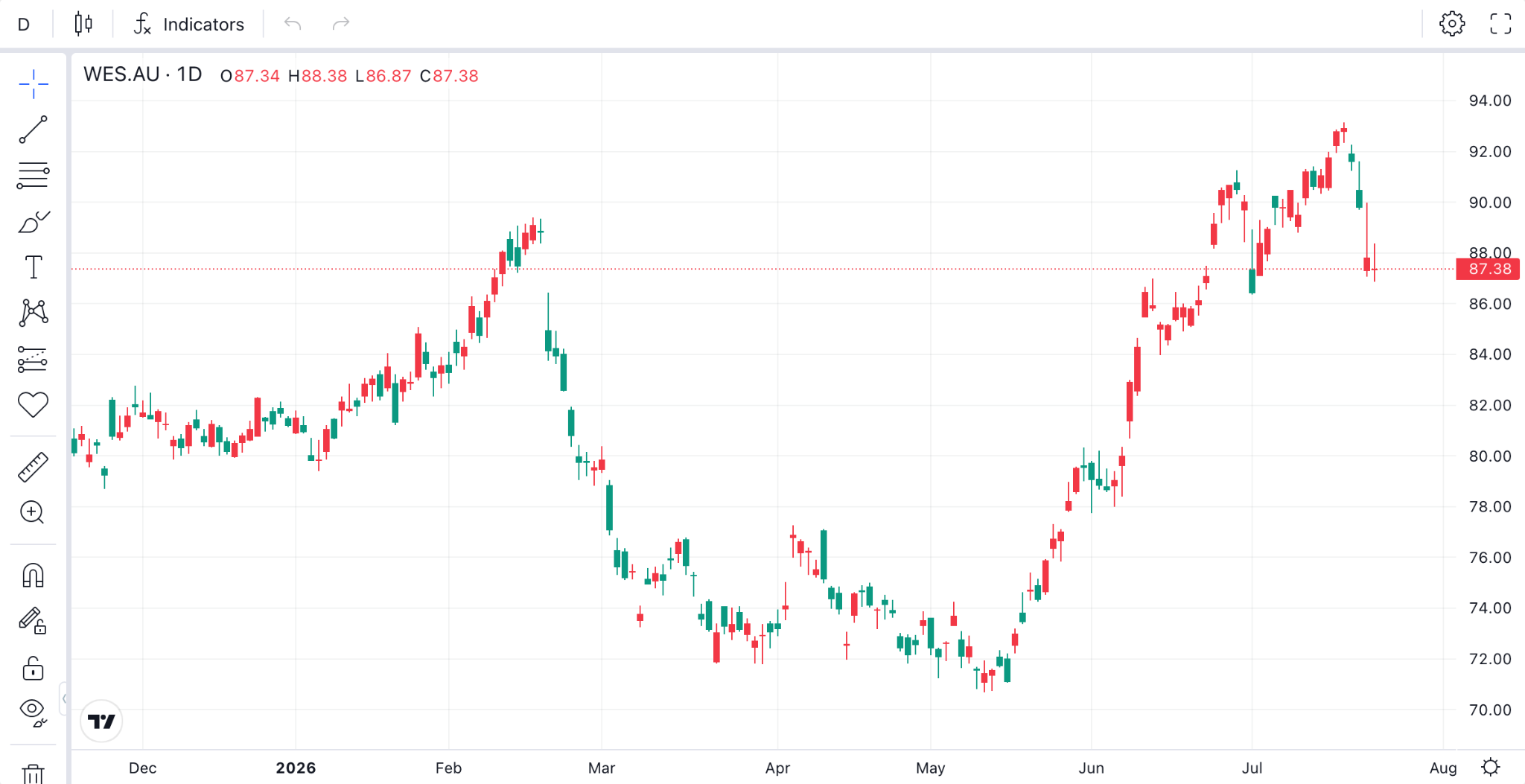
Image: Mitrade (WES.AU)
“Trade Dividend Stocks with an ASIC-regulated broker. Fast AUD funding via PayID. ”
Telstra
Telstra (TLS.AX) is the clearest example of dividend growth on the ASX right now. It has lifted its annual payout in each of the past four consecutive years, a track record that puts it in a small group of ASX large-caps genuinely growing income rather than just maintaining it.
In the first half of FY2026, Telstra delivered a 10.5% increase in its interim dividend to 10.5 cents per share, backed by group cash EBIT growth of 14% and mobile services revenue growth of 5.6%. Analysts forecast Telstra's full-year FY2026 dividend at 21 cents per share, representing a more than 10% increase on FY2025's 19-cent payout.
The one nuance income investors should note is that Telstra's interim dividend for FY2026 was 90.5% franked rather than fully franked, a slight reduction from prior years that investors should factor into their after-tax yield calculations. That is not a deal-breaker but it is worth understanding before calculating the gross yield. A 90.5% franked dividend at 21 cents grosses up to approximately 28.6 cents for a 30% tax rate investor, still a meaningful after-tax premium over the headline figure. Telstra is not available as a CFD on Mitrade at this time.
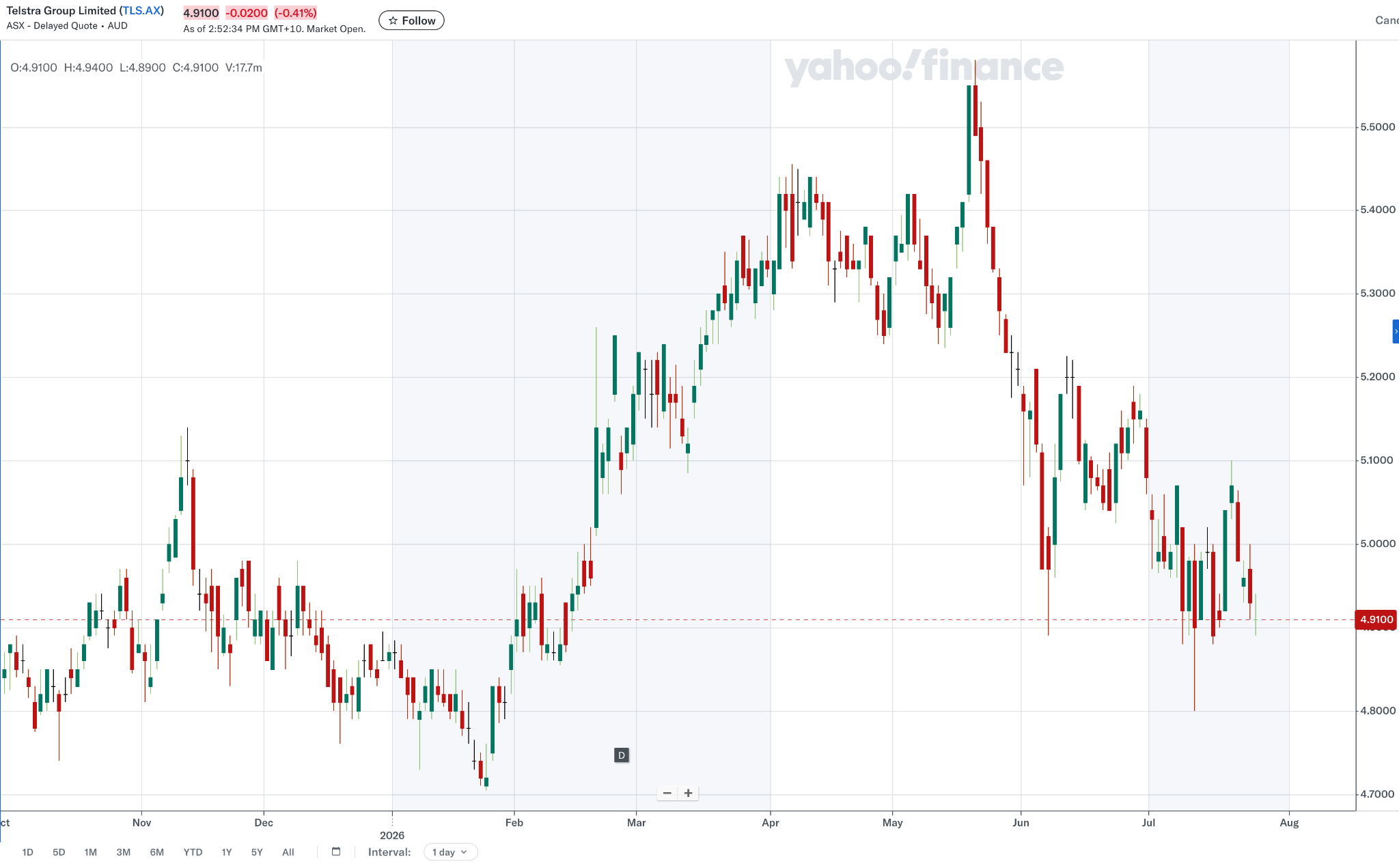
Image - Yahoo Finance (TLS.AX)
Washington H. Soul Pattinson
Washington H. Soul Pattinson (SOL.AX) is the least discussed but most compelling income story among Australia's large investment houses, and its 120-year unbroken dividend history is a record that no other ASX-listed company can match.
Soul Pattinson declared an interim dividend of 48 cents per share for the half year to January 31, 2026, representing a 9.1% year-over-year increase. Adding the final dividend from FY2025 and the HY26 interim dividend, Soul Patts has an annual dividend yield of 2.8%, or 4% including franking credits. The 3-year average dividend growth rate stands at 21.89% per year, making it one of the fastest growing dividend payers on the entire ASX. The next ex-dividend date falls approximately in August 2026, putting income investors who act now in a position to capture that payment.
The business model is simple. Soul Pattinson is an investment house that owns stakes in a diversified portfolio of companies across resources, telecommunications, financial services, and private equity. The dividend it pays to shareholders is funded from the dividends and distributions it receives from those portfolio companies, which gives it a degree of earnings diversification that pure-play sector stocks cannot offer. Soul Pattinson is not available as a CFD on Mitrade at this time.
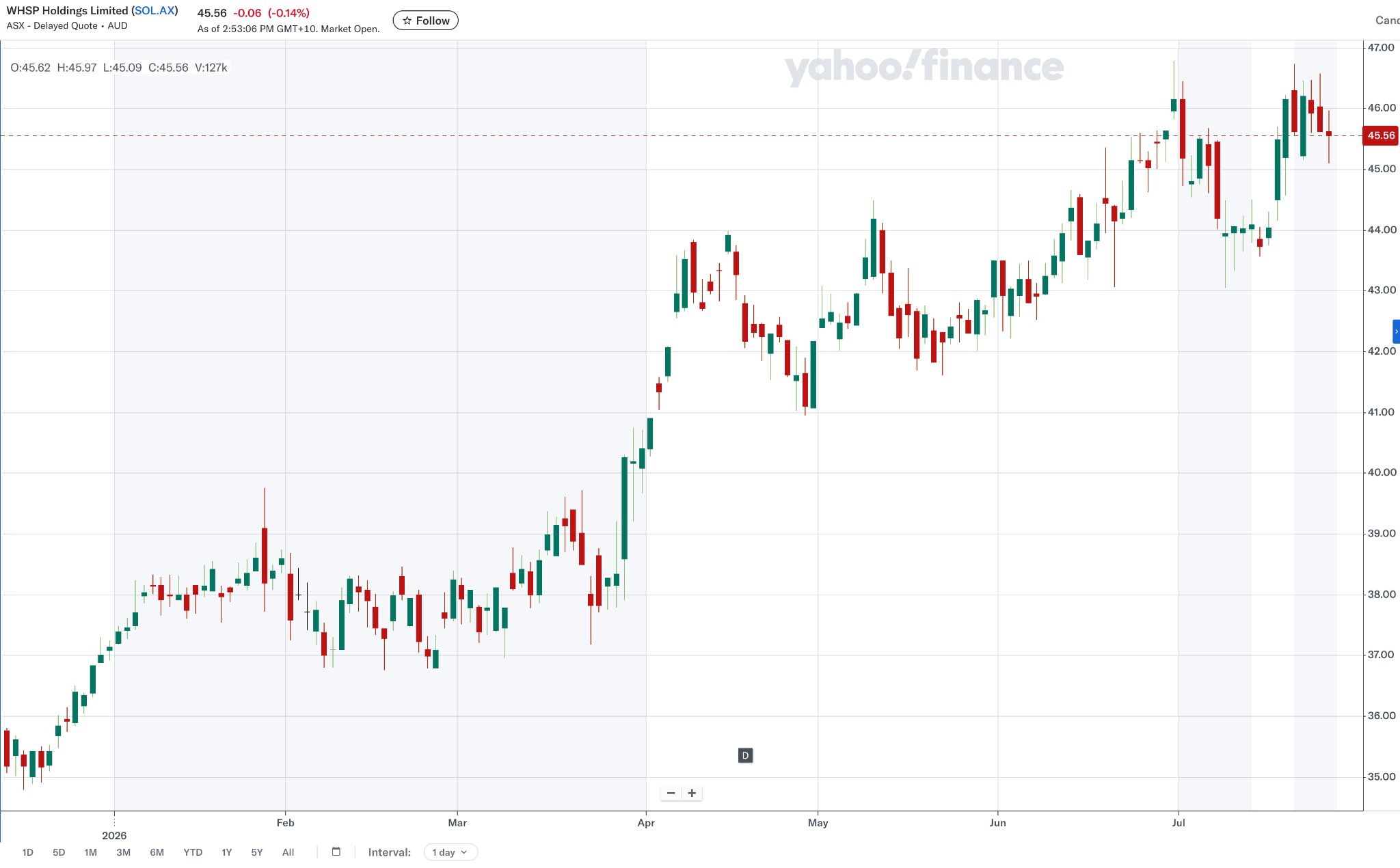
Image - Yahoo Finance (SOL.AX)
How to Access ASX Dividend Stocks on Mitrade
Mitrade, regulated by ASIC under licence AFSL 398528, offers Commonwealth Bank (CBA.AU) and Wesfarmers (WES.AU) as CFD instruments from a single zero-commission account. Both are available to go long or short, which means income-focused traders can position for a dividend uplift announcement or hedge an existing holding ahead of a result that carries uncertainty.
The practical difference between holding a dividend stock directly and trading it as a CFD is important to understand. A CFD does not entitle you to the actual dividend payment. Instead, when a stock goes ex-dividend, the CFD price adjusts to reflect the dividend amount and a corresponding cash adjustment is made to your account. For traders focused purely on price movement around dividend announcements and results, the CFD structure suits short to medium-term positioning. For investors who want to receive actual franked dividend payments with the associated franking credits, direct share ownership remains the appropriate route.
CBA's full-year result and final dividend announcement is due in August 2026, which is the next major catalyst for the stock. Wesfarmers reports its full-year result in August as well. Both events will confirm whether the dividend growth trajectory from the first half continues into the second. Traders watching those announcements can position around them on Mitrade with stop-loss and take-profit controls set before any trade is confirmed. A free demo account with $50,000 in virtual funds is available to practise before committing real capital.



You might be interested in…
1. What are the best ASX dividend stocks to watch in 2026?
The five ASX dividend stocks worth watching in 2026 are Commonwealth Bank for consistent fully franked income and 8.24% three-year average dividend growth, Wesfarmers for a 7.4% interim dividend increase backed by strong Bunnings and Kmart performance, Telstra for four consecutive years of payout growth with a FY2026 full-year forecast of 21 cents per share, Washington H. Soul Pattinson for a 9.1% dividend increase and a 120-year unbroken payment history, and BHP for commodity-linked income with energy and copper tailwinds supporting the earnings base.
2. Why do franking credits matter for ASX dividend investors?
Franking credits are tax credits attached to dividends paid by Australian companies that have already paid corporate tax at 30%. Australian resident investors can use these credits to offset their personal tax liability, effectively grossing up a fully franked dividend of 3% to approximately 4.3% for a 30% tax rate investor. This gross-up makes fully franked ASX dividends significantly more competitive against term deposits than the headline yield comparison suggests.
3. Is Commonwealth Bank a good dividend stock in 2026?
CBA reported unaudited cash net profit after tax of $2.7 billion in the third quarter of FY2026, up 4% on the prior corresponding period, with a fully franked interim dividend of $2.35 per share paid for H1 FY2026. The forward yield of 2.89% grosses up to approximately 4.1% for a 30% tax rate investor. The three-year average dividend growth rate of 8.24% makes it a reliable compounder for long-term income investors, with the full-year result and final dividend decision due in August 2026.
4. What is the Morningstar dividend drought and does it affect the stocks in this article?
Morningstar's analysis found that the ten largest ASX companies, which represent approximately 50% of the index by market capitalisation, have delivered little meaningful dividend growth since conditions normalised post-pandemic in 2022. The drought is concentrated in the biggest index heavyweights. It does not apply to Telstra, which has grown its payout for four consecutive years, or Wesfarmers, which lifted its interim dividend 7.4% in FY2026, or Washington H. Soul Pattinson, whose three-year average growth rate is 21.89%.
5. How does Soul Pattinson's 120-year dividend history compare to other ASX stocks?
Washington H. Soul Pattinson has been listed on the ASX for 120 years and has paid a dividend every single year in that time. No other ASX-listed company can match that record. Its most recent interim dividend of 48 cents per share grew 9.1% year over year. Including franking credits, the annual yield grosses up to approximately 4%, which matches the RBA cash rate before any capital growth is considered.
6. Can Australian traders access ASX dividend stocks on Mitrade?
Yes. Mitrade offers Commonwealth Bank (CBA.AU) and Wesfarmers (WES.AU) as CFD instruments under ASIC regulation with licence AFSL 398528. Traders can go long or short on both with zero commission and stop-loss controls directly on the order screen. Note that CFD positions do not receive actual dividend payments or franking credits. A free demo account with $50,000 in virtual funds is available before going live.
Disclaimer: The content presented above, whether from a third party or not, is considered as general advice only. CFD trading involves significant risk of loss. Past performance does not guarantee future results. This article serves informational purposes only and does not constitute financial advice. Consider your risk tolerance before trading.


