




Nvidia Surges 4% Post-Earnings as Dim Hopes for Jensen Huang Return Cap Valuation, Fed Hikes Risk Drop to $100
TradingKey - Nvidia surged 4% after hours, but dim prospects of Jensen Huang's return cap valuations, and potential Fed rate hikes could drag the stock down toward the $100 mark.
After the bell on November 17, Eastern Time, AI giant Nvidia (NVDA) reported its fiscal 2027 third-quarter results, delivering an across-the-board beat that drove its after-hours stock price up more than 4% to surge to $163, before pulling back to around $157.
Nvidia's latest earnings report showed that both quarterly revenue and data center revenue surpassed the $100 billion mark, while its fourth-quarter revenue guidance significantly beat Wall Street consensus, directly dispelling market concerns over a slowdown in AI computing capital expenditures.
Financial Metric | Reported Figure | Market Consensus | Comparison & Key Highlights |
Total Revenue | $115.8 billion | $109.33 billion | Beat expectations, up 103.1% year over year, topping the $100 billion mark for the first time in history |
Data Center Revenue | $107.6 billion | $101.87 billion | Beat expectations, AI computing hardware demand maintains strong momentum |
FY2027 Q4 Revenue Guidance | $127.4 billion – $132.6 billion | $125.25 billion | Above expectations across the board, dispelling market concerns over a slowdown in AI capex |
Nvidia's better-than-expected results and guidance demonstrate that the company still possesses strong momentum in operational execution, supply chain delivery, and customer relations, easing market panic over a leadership void. Although short-term fundamentals remain sound, Jensen Huang was Nvidia's soul and technological visionary; his departure and the board's stated lack of intention to bring him back have made some long-term institutional investors more cautious when assigning forward P/E multiples for the next 3 to 5 years.
Until an official new CEO is named and proves their strategic leadership, it will be difficult for the market to grant Nvidia the extreme "leadership halo premium" of the past. As a result, the stock pulled back after rebounding on positive news, making it difficult to replicate past one-sided short squeezes with unlimited upside.
Recently, both U.S. October inflation data (CPI/PPI) and retail sales data beat expectations, pushing 10-year Treasury yields firmly above 5%. The market has begun to reprice the risk of the Fed keeping interest rates higher for longer or even resuming rate hikes within the next 12 months. High risk-free rates directly compress the discounted value of future cash flows for high-growth tech stocks, triggering capital outflows from highly valued tech sectors, making it very likely that Nvidia's stock will face continued downward pressure.
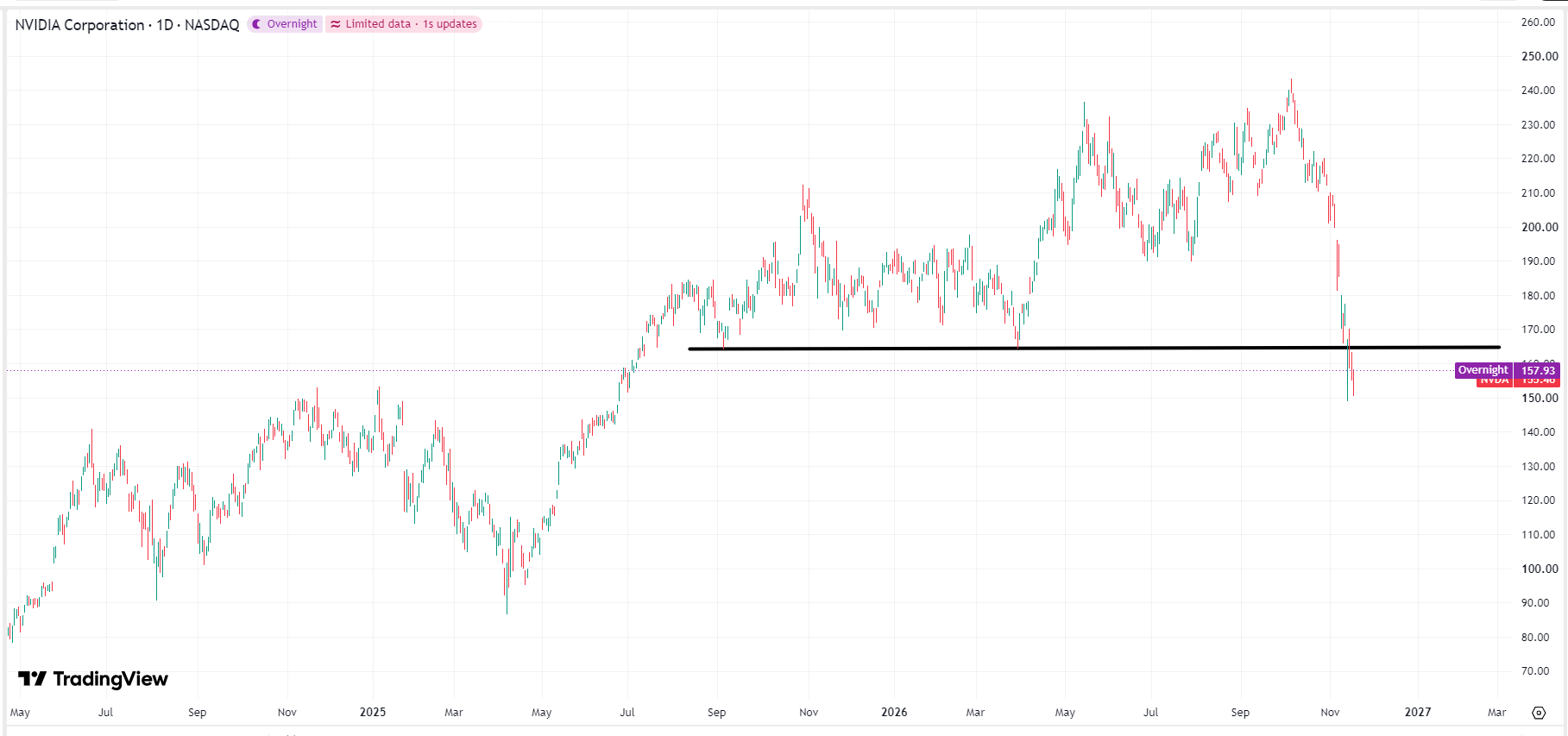 Nvidia stock price chart, Source: TradingView
Nvidia's stock price has now broken below $165, a strong support level that held across multiple pullbacks from September 2025 to November 2026. It has now turned into strong resistance, hindering stock rebounds and meaning that every bounce is likely to attract break-even selling pressure and short-term profit-taking.
On technical charts, when the stock recently fell toward $148–$150, it received short-term buying support that sparked an oversold rebound. However, if the macroeconomic environment continues to deteriorate and this defensive line is broken on heavy volume, technicals will open up room for further downside to seek deeper support, with the next dense trading zone of historical turnover significance sitting near $100.
Recommended Articles


