




SpaceX Rises Over 2% Pre-Market: Plans to Connect 80,000 Base Stations, Can Stock Price Reclaim the $155 20-Day Moving Average?
TradingKey - On Friday (October 23) Eastern Time, SpaceX (SPCX) rose more than 2% in pre-market trading to around $148. This follows a Bloomberg report that the company is seeking access to at least 80,000 cellular sites in the U.S., aiming to integrate Starlink satellites, wireless spectrum, and ground base stations into a nationwide mobile communications network.
According to people familiar with the matter, SpaceX is in talks with at least one major communications infrastructure enterprise, with potential partners including major U.S. tower operator Crown Castle. Crown Castle, along with American Tower and Vertical Bridge, ranks among the major owners of cellular base station assets in the United States. A potential deal could involve long-term leases or network access with a potential value reaching billions of dollars, though no formal deal has been finalized yet.
Mobile operators typically do not directly own all base stations; instead, they lease sites from tower companies to install antennas and network equipment. For SpaceX, accessing existing base stations can shorten the ground network construction cycle and avoid starting entirely from scratch to acquire land, construct towers, and secure local approvals.
This plan signifies that SpaceX's communications strategy is shifting from pure satellite internet to a hybrid model combining satellite and ground networks. Starlink is suited for covering remote areas, maritime regions, and other locations with insufficient ground infrastructure. However, in densely populated cities, indoors, and large public venues, delivering stable service still requires low-band spectrum paired with ground base stations.
SpaceX recently acquired low-band spectrum and received approval from the Federal Communications Commission (FCC) to launch 15,000 satellites for direct-to-cell service. Musk stated during the latest earnings call that the company will continue to build out its ground network, and that the combination of satellite launches and spectrum resources will pave the way for Starlink Mobile to become a major U.S. mobile carrier.
If SpaceX successfully gains access to 80,000 sites, its network scale would cover approximately half of the existing dedicated cellular towers in the U.S., laying a foundation to challenge AT&T (T), Verizon (VZ), and T-Mobile (TMUS). However, gaining access to base stations does not mean immediately possessing a complete nationwide network; the company still needs to deploy antennas, backhaul systems, core networks, billing platforms, and customer service operations.
This also means that SpaceX's path to becoming the fourth-largest nationwide carrier in the U.S. remains long and expensive. TD Cowen estimates that building a nationwide ground network could require an investment of over $80 billion, taking years to establish initial coverage, while capturing significant market share could take even longer.
Source: TradingView
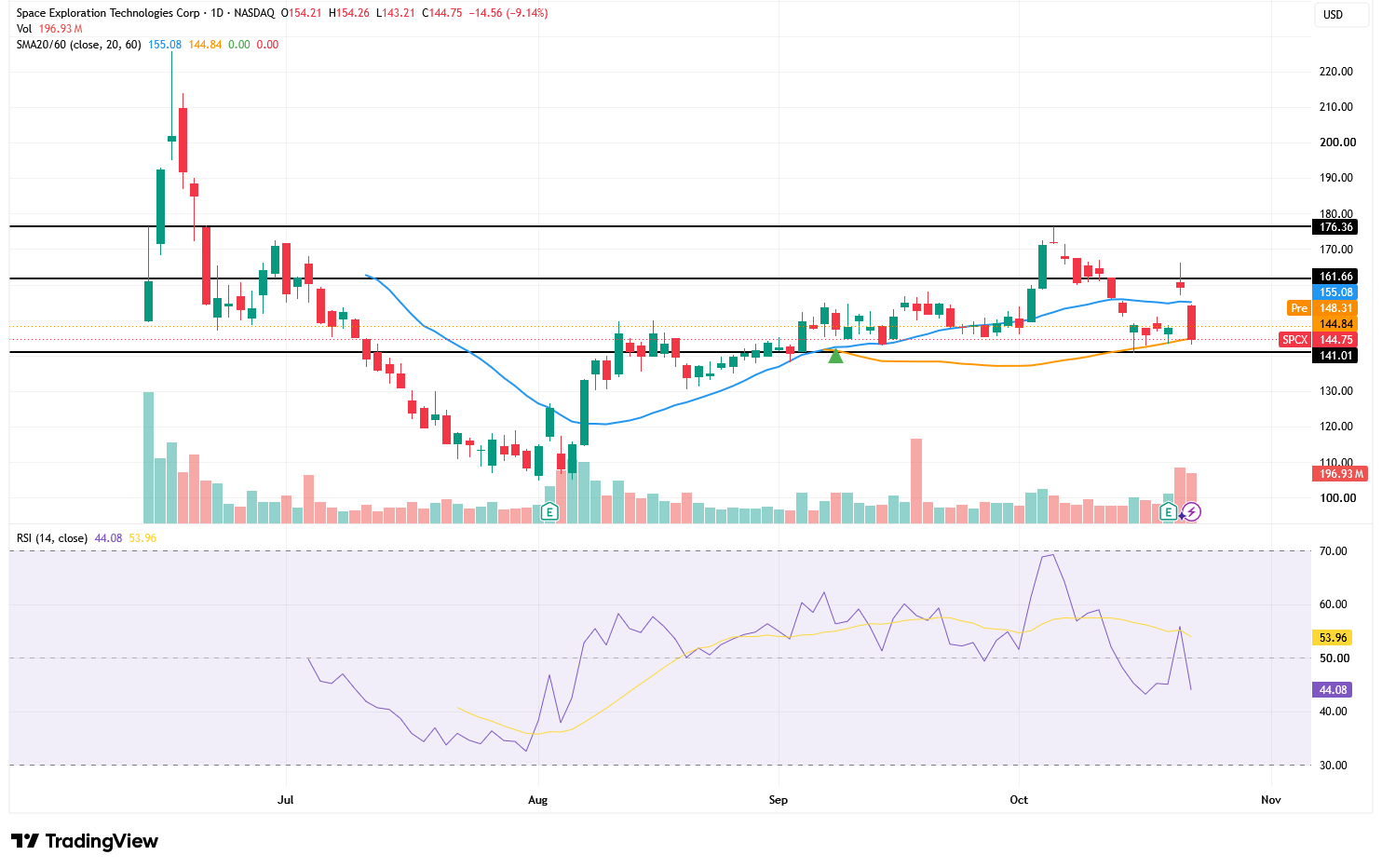
From a technical perspective, SpaceX closed at $144.75 in the previous trading session, down 9.14% for the day. Driven by the news, the stock rebounded to $148.31 in pre-market trading, regaining the 60-day moving average of $144.84, though there remains room before a trend reversal is confirmed.
In the short term, the most critical resistance level is $155. If the stock can break through on heavy volume and close above the 20-day moving average on a daily basis, the rebound target could further extend toward $161.66; a breakthrough could then pave the way to test the previous high of $176.36. Conversely, if the stock faces resistance near $155, the current uptick may still be a technical recovery following a sharp drop.
To the downside, initial focus is on moving average support around $144–$145, with further support at $141. If the daily chart effectively breaks below $141, the stock price may continue to retest $135 or even $130. The RSI currently stands at around 44.08, below the signal line of 53.96, indicating that short-term momentum remains weak.
Recommended Articles


