




Why Is Novo Nordisk Suing Eli Lilly, and What Does it Mean for Investors?
Key Points
Eli Lilly's ads don't account for a new, higher dose of Novo Nordisk's Wegovy.
Lilly has been winning the race to dominate the GLP-1 drug market.
- 10 stocks we like better than Novo Nordisk ›
GLP-1 drugs for weight loss are such a booming business that it was inevitable the major manufacturers of these wonder drugs would eventually end up in court.
This week, GLP-1 heavyweight Novo Nordisk (NYSE: NVO) sued the leading GLP-1 drugmaker, Eli Lilly (NYSE: LLY), claiming its television ads are deceptive because they state that Lilly's Zepbound is more effective for weight loss than Novo's Wegovy.
Missed Nvidia in 2009? This Rare Signal Is Flashing Again. In 2009, a "Double Down" signal flashed for a little-known chipmaker called Nvidia. For the first time in years, that same "Total Conviction" signal is flashing for a company 1/100th the size of Nvidia. Continue »
One such ad by Eli Lilly claims that "in a study," people using Zepbound lost an average of 50 pounds, while those using Wegovy lost an average of 33 pounds.
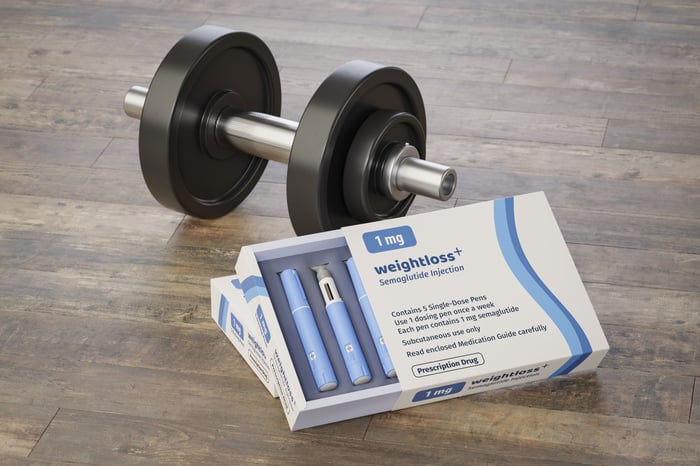
Image source: Getty Images.
But that study is outdated, Novo Nordisk claims. A higher dose of Wegovy was approved in March and launched in April, according to the Danish drugmaker, and a more recent study shows that the new dose increased average weight loss to 47 pounds.
Novo Nordisk claims that Lilly's advertisements also make misleading comparisons in ads for its diabetes drug Mounjaro versus Novo Nordisk's drug Ozempic.
Novo Nordisk's lawsuit seeks a permanent injunction forcing Eli Lilly to pull the ads, as well as a corrective ad campaign. It's also been reported that Novo Nordisk will seek to recover profits it lost due to the advertising, though the amount is unspecified.
The damages to Lilly, if awarded, probably won't be huge
Considering that the ads Eli Lilly ran comparing the two drugs only became outdated in April, when Novo Nordisk brought its higher-dose Wegovy to market, any damages to Eli Lilly, if awarded, would probably be immaterial. However, if the New Jersey court where the suit is filed forces Eli Lilly to halt the ads, that could be a big win for Novo Nordisk.
Investors have clearly been favoring Lilly in the battle for GLP-1 market share. Shares of Eli Lilly are up about 50% over the past 52 weeks, while Novo Nordisk's share price has plummeted about 27%.
Tirzepatide, the GLP-1 drug behind both Mounjaro and Zepbound, became the world's best-selling drug in the third quarter of 2025, surpassing Keytruda, a blockbuster immunotherapy drug from pharmaceutical giant Merck.
But demand for GLP-1 drugs is enormous and growing rapidly. The global market for obesity medicines reached $66 billion in 2025. Bloomberg predicts it will hit $120 billion by 2030. While Lilly has the larger share of that market, about 60% of the U.S. market as of February of this year, there will probably be plenty of opportunities for both companies to ratchet up global sales.
Should you buy stock in Novo Nordisk right now?
Before you buy stock in Novo Nordisk, consider this:
The Motley Fool Stock Advisor analyst team just identified what they believe are the 10 best stocks for investors to buy now… and Novo Nordisk wasn’t one of them. The 10 stocks that made the cut could produce monster returns in the coming years.
Consider when Netflix made this list on December 17, 2004... if you invested $1,000 at the time of our recommendation, you’d have $371,519!* Or when Nvidia made this list on April 15, 2005... if you invested $1,000 at the time of our recommendation, you’d have $1,281,302!*
Now, it’s worth noting Stock Advisor’s total average return is 892% — a market-crushing outperformance compared to 206% for the S&P 500. Don't miss the latest top 10 list, available with Stock Advisor, and join an investing community built by individual investors for individual investors.
See the 10 stocks »
*Stock Advisor returns as of July 24, 2026.
Matthew Benjamin has positions in Novo Nordisk. The Motley Fool has positions in and recommends Eli Lilly, Merck, and Novo Nordisk. The Motley Fool has a disclosure policy.
Recommended Articles


