




SpaceX Has a Glaring Problem. Here's What Investors Can Do About It.
Key Points
SpaceX is losing money, so its investment thesis depends on future growth.
The company plans to rapidly scale the production and deployment of AI compute satellites.
Operating these satellites in sun-synchronous orbit could lead to severe light pollution.
- 10 stocks we like better than Space Exploration Technologies ›
Where to invest $1,000 right now? Our analyst team just revealed what they believe are the 10 best stocks to buy right now, when you join Stock Advisor. See the stocks »
In just five trading sessions since its initial public offering (IPO) on June 12, Space Exploration Technologies (NASDAQ: SPCX) briefly reached a market cap above Microsoft and Amazon, but is now down 18% from its intraday high.
After booking a profit in 2024, the Elon Musk-led company reported a loss from operations of $2.59 billion in 2025 and a $1.94 billion loss from operations for the three months ended March 31, 2026. Some investors are willing to endure losses because of SpaceX's long runway for future growth from its Starlink network of low-Earth-orbit satellites, artificial intelligence (AI)-fueled efforts from xAI, social media platform X, and, perhaps most importantly, its goal to deploy potentially millions of AI compute satellites in clusters of orbital data centers.
Here's why SpaceX is chock-full of potential, and a glaring problem that could throw a wrench in its orbital data center aspirations.
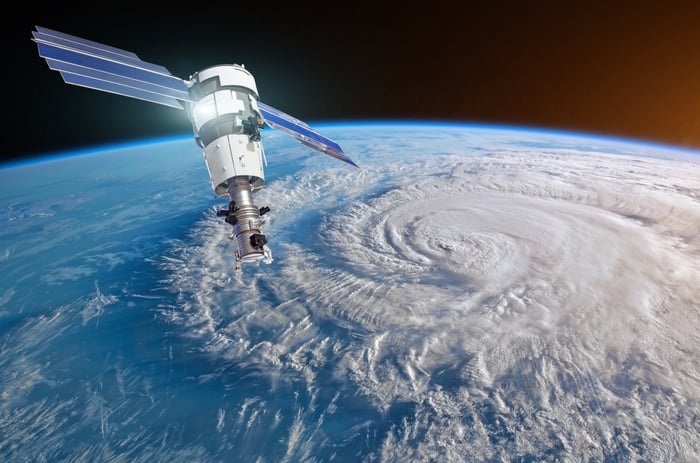
Image source: Getty Images.
A "glaring" problem
SpaceX exited 2025 with 9,600 Starlink broadband and mobile satellites in low-Earth orbit. That's about 75% of active maneuverable satellites in orbit as of March 31, 2026. As Starlink has expanded, one of its greatest challenges has been reducing light pollution, especially from sunlight scattered by the main satellite body and solar arrays. SpaceX has been addressing this issue by using low-albedo components, mirrors to minimize brightness and glints, and by rotating solar arrays during critical twilight hours to prevent bright reflections. Since they are in low Earth orbit, Starlink satellites will also pass into Earth's shadow, which blocks them from sunlight and makes them invisible to the naked eye at night.
But SpaceX's Form S-1 filing with the Securities and Exchange Commission specifically mentions using sun-synchronous orbit (SSO) for AI compute satellites. Sun-synchronous satellites will orbit Earth around its poles for consistent solar energy capture. SSO is a completely different approach from Starlink's low-Earth-orbit satellites. With maximum sun exposure powering energy-intensive data centers, the higher-altitude AI satellites would be farther from Earth and reflect light even at night, making them highly visible and challenging to manage from a dark-sky perspective.
The large-scale deployment of AI compute satellites in SSO would effectively ruin the nighttime sky and present the greatest challenge to astronomy in history. And given the resistance offshore wind farms have faced from residents and businesses, it stands to reason that a nighttime sky illuminated by satellites would draw significant backlash.
Addressing AI satellite light pollution
There are basically two ways around SpaceX's sky-damaging pickle. The first is that it could come up with a Harry Potter-style invisibility cloak for SSO satellites that reduces visibility to the naked eye without impacting solar generation. As mentioned, Starlink has already made significant progress by using low-albedo components, black foam, and black paint. But these are in conjunction with tilting solar arrays away from Earth at certain times and using Earth's shadow, which satellites in SSO can't do.
The other approach is to use energy storage (maybe even from Tesla) to avoid SSO. Energy storage would make the satellites heavier and more expensive to launch, and maybe lower their useful life due to the battery packs. But they would reduce the need for the satellites to generate maximum solar energy. What's more, data center constellations could time their orbits so that they are generating solar energy during the most energy-intensive period of AI compute conditions, similar to how the grid has peaker plants kick in during periods where energy usage spikes, like when many people are waking up or getting home from work and school.
Preparing for launch
Orbital data centers are by far the most captivating element of SpaceX's investment thesis for investors who believe we are still in the early innings of AI adoption, but they face a mounting AI energy bottleneck. Generating free solar energy and avoiding energy-intensive water cooling is a dream come true for reducing costs and environmental impact. But the vision faces challenges from light pollution and maintenance.
Starlink satellites in low-Earth orbit have built-in thrusters, collision-avoidance systems, over-the-air software updates, and de-orbit commands to retire old satellites (by burning them in the atmosphere) and replace them with new ones. SpaceX may have the same game plan for AI compute satellites.
Since AI satellites don't require the complex antennas of Starlink satellites, SpaceX expects them to be simpler, consisting mainly of a solar array with deployable liquid radiators extending from the centralized compute module. The first model has a wingspan of 70 meters and a height of 20 meters, with a peak generation of 150 kW and an average payload of 120 kW. So a surface area of about a fourth the size of a football field, which is large from a production standpoint but small in terms of space.
SpaceX will try to reach an annualized rate of 1 GW per year of orbital AI compute capacity by the end of 2027 and then scale that by an order of magnitude per year, so 10 GW by the end of 2028, 100 GW by the end of 2029, and then 1 terawatt (1,000 GW) per year by the end of 2030. For context, the annual electricity consumption of the U.S. is about 4 terawatts.
Keep SpaceX on a watch list
SpaceX is laying the groundwork for mass-producing AI compute satellites. But the plan faces significant challenges if it relies on SSO.
The best way for investors to address this glaring issue is to keep SpaceX on a watch list for now and pay close attention to how the company solves these challenges, as well as management's commentary on its earnings calls.
Based on Starlink, SpaceX's role in the commercial space launch industry, xAI, and X alone, SpaceX may be able to generate solid near-term growth, turn a profit, and maybe even justify its place in the $2 trillion club. But for the growth stock to be a good long-term buy for new investors at this valuation, it must successfully deploy orbital data centers without ruining the nighttime sky.
SpaceX's mission is "To build the systems and technologies necessary to make life multiplanetary, to understand the true nature of the universe, and to extend the light of consciousness to the stars." But that mission means little if people on Earth can't see the stars to begin with.
Should you buy stock in Space Exploration Technologies right now?
Before you buy stock in Space Exploration Technologies, consider this:
The Motley Fool Stock Advisor analyst team just identified what they believe are the 10 best stocks for investors to buy now… and Space Exploration Technologies wasn’t one of them. The 10 stocks that made the cut could produce monster returns in the coming years.
Consider when Netflix made this list on December 17, 2004... if you invested $1,000 at the time of our recommendation, you’d have $417,305!* Or when Nvidia made this list on April 15, 2005... if you invested $1,000 at the time of our recommendation, you’d have $1,293,148!*
Now, it’s worth noting Stock Advisor’s total average return is 936% — a market-crushing outperformance compared to 207% for the S&P 500. Don't miss the latest top 10 list, available with Stock Advisor, and join an investing community built by individual investors for individual investors.
See the 10 stocks »
*Stock Advisor returns as of June 19, 2026.
Daniel Foelber has no position in any of the stocks mentioned. The Motley Fool has positions in and recommends Amazon, Microsoft, and Tesla. The Motley Fool has a disclosure policy.
Recommended Articles


