




A Monthly Weight Loss Shot? Why Pfizer Could Topple Lilly's and Novo's GLP-1 Duopoly
Key Points
Novo Nordisk and Eli Lilly are largely responsible for creating today's weight-loss drug market.
The two companies, however, can’t fend off creative competitors forever.
Drugmaker Pfizer may be on the verge of shaking up the industry’s existing but tenuous pricing power.
- 10 stocks we like better than Pfizer ›
You probably already know that pharmaceutical powerhouses Novo Nordisk (NYSE: NVO) and Eli Lilly (NYSE: LLY) dominate the anti-obesity drug market, and in fact, largely invented the business as we know it today.
Ozempic -- Novo's brand name for semaglutide -- has been around since 2017 as a diabetes treatment, but in mid-2021, the FDA first approved Novo's weekly injectable Wegovy (also semaglutide) specifically for weight loss. Then, the FDA's 2023 approval of Lilly's Zepbound (or tirzepatide, which is the active ingredient in diabetes treatment Mounjaro) made the weight loss market a two-horse race.
Will AI create the world's first trillionaire? Our team just released a report on the one little-known company, called an "Indispensable Monopoly" providing the critical technology Nvidia and Intel both need. Continue »
Novo Nordisk and Eli Lilly have since increased their market shares by gaining approvals for variants of their respective GLP-1 drugs -- like oral pills. Precedence Research expects this space to grow at an average annual pace of nearly 25% through 2035, so it's not surprising that new competitors are emerging for a bite at this proven profit opportunity.
Enter Pfizer (NYSE: PFE): which is catching up quickly. Earlier this year, the pharma company confirmed that its GLP-1 focused drug, currently just called PF-08653944, is performing very well in Phase 2b trials. Specifically, the study shows that by week 28 of an intended 64-week low and medium dose treatment regimen, weight loss of between 10% and 12% was the norm.
(Image Source: Getty Images)
The results in and of themselves are just OK -- more or less in line with similar GLP-1-based alternatives. There's an important detail to add here, however. That is, in contrast with Novo Nordisk's Wegovy and Eli Lilly's Zepbound, PF'3944 only requires monthly rather than weekly subcutaneous injections to achieve comparable weight loss.
Competitive enough to cause more trouble
The common weekly dosing cadence is more of a stumbling block than you might imagine. At least half -- and up to two-thirds -- of GLP-1 drug users discontinue them within a year, with cost frequently cited as the reason. Although it's too soon to know how Pfizer's PF'3944 might be priced (if approved), with fewer total doses needed, it could prove to be a more affordable alternative to Wegovy or Zepbound.
Cheaper alternatives are already taking their toll on the first movers. Total prescriptions for Wegovy, while up for all of 2025, did decline before the end of 2025 despite the price drop for self-pay users in November.
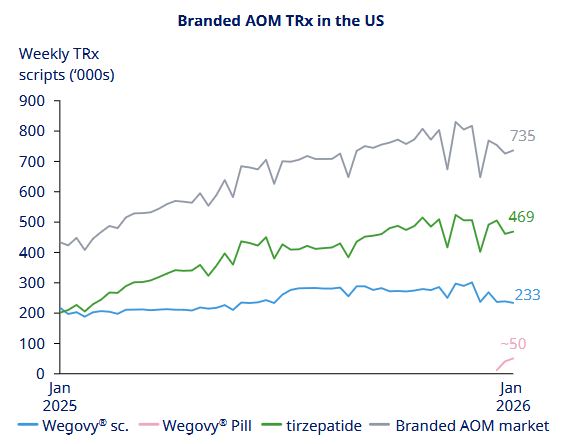
Image source: Novo Nordisk's Q4-2025 earnings call slide deck. "AOM" means "anti-obesity medication."
Indeed, Novo expects its top and bottom lines to outright sink between 5% and 13% this year, largely due to weakness from its weight-loss drug business.
At least some of these patients seem to be trying Zepbound. This anti-obesity treatment's revenue grew an incredible 175% last year, from $4.9 billion to $13.5 billion.
Even so, this relatively recently approved drug's revenue growth was also already slowing by the fourth quarter of last year, with lower realized prices taking at least some toll. And as a reminder, both of these stocks are down since the beginning of this year due to disappointing anti-obesity treatment growth and guidance, with Novo shares steadily losing ground since early 2024, shortly after Lilly's Zepbound first became available, setting off what would eventually turn into a price war.
Take the hint. The introduction of another, similar GLP-1 option -- even if only lukewarmly received -- is only going to heat up this price war.
Not a complicated or nuanced concern
The good news for Novo and Lilly is that most of Pfizer's work with PF'3944 is still only in Phase 2 trials, or earlier. While it's already planning Phase 3 testing based on what it's finding right now in its Phase 2b testing of low and medium monthly maintenance dosing for 64 weeks, it could be a while before this drug candidate could be approved and commercialized.
But Pfizer already has more than 20 anti-obesity trials planned for 2026, including 10 Phase 3 trials of PF'3944, one of which will measure the benefit of a weekly dosing. It doesn't need all of them to work to turn an already-strained GLP-1 duopoly into a low-margin commodity-like business, nor does it need any of them to be complete in the immediate future. Just a handful of successful tests would be enough.
More to the point for investors, this is enough of a reason to doubt that Eli Lilly or Novo Nordisk shares will ever reclaim yesteryear's highs when they were dominating the weight-loss drug market. The pharmaceutical industry was never going to allow this anti-obesity duopoly to make a fortune forever. Pfizer's on the verge to transform the future of the weight loss market, so investors should keep an eye out as these trials progess.
Should you buy stock in Pfizer right now?
Before you buy stock in Pfizer, consider this:
The Motley Fool Stock Advisor analyst team just identified what they believe are the 10 best stocks for investors to buy now… and Pfizer wasn’t one of them. The 10 stocks that made the cut could produce monster returns in the coming years.
Consider when Netflix made this list on December 17, 2004... if you invested $1,000 at the time of our recommendation, you’d have $524,786!* Or when Nvidia made this list on April 15, 2005... if you invested $1,000 at the time of our recommendation, you’d have $1,236,406!*
Now, it’s worth noting Stock Advisor’s total average return is 994% — a market-crushing outperformance compared to 199% for the S&P 500. Don't miss the latest top 10 list, available with Stock Advisor, and join an investing community built by individual investors for individual investors.
See the 10 stocks »
*Stock Advisor returns as of April 21, 2026.
James Brumley has no position in any of the stocks mentioned. The Motley Fool has positions in and recommends AbbVie, Hims & Hers Health, and Pfizer. The Motley Fool recommends Novo Nordisk. The Motley Fool has a disclosure policy.
Recommended Articles


