




8 Best Trading Platforms in Australia (2026): Compare Fees, Features & Brokers

Financial technology has democratized access to the best trading platforms in Australia. For decades, top-notch brokers have been fine-tuning their services to comply with local regulations and serve the needs of this key market.
Data from Ken Research indicates that the Australian financial brokerage and trading apps market is valued at $4.1 billion, with roughly 45% of the market share being based in New South Wales.
In this article, we provide a detailed overview of the 8 best trading platforms in Australia offering access to domestic and international assets, primarily via contracts for difference (CFDs).
Quick Comparison – Best Trading Platforms in Australia (2026)
Types of Trading Platforms
Australia is one of the top financial jurisdictions in the world due to its robust regulatory oversight of trading platforms.
This is a list of the main types of trading platforms available in Australia:
1. Full-Service Brokers
These are traditional firms providing a wide range of services, including personalized investment advice, portfolio management, and detailed research reports.
Key Feature: Direct access to a human advisor.
Cost: Generally higher commissions or percentage-based fees.
2. Online Share Trading Platforms (CHESS Sponsored)
These platforms allow individuals to buy and sell stocks and ETFs directly on the ASX (Australian Securities Exchange). Most Australian-based platforms offer "CHESS-Sponsored" trades, meaning that users own the shares directly with a unique HIN (Holder Identification Number).
Key Feature: Direct ownership of Australian equities.
Cost: Flat brokerage fee per trade.
3. CFD Brokers
These platforms offer access to financial derivatives (CFDs) and speculative assets (forex). They support high-leverage (though ASIC caps this at 1:30 for retail traders) and the ability to take short positions.
Key Feature: Derivative trading without owning the underlying asset.
Cost: Bid/ask spreads (the difference between buy and sell price) and overnight holding fees.
4. Global Market Access Platforms
These are platforms designed for traders who want to access instruments listed on international exchanges, like the NYSE or NASDAQ.
Key Feature: Access to fractional shares and multi-currency accounts.
Cost: FX conversion fees and variable international commissions.
5. Cryptocurrency Exchanges
These are trading platforms specialized in buying, selling, and staking digital assets. In Australia, these must be registered with AUSTRAC for Anti-Money Laundering (AML) compliance.
Key Feature: 24/7 trading of crypto-assets. Off-ramps integration with Australian banks and fintechs.
Cost: Percentage-based trading fees and withdrawal fees.
6. Micro-Investing Apps
Designed for beginners or those wanting to invest small amounts to progressively build long-term investment portfolios.
Key Feature: Automated investing into pre-set portfolios.
Cost: Monthly maintenance fees rather than per-trade commissions.
“Trade CFDs with an ASIC-regulated broker. Fast AUD funding via PayID. ”
8 Best Trading Platforms in Australia (2026)
#1 - Mitrade

Overview
Mitrade offers Australian users access to multiple financial asset classes and markets through financial derivatives called Contracts for Difference (CFDs).
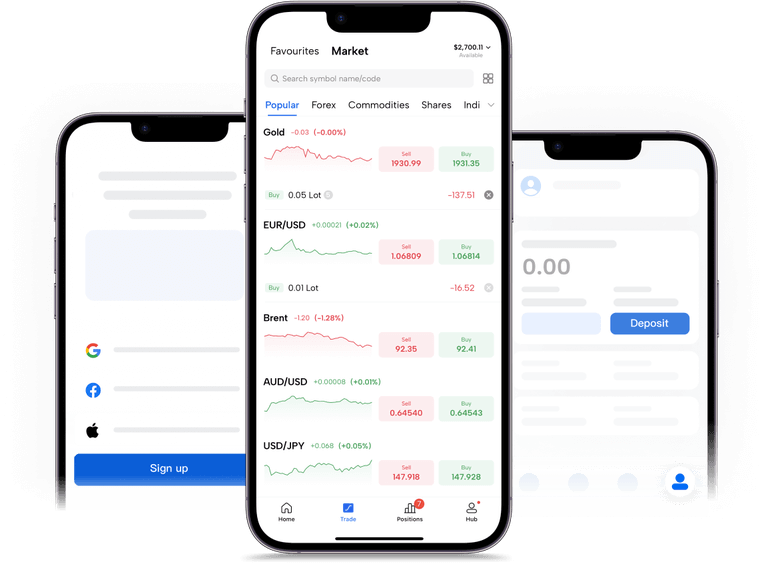
This provider developed a highly user-friendly proprietary platform that features powerful technical indicators, a real-time news feed, an economic calendar, and other advanced tools that give traders an edge.
What Can I Trade?
Mitrade only supports trading via CFDs. Contracts for difference (CFDs) allow speculators to open long or short positions and use significant leverage to boost the size of their trades. They track the price of the underlying asset but settle based on the price difference between the purchase price and the closing price.
These are the instruments available to be traded via Mitrade’s CFDs:
Australian and international equities.
Commodities.
Cryptocurrencies.
Forex.
Indexes.
ETFs.
Fees & Commissions
Mitrade makes money via bid/ask spreads, which is the difference between the buying and selling price of a specific asset. They also collect overnight trading fees for holding positions opened for more than one trading session.
For example, Tesla (TSLA) stock carries a bid/spread of around $0.75 at the time of writing.
Pros & Cons
Pros
Highly regulated global trading platform.
Access to hundreds of different financial instruments.
Mitrade offers access to high-end trading interfaces, including top-notch mobile, web, and desktop platforms.
Low minimum deposit required to open an account.
Competitive bid/ask spreads and fast execution.
Cons
Mitrade only offers access to CFDs. Direct purchases of financial assets are not currently supported.

 Enjoy simple and fast trading Flexible leverage options available Follow real-time trading strategies Demo account with $50,000 virtual funds

#2 – IC Markets

Overview
IC Markets is a native Australian trading platform, offering access to over 2,250 financial instruments that can be traded via contracts for difference (CFDs).
This provider’s robust footprint and expertise in the local market make it one of the top choices for seasoned traders who lean toward using MetaTrade or cTrader instead of proprietary trading platforms.
What Can I Trade?
With IC markets, traders get full access to international markets and a wide range of asset classes, including the following:
61 forex pairs.
Over 20 commodities.
More than 1,700 stocks listed in top exchanges, including the ASX, NYSE, and Nasdaq.
25 equity indexes
A selected group of bonds, futures contracts, and cryptocurrencies.
Fees & Commissions
IC Markets typically embeds its commission in the bid/ask spread of each instrument listed in its platform. For reference, the EURUSD bid/ask spread with this provider ranges from 0.01 to 0.08 pips.
However, this provider also offers multiple types of accounts, like the Raw Spread, Standard, and cTrader Raw Spread, with distinctive pricing systems.
Pros & Cons
Pros
Australian trading platform offering access to the global markets via CFDs.
IC Markets supports MT4, MT5, and cTrader.
It allows users to link their IC Markets account with TradingView to trade instantly from within this popular technical analysis platform.
A minimum deposit of just $200 is required to open an account.
Straightforward pricing schedule that only varies depending on the platform used by each trader.
Cons
Limited number of cryptocurrencies available for trading.
No proprietary trading system.
#3 – Fusion Markets

Overview
Fusion Markets is a Seychelles-based trading platform with a license to operate lawfully in Australian soil, offering access to multiple financial instruments via contracts for difference (CFDs).
This broker supports various trading platforms and systems, including TradingView webhooks, MT4, MT5, cTrader, and a proprietary copy trading interface called Fusion+.
What Can I Trade?
Through their Zero and Classic accounts, Fusion Markets users are allowed to trade more than 250 different financial instruments, including the following:
Forex (over 90 different pairs, including traditional and exotic ones).
Commodities (gold, silver, copper, and multiple energy products).
Equity indexes (15 instruments covering the U.S., Asian, Australian, and European markets primarily).
Cryptocurrencies (BTC, ETH, DOGE, LTC, and more).
U.S. stocks (more than 110 U.S.-listed stocks supported).
Fees & Commissions
The Zero account offers spreads starting at 0 for a selected number of instruments and a flat commission per trade of $4.50. It is designed primarily for active traders with previous experience.
Meanwhile, the Classic account offers bid/ask spreads starting at 0.9 pips and zero commissions to make it easier for beginners to understand the cost of trading different instruments.
Pros & Cons
Pros
Regulated broker with years of experience serving the Australian market.
Ample portfolio of CFDs available for trading, including forex, commodities, cryptocurrencies, indexes, and U.S. stocks.
Fusion Markets supports trading via four different platforms (TradingView, MT4, MT5, and cTrader).
Interesting copy trading program through its proprietary Fusion+ platform.
Zero deposit and withdrawal fees. Low minimums of $10 required per method.
Human assistance for new users and troubleshooting.
Cons
Commissions per trade on the Zero account are a bit higher for small lots.
No proprietary trading platform.
#4 - Trade Nation

Overview
Trade Nation is a UK-based trading platform operating under a license issued by the Australian Securities & Investment Commission (ASIC). In 2025, it received the Best FX / CFD Broker in the UK Award from TradingView.
This CFD broker has been around since 2014, offering access to the international markets to thousands of customers through its proprietary trading interface, TN Trader. In addition, this provider supports MT4 and TradingView, along with a proprietary copy trading system called TradeCopier.
What Can I Trade?
Trade Nation supports trading for more than 1,000 different contracts for difference (CFDs) covering a wide range of assets, including:
Forex - 35 pairs in total, including majors and minors.
Indexes - 40+ indexes available covering the U.S., European, Asian, and Australian markets.
Commodities – long list of traditional and exotic commodities starting with Aluminum and all the way down to Zinc.
Stocks – wide range of equity instruments listed in top markets like the U.S., the United Kingdom, South Africa, Australia, and more.
Cryptocurrencies – four digital assets supported (BTC, ETH, LTC, and ADA).
Fees & Commissions
Trade Nation makes money via embedded bid/ask spreads. These spreads could be fixed or variable, depending on the instrument. The spread on EURUSD trades with this CFD broker sits at 0.5 pips.
The TN Trader and TradingView accounts charge fixed spreads on all forex, indexes, commodities, and bonds.
Overnight fees also apply for positions held for more than one trading session.
Pros & Cons
Pros
Robust CFD trading platform with a positive track record in the Australian markets.
Decent portfolio of available trading instruments, including an extensive list of global stocks.
Trade Nation supports multiple external trading platforms (MT4 and TradingView) and a proprietary one called TN Trader.
Competitive trading costs.
Extensive knowledge base with hundreds of educational articles for beginners.
Cons
Limited selection of cryptocurrencies available for trading compared to other providers.
#5 - eToro

Overview
eToro is a global trading platform with a strong edge in the copy trading segment. It offers access to more than 10,000 different financial instruments and supports CFD trading plus direct purchases for a selected number of assets.
This provider offers access to the international markets for both beginner and seasoned traders via a proprietary trading platform. To date, it serves over 40 million users based in 75 different countries.
What Can I Trade?
eToro’s trading solution offers access to almost every instrument users can think of, either via contracts for difference (CFDs) or direct purchases. Its list of supported assets includes:
Hundreds of global stocks and exchange-traded funds (ETFs) listed in dozens of countries.
86 cryptocurrencies.
23 equity indexes (including the AUS200, SP500, and DJIA30).
984 exchange-traded funds (ETFs).
39 commodities (gold, silver, oil, natural gas, and more).
62 forex pairs.
Options.
Fees & Commissions
eToro embeds its trading commission in the bid/ask spread of the different financial instruments available on its trading platform.
For CFDs, which are the primary instrument used for active trading, the spreads start at 0.15% for stocks and ETFs, and go up to 1% for crypto. For forex, commodities, indexes, and other assets, the spreads vary per instrument.
Overnight fees also apply for positions held for longer than one trading session. This is a financing cost that varies depending on market conditions, position size, and other factors.
Pros & Cons
Pros
Global trading platform catering to over 40 million users and a positive footprint in the Australian market.
Hundreds of instruments can be traded with this broker via CFDs, including stocks, indexes, forex, commodities, cryptocurrencies, and more.
eToro requires a small minimum deposit of AUD $50 to open an account.
Zero deposit or withdrawal fees are charged for most payment methods.
Robust proprietary trading platform featuring a top-notch copy trading hub.
Transparent percentage-based bid/ask spreads for stock, ETF, and crypto trades.
Cons
eToro does not support trading via MetaTrader, cTrader, or any other external platform.
#6 – CMC Markets

Overview
CMC Markets is a trading platform with more than 25 years of positive track record, and it is a publicly listed U.K.-based company serving over 1 million customers worldwide.
They first launched their platform in Australia in 2002 and have established a solid footprint in this market since then, offering direct share purchases and CFD trading via its proprietary platform and external systems like MT4 and TradingView.
What Can I Trade?
CMC Markets currently offers access to the following CFDs:
330 forex pairs.
80 cash and forward global indexes (including the AUS200 and US500).
100 commodities, including precious metals, energy, food, and more.
10,000 global shares and round-the-clock trading for more than 250 U.S. stocks.
40 cryptocurrencies.
Fees & Commissions
Like most CFD brokers, CMC Markets charges an embedded bid/ask spread and overnight fees. With this provider, the minimum EURUSD spread is 0.50, while its margin rate sits at 3.34%
For indexes like the US500, the spread starts at 0.50, while Bitcoin’s minimum spread sits at 0.50.
Pros & Cons
Pros
Highly regulated CFD trading platform with years of experience serving customers in top-notch jurisdictions.
Extensive portfolio of available assets to trade, including a decent list of forex pairs and cryptocurrencies.
Straightforward and transparent pricing.
Proprietary trading platform featuring advanced mobile and desktop interfaces and support for third-party systems like MT4 and TradingView.
A premium account called CMC Alpha is available for high-volume traders, offering access to lower spreads and fees.
This provider requires no minimum deposit to open an account.
Cons
A limited number of instruments are supported on the MT4 platform.
#7 - Pepperstone

Overview
Pepperstone has been around for around 16 years, currently serving more than 800,000 traders across the globe. The firm reportedly processes over AUD $1 trillion in monthly trades and has global offices in 10 different countries, including Australia.
This CFD broker holds a license to operate lawfully in the country and offers access to hundreds of different financial instruments through its proprietary trading platform and third-party software, including MetaTrader 4, MetaTrader 5, and cTrader.
What Can I Trade?
With Pepperstone, traders can operate with the following financial instruments:
11 Commodities (metals, energy, and soft)
40+ Forex pairs (major, exotics, and crosses)
22 Indexes (American, European, and EMEA)
500+ Stocks and Exchange-traded funds (ETFs) (Australian, American, European)
13 Cryptocurrencies (BTC, ETH, ADA, SOL, XRP, and more)
Fees & Commissions
Pepperstone charges percentage-based fees ranging from 0.10% to 0.20% for most CFDs on the Standard account and a flat fee of $3.50 per lot, per side when trading margin forex CFDs on its Razor accounts.
This provider also charges overnight trading fees for positions held for more than one trading session. They do not charge any fees on deposits or withdrawals.
Pros & Cons
Pros
Highly regulated CFD broker with more than 16 years of positive track record.
Ample portfolio of available CFDs covering Australian and international assets.
Flat trading fee or straightforward percentage-based commissions, depending on the account the trader chooses.
Pepperstone does not require a minimum deposit to open or activate an account.
This broker offers both a proprietary platform and supports third-party systems like MT4, MT5, and cTrader.
Extensive library of educational materials, including articles and videos.
Cons
Trading fees are high compared to its competitors when using MetaTrader 4 or cTrader.
#8 – Vantage Markets

Overview
Vantage is an award-winning CFD trading platform based in Australia that currently serves more than 5 million customers. This broker caters to seasoned traders by offering robust technical analysis tools and automated trading systems like its Forex VPS.
Its platform gained global visibility after signing a sponsorship deal with the Ferrari F1 Team. It offers access to the global markets via its proprietary mobile app and web-based platforms, while it also supports trading through third-party systems like MetaTrader and TradingView.
What Can I Trade?
Vantage Markets offers access to a wide range of trading instruments via contracts for difference (CFDs), including the following:
50+ forex pairs.
35+ equity indexes.
23 commodities (precious metals, soft, and energy).
Hundreds of shares and exchange-traded funds (ETFs) (Australian, U.S., EMEA).
7 bonds.
Fees & Commissions
Vantage Markets charges either a fixed or percentage-based commission, or embeds its fees in each instrument’s bid/ask spread, depending on the account that the user chooses to open.
This provider offers four different account types at the time: Pro, Raw, Standard, and Swap Free.
Its commissions per a single lot typically start at $6 for a round turn for USD-based accounts. Meanwhile, trading fees are the following, per trade, per lot:
Forex – USD 6
ETFs – USD 12
Precious Metals – USD 6
AU Shares – 0.08% of the trade value.
Pros & Cons
Pros
Australian CFD trading platform with expertise and knowledge of the local markets.
Ample portfolio of available trading instruments.
Low minimum deposit of $50 required to open an account.
Multiple base currencies supported.
Top-notch services for brokers, high-volume operators, and algorithmic traders.
Advanced proprietary platform and support for third-party systems.
Cons
High trading fees for most international instruments.
Fees Explained
CFD fees are structured differently compared to traditional investing platforms, as these platforms deal with derivatives instead of the underlying asset. These costs are primarily divided into transactional, holding, and administrative fees.
1. Transactional Fees (Entering & Exiting)
The Spread: For most assets (Forex, Indices, Commodities), brokers don't charge a flat fee. Instead, they create a gap between the "buy" and "sell" prices and keep that difference.
Commissions: Typically reserved for stock CFDs. Traders pay a percentage of the total trade value (e.g., 0.10%) or a flat minimum fee (e.g., $3) when they both open and close the position.
2. Holding Fees (Time-Based)
Overnight Financing (Swaps): Since CFDs involve leverage, the broker acts as a lender. If the trader holds a position past the daily market close, they pay an interest charge based on the total value of the trade.
Formula: This is usually a benchmark interest rate (like SOFR) plus a broker markup (typically 2.5%–3%).
3. Indirect & Administrative Fees
Currency Conversion: If the account is in AUD but the user trades a US-listed CFD, the broker will charge a fee (usually 0.5%–1.0%) to convert the profit/loss and margin.
Inactivity Fees: Many brokers charge a monthly fee (e.g., $15) if the account remains dormant for 6 to 12 months.
Guaranteed Stop-Losses: Some platforms charge a premium (higher spread) to guarantee that the trade closes at an exact price, protecting the user from slippage.
How to Start Trading in Australia?
Users can get started with their trading journey in just a few minutes now, as financial technology, mobile apps, and the internet have made the entire process quite frictionless for users.
1. Select an ASIC-Regulated Broker
You can select Mitrade from the list; it holds an Australian Financial Services License (AFSL) and can legally operate in Australia.
2. Complete Account Verification
The user must complete an online registration by providing personal details and a Tax File Number (TFN). To satisfy "Know Your Customer" (KYC) laws, the user must provide digital copies of government-issued identification, such as a passport or driver's licence.
3. Deposit Initial Capital
Once verified, the user must transfer some funds into the account via PayID, Osko, or bank transfer. Most platforms require a small minimum deposit to activate the account and execute the first trade.
4. Execute the First Trade
Traders will use the broker’s interface to search for a ticker symbol and choose between a Market Order (instant execution) or a Limit Order (at a pre-defined price). After confirming the size of the position and price, the order is submitted to the exchange for execution.
1. What is the difference between direct share ownership and CFD trading in Australia?
Direct share trading via CHESS-sponsored brokers allows users to legally own the underlying stock with a unique HIN on the ASX. In contrast, CFDs are derivatives used to speculate on short-term price movements by using leverage without ever taking ownership of the actual asset.
2. How are trading fees structured on Australian CFD platforms?
Most platforms charge a "spread," which is the difference between the buy and sell price, or a flat commission for stock-specific trades. Traders will also pay overnight swap fees for holding leveraged positions open past the daily market close.
3. How does ASIC regulation protect traders in Australia?
ASIC protects retail investors by capping leverage at 1:30 for major forex pairs to limit potential losses from market volatility. Additionally, licensed brokers must hold clients’ funds in segregated trust accounts to ensure their capital is protected if the firm becomes insolvent.
Disclaimer: The content presented above, whether from a third party or not, is considered as general advice only. CFD trading involves significant risk of loss. Past performance does not guarantee future results. This article serves informational purposes only and does not constitute financial advice. Consider your risk tolerance before trading.


