




How to Buy American Stocks in Australia: A Step-by-Step 2026 Guide

If you've been wondering how to buy American stocks in Australia, you're not alone. The US stock market makes up over 49% of global equity market cap. Australia accounts for around 2%. That gap tells you how much you could be missing by staying local.
The good news?
There are no citizenship restrictions on owning US stocks. It's purely a matter of process and paperwork.
This guide covers everything you need to know on how to buy shares in Australia and beyond. You’ll learn how to pick the right platform, handle tax obligations, and manage risk.
Why Australians Invest in US Stocks
With the US holding such a dominant share of global markets, it's no surprise that more Australians are looking beyond the ASX. And when you look at the numbers more closely, it's easy to see why.
According to Visual Capitalist, the US stock market makes up nearly half of the world's total equity value. Australia's share sits at roughly 2%.
That means staying ASX-only leaves most of the global market untouched.
The performance gap backs this up. Over the past decade, the S&P 500 has gained around 239%. The ASX 200 returned roughly 70% over the same period.
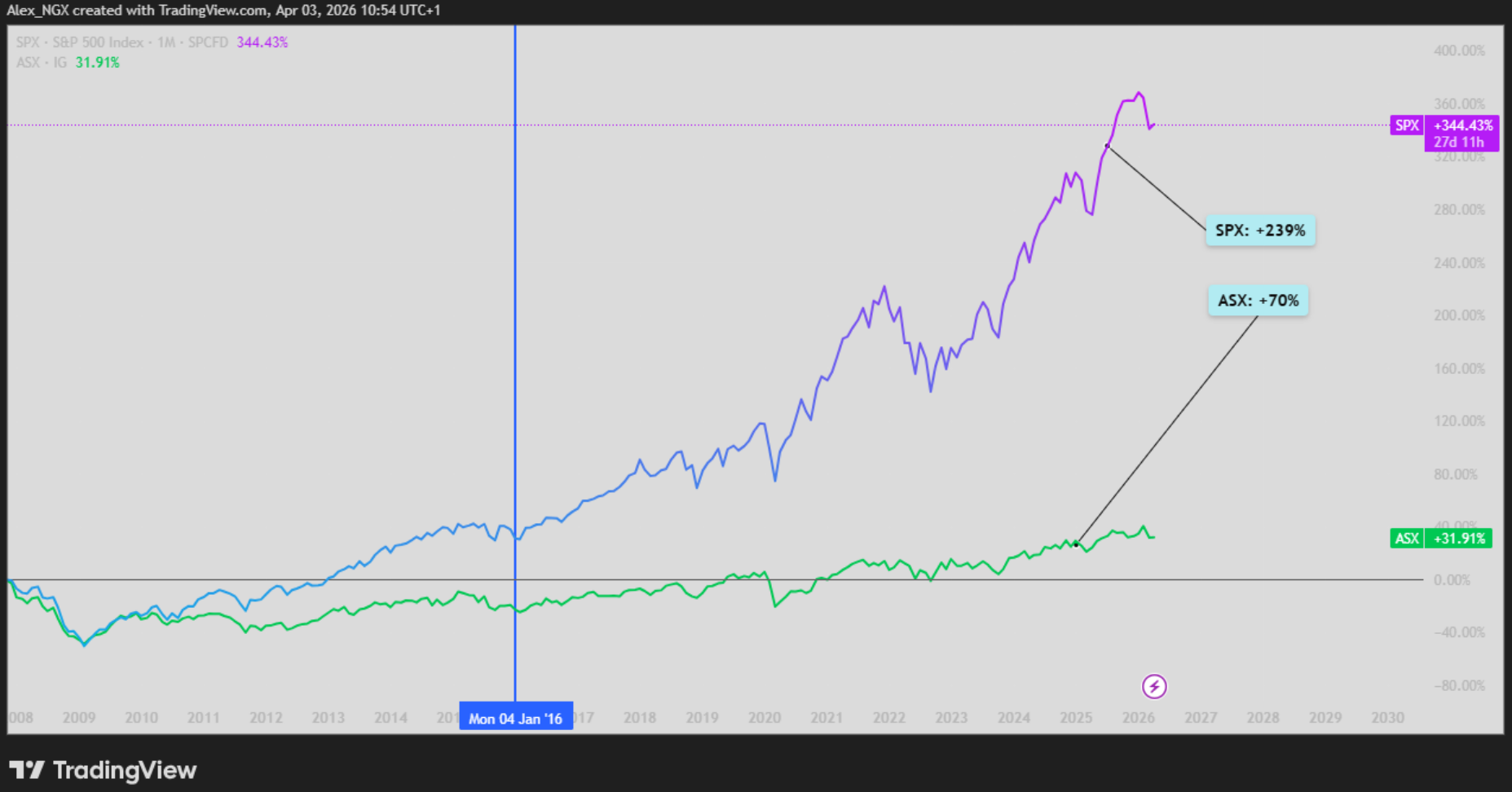
Image via TradingView: SPX vs. ASX Monthly Chart
Of course, past performance doesn't guarantee future results, but the gap is difficult to ignore.
There's also a sector angle worth considering. The ASX leans heavily on financials, mining, and resources. The US market is where you'll find the world's biggest tech, pharmaceutical, and AI-driven companies.
Apple, Nvidia, and Amazon don't have local equivalents. If you want exposure to those industries, you have to look beyond Australia.
Despite all of this, only 16% of Australian investors currently own international shares, according to an ASX study. Most Aussie investors are still keeping it local.
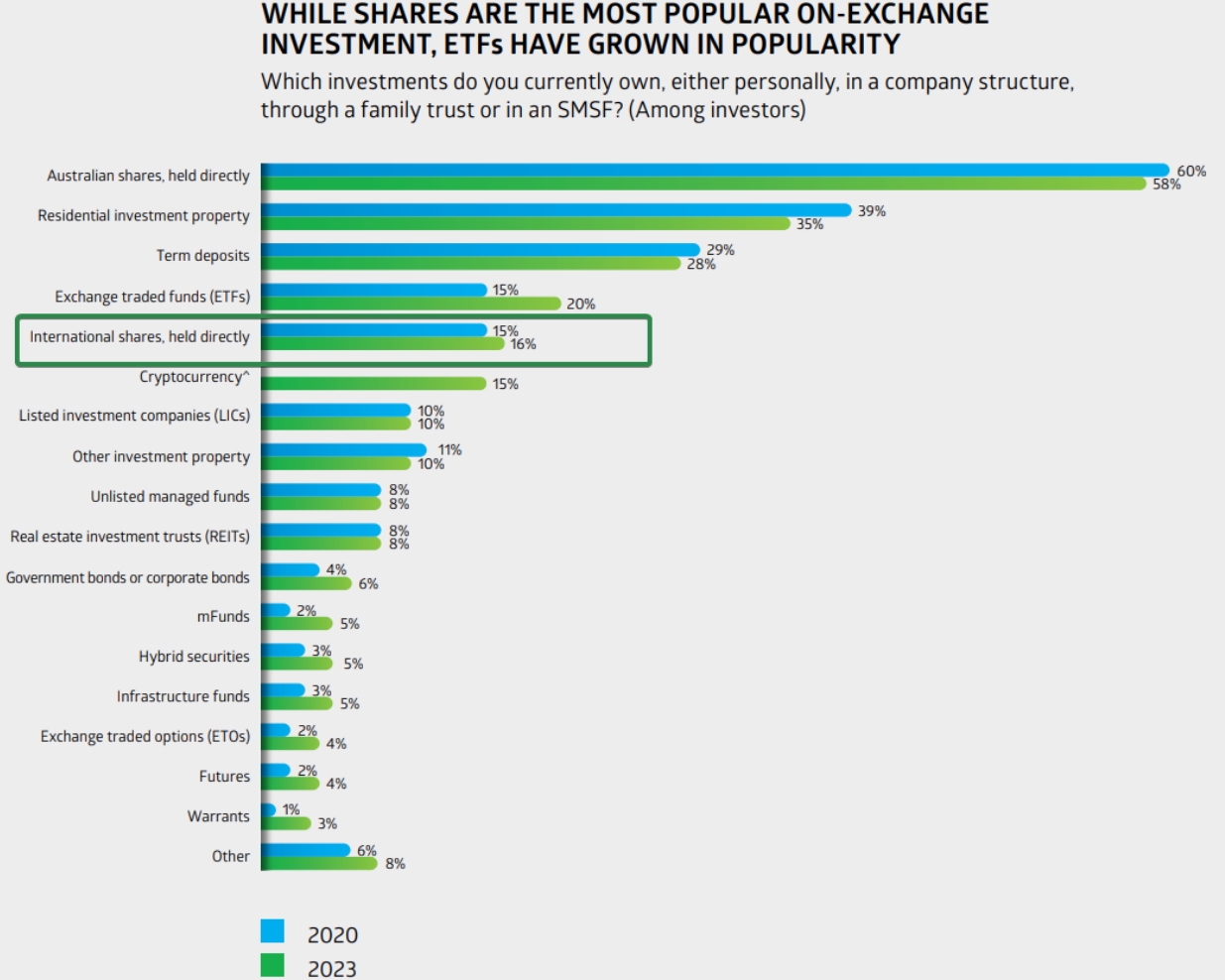
Image via ASX
It's also important to know that investing in US stocks gives you USD exposure. When the AUD weakens against the USD, your returns get a boost on conversion. When it strengthens, the opposite happens.
Currency diversification cuts both ways, and it's something to factor into your thinking before you start.
“Trade US Stocks with an ASIC-regulated broker. Fast AUD funding via PayID. ”
How to Buy American Stocks in Australia
Getting started is more straightforward than most people expect. Here's a step-by-step breakdown of how to buy American stocks in Australia.
Step 1: Choose the right platform
Your first decision is choosing where to buy. There are two main routes available to Australian investors.
The first is a direct share ownership platform. These let you buy and own actual US stocks. Popular options include:
Stake: US$3 per trade on trades up to US$30,000; 1% FX fee on deposits
Moomoo: US$0.99 per trade; access to over 11,000 US stocks
SelfWealth: Flat US$9.50 per trade; 0.6% currency conversion fee
IG: Zero brokerage on US shares; 0.7% FX fee
Under the US custodian model, the broker holds legal ownership of the shares, but you retain full shareholder rights.
Also, many of these platforms also offer fractional shares, meaning you can buy a portion of a share rather than a whole one.
The second route is trading through a CFD platform. A contract for difference (CFD) lets you speculate on a stock's price movement without owning the underlying share.
For instance, Mitrade is an ASIC-regulated CFD platform that offers access to US stock price movements with zero commission. Its costs come through the spread rather than flat brokerage fees.
The platform is beginner-friendly, with TradingView-integrated charts, a free demo account loaded with AUD$50,000 in virtual funds, and negative balance protection.

 Enjoy simple and fast tradingFlexible leverage options available Follow real-time trading strategies

Step 2: Open and verify your account
Most platforms let you open an account online in minutes. You'll typically need:
A government-issued ID such as a passport or driver's license
Your tax file number (TFN)
Basic banking details
All platforms carry out standard identity checks under anti-money laundering (AML) and know-your-customer (KYC) regulations.
Step 3: Complete the W-8BEN form
If you're using a direct share platform, you'll need to complete a W-8BEN form. This is a US Internal Revenue Service (IRS) document that certifies you're not a US taxpayer.
Without it, the IRS withholds 30% of your US dividend income automatically. With a completed form, that rate drops to 15% under the Australia-US Double Tax Agreement (DTA).
The form is valid for three years, and many platforms handle it digitally during sign-up. You should know that this applies to dividend income only, not capital gains.
Step 4: Fund your account and convert currency
US stocks are priced in USD, so your AUD needs to be converted first. Most platforms handle this automatically, but FX fees apply.
As a hypothetical example, depositing AUD$5,000 on a platform with a 1% FX fee means around AUD$50 goes to conversion before you've placed a single trade.
Always check the FX rate before depositing.
Step 5: Place your first trade
Search for your stock using its ticker symbol. For example, Apple trades as AAPL and Nvidia as NVDA. After that, choose an order type:
Market order: This order executes at the current available price—it’s fast but the price can shift in volatile conditions
Limit order: This option lets you set the exact price you're willing to pay, giving more control, but may not fill immediately
Factors to Understand Before Investing in US Shares
Knowing how to buy shares in Australia and beyond is only half the picture. Before you put money in, there are a few things worth getting your head around first:
1. Tax obligations as an Australian investor
When you sell US shares at a profit, that gain is subject to Australian capital gains tax (CGT). You report it on your Australian tax return, not a US one.
Australian residents investing through a standard broker generally don't need to file a US tax return at all.
You should know that if you hold your shares for more than 12 months before selling, you may be eligible for a 50% CGT discount on the taxable gain.
That's a notable difference for long-term investors.
On the dividend side, the US withholds 15% tax on dividends paid to Australian residents, provided you've completed your W-8BEN form.
The good news is you can claim that 15% as a foreign tax credit on your Australian return, which helps avoid paying tax twice on the same income.
Tax rules can get complicated quickly. Always speak to a tax professional for advice specific to your situation.
2. Currency risk
Your US stock returns are denominated in USD. When you eventually convert back to AUD, the exchange rate at that point affects what you actually pocket.
For example, say you hold a US stock that gains 10% over a year.
If the AUD has strengthened significantly against the USD in that time, your AUD-equivalent return could be considerably lower than 10%. The reverse also holds—a weaker AUD works in your favor on conversion.
There's also a CGT angle to this. When calculating your capital gain, you convert both your purchase price and your sale price to AUD separately, using the exchange rate on each respective date.
This means currency movements create an additional variable in your final tax position.
3. Market hours and timing
The US market trades while most Australians are asleep. The NYSE and Nasdaq are open from 9:30 am to 4:00 pm Eastern Time, which falls in the early hours of the morning in Australia.
That means you often can't respond in real time when breaking news moves a stock overnight.
Setting limit orders before you go to sleep and using price alerts can help manage this.
Some platforms also offer extended hours trading, which gives you a wider window, though liquidity tends to be lower outside regular market hours.
4. Direct shares, ETFs, or CFDs
Individual US stocks offer direct exposure to specific companies, but they require more research and carry more concentration risk. If one stock underperforms, your whole position feels it.
An exchange-traded fund (ETF) tracks a basket of stocks in a single product. A US-listed ETF tracking the S&P 500, for example, gives you exposure to 500 companies in one trade.
Australian investors can also access US market exposure through ASX-listed ETFs. These are usually denominated in AUD and sidestep direct currency conversion. But they still carry underlying USD exposure.
CFDs, such as those available through Mitrade, offer leveraged exposure to US price movements without share ownership. This suits shorter-term traders but carries a higher risk profile than direct share investing.
As you can see, no single approach suits everyone. The right choice comes down to your goals, your risk tolerance, and how much time you're prepared to put into research.
Conclusion
Buying US stocks from Australia comes down to five steps:
Pick a platform
Open and verify your account
Sort your W-8BEN
Fund your account
Place your trade
The mechanics are straightforward. What catches most people off guard is the tax and currency side, so it pays to understand both before you start.
If you're ready to take the next step, opening a demo account is a good way to get familiar with a platform before committing real money.
As with any investment, US stocks carry risk, and past performance is no guarantee of future results.
Ready to explore the US market? Open a free Mitrade demo account and practice trading US stocks with AUD$50,000 in virtual funds—no risk, no commitment.
1. Can Australians legally buy US stocks?
Yes. There are no citizenship restrictions on owning US stocks. Any Australian resident can invest in the US market through a broker or trading platform that provides access to US stocks.
2. Do I need to pay US tax on American stocks I buy from Australia?
Generally, no. Australian residents investing through a standard broker don't need to file a US tax return. You will pay Australian capital gains tax when you sell at a profit, and US dividend withholding tax applies at 15% if you've completed your W-8BEN form.
3. What is the minimum amount I need to start investing in US stocks from Australia?
It depends on the platform. Some brokers have no minimum deposit requirement, while others set a minimum. Mitrade, for example, requires a minimum deposit of AUD$50 to AUD$100 on a live account. Fractional shares on some platforms also let you start with as little as US$10.
4. How do I buy shares in Australia as a complete beginner?
Start by choosing an ASIC-regulated platform that suits your goals. Open and verify your account, fund it, and place your first trade using a ticker symbol. A demo account is a great way to practice before using real money.
5. Can I trade US stocks on Mitrade from Australia?
Yes. Mitrade offers access to US stock CFDs from Australia. The platform is ASIC-regulated and commission-free, with the spread as the main cost.
6. Are US ETFs or individual stocks better for Australian investors?
It depends on your goals. ETFs offer instant diversification across hundreds of stocks in a single trade, which suits investors who want broad market exposure with less research. Individual stocks offer more targeted exposure but carry higher concentration risk.
Disclaimer: The content presented above, whether from a third party or not, is considered as general advice only. CFD trading involves significant risk of loss. Past performance does not guarantee future results. This article serves informational purposes only and does not constitute financial advice. Consider your risk tolerance before trading.


