




10 Best Oil Stocks to Buy in 2026: Top Energy Picks for Australian Investors

Oil companies are popular for their global presence, strong financials, and consistent year-round demand. They even become hot during periods of political unrest or global wars, such as the US-Iran war, which causes tensions in the Middle East and impacts both the upstream and downstream industry players.
From an investor perspective, the volatility in the oil sector this year, including the high oil prices due to the closure of the Strait of Hormuz, presents an opportunity to tap into the market and back oil stocks with potential. However, with the sector’s volatility and the overall market outlook, which oil stocks are worth investing in? Let’s take a look at the 10 best oil stocks for Australian investors in 2026.
Comparative Table of 10 Oil Sector Stocks
As a global economy, the Australian stock market has notable oil stocks Australia that investors are bullish on. There are also strong energy stocks worth looking at in the global market. Here’s an overview of our top picks for 2026:
“Trade Oil with an ASIC-regulated broker. Fast AUD funding via PayID. ”
10 Best Oil Stocks to Buy in 2026 – Full Analysis
Now, let’s get into the details of each oil stock in Australia and beyond which made it into our list.
1. Woodside Energy Group (ASX:WDS)

When thinking of the top oil companies in Australia, Woodside Energy unrguably comes to mind. The company has a strong focus on liquefied natural gas (LNG), which means that it’s properly positioned to benefit from the rising demand for LNG across Asia and Europe.
Another reason investors find Woodside stock exciting is its direct movement with rising. When the market is volatile, as it is in early 2026, companies like Woodside benefit directly from the price movements. The company also reports strong cash flows, which makes its dividend payouts consistent.
As an investor in Australia, besides being a homegrown oil company, another reason to consider Woodside shares is that the firm offers a perfect mix of income and growth. It also boasts a global asset base with long-term supply contracts that make it stable.
So, if you’re looking for a dominant, large-cap energy stock, Woodside shares have these qualities. However, due to its upstream positioning, the company’s stock performance is strongly depends on commodity prices.
2. Santos (ASX:STO)

Santos is another Australian oil and gas entity worth a look if looking for the best oil stocks this year. It has a slightly more diversified operational approach than competitors like Woodside, making it more balanced. For context, Santos has a strong LNG demand globally, especially in the Asia-Pacific region. With this market positioning, Santos has been able to create long-term energy demand in countries tilting towards its cleaner energy products like gas.
In other words, if you invest in Santos, you can expect a more balanced portfolio. That means the stock is more suitable if you are a low- to medium-risk investor. The company also has a record of steady dividends and decent growth over the years. However, the Santos’ performance depends on the success of its various large-scale developments.
3. Viva Energy Australia (ASX:VEA)

Viva Energy primarily operates in the downstream oil sector. That means the company’s services cut across crude oil refining, fuel distribution, and retail sales. The operating system at Viva makes it less directly tied to crude oil prices and more influenced by fuel demand and refining costs.
Who’s Viva Energy suitable for? If you’re an investor who is particular about consistent cash flows and a track record of good dividend payouts, then this could be a stock worth considering. However, based on its operational structure, Viva Energy’s growth potential is limited. Without strong domestic fuel demand and operational efficiency, the company’s performance is largely restricted.
4. Beach Energy (ASX:BPT)

Beach Energy is another oil and gas brand based in Australia with its shares available on the ASX. In terms of market size, the company has its operations mainly tied to oil and gas production, meaning its market capitalisation is relatively small. Because of this, Beach Energy is more prone to structural changes in production, exploration, and operations.
For investors, this makes the company’s stock high-risk with potentially high rewards. Additionally, Beach Energy’s dividends are less consistent compared to bigger entities, making it better suited to aggressive stock investors.
5. Karoon Energy (ASX:KAR)

Karoon Energy is a unique oil company in the sense that it offers speculative oil stocks ASX. The company operates out of Australia but also has a slight international presence in Brazil. With a growing global exposure, Karoon Energy could be worth a shot if you’re convinced about its opportunities for higher returns. However, the company currently does not offer anything compelling in terms of dividends. That means its earnings can be discouraging unless you’re focused on long-term growth.
6. Saudi Aramco

Saudi Aramco is big when speaking of global oil companies. A major advantage the company has is its operations in one of the world’s largest oil-producing countries. Its presence in the global oil supply chain makes it enticing and gives it an edge in terms of production costs and reserves. As such, Saudi Aramco reports massive profits from time to time.
For investors, Aramco is primarily an income-based oil brand with a reputation for strong and consistent dividends. However, it is state-controlled, which means strategic decisions may tilt towards national interests and not shareholders at certain times.
7. ExxonMobil

ExxonMobil is another big name among the world’s publicly traded oil companies. When speaking of brands that incorporate end-to-end energy provision and consumption, ExxonMobil thrives in the industry. It operates across the entire energy value chain, including exploration, production, refining, and chemicals. This diversification helps reduce the impact of oil price volatility on its stock performance.
For investors, ExxonMobil offers stability and consistent returns. It is known for its strong dividend history and disciplined capital management. While it may not deliver explosive growth, it provides consistent long-term value. The company also continues to invest in new technologies and energy solutions, which could support future growth. If you’re an Australian investor who prefers steady exposure without excessive risk, this stock could be worth considering.
8. Chevron

Chevron is another US-based oil giant that shares many similarities with ExxonMobil but is often viewed as more capital disciplined. The company focuses on maintaining strong balance sheets and returning value to shareholders through dividends and buybacks.
In 2026, Chevron remains a solid choice for income-focused investors. It benefits from strong upstream operations while maintaining efficiency across its projects. Many investors seeking a dependable oil stock with a focus on shareholder returns consider Chevron to be a strong contender.
However, like all oil companies, it is still exposed to price fluctuations. Its conservative approach means it may not grow as aggressively as smaller players, but it offers stability and reliability.
9. PetroChina

PetroChina is one of the largest oil and gas companies in Asia and is backed by the Chinese government. It has extensive operations across exploration, refining, and distribution, making it a fully integrated energy company.
From an investment standpoint, PetroChina offers exposure to one of the world’s largest energy markets. It also provides relatively strong dividends. Value-focused investors who are looking to diversify geographically and tap into Asia’s growing energy demand. However, the stock comes with unique risks, including government influence and regulatory constraints. These factors can affect transparency and investor confidence.
10. Shell

Shell is one of the most forward-looking oil majors, actively investing in both traditional energy and renewable solutions. It has a strong presence in LNG, which continues to be a key growth area globally. This positions Shell as a bridge between current energy needs and the transition to cleaner alternatives.
For investors, Shell offers a balanced profile. It provides solid dividends while maintaining growth potential through its diversified operations. The company’s focus on energy transition also makes it more adaptable to long-term industry changes. Overall, Shell is a strong option for investors who want exposure to both traditional oil markets and future energy trends. However, this shift comes with uncertainty as the company balances profitability with sustainability goals.
How to Invest in Oil Stocks?
When thinking of investing in oil stocks in 2026, you can buy shares directly or trade them through Contracts for Difference (CFDs).
The first method is the traditional investing style that involves buying energy shares on exchanges like the ASX or the New York Stock Exchange (NYSE) and holding them in your portfolio for potential gains if the company grows.
CFDs, on the other hand, allow you to trade the prices of stocks without directly buying or owning the underlying assets. That means you can buy and sell oil stocks without purchasing individual shares on exchanges. Instead, platforms like Mitrade make this process simple by allowing short and long trades with CFDs.
That way, you can potentially make a profit when oil prices rise or fall. You also gain access to leverage, which allows you to open larger positions with smaller capital, making it easy to take advantage of short-term volatility in oil markets.
“Trade Oil with an ASIC-regulated broker. Fast AUD funding via PayID. ”
Why Invest in Oil Stocks on Mitrade?
If you want to trade oil stocks and energy assets, especially through CFDs, here are a few reasons to buy and sell stocks on Mitrade as an Aussie investor:
Accessibility: On Mitrade, you can trade individual stock CFDs like Woodside and global giants like ExxonMobil from a single platform.
Low fees: There is a 0% commission for CFD trades on Mitrade. The platform uses a spread-fee structure.
Leverage: Mitrade offers up to 1:30 leverage for retail Aussie investors and up to 1:200 for professional traders.
Trading tools: The platform also offers tools, such as real-time charts, risk management features like stop loss, and a demo account for beginners to test the platform or build their skills.
Deal on rising and falling markets: With support for rising and falling market strategies on Mitrade, oil sector traders can manage their trades better.
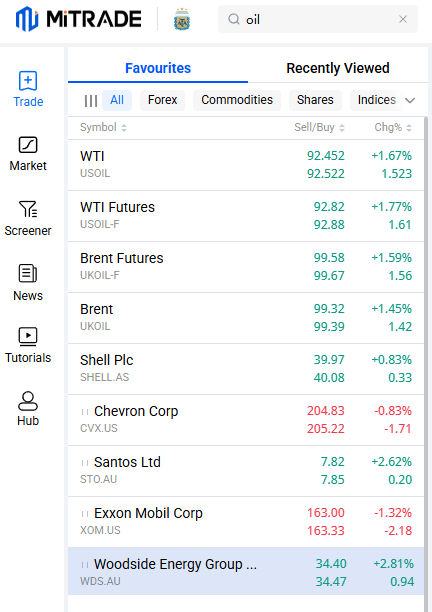
Mitrade allows you to invest directly in oil and seek profits from its price fluctuations. One of the main advantages of investing directly in this asset is the lower influence of external factors, making it easier to analyze and predict price movements.
On the other hand, when investing in shares of oil companies, even if the price of oil rises, stock values may not follow the same trend, as they depend directly on the company’s financial performance. Therefore, investing directly in oil can be a simpler and less complex alternative for those who want to reduce risks associated with corporate performance.



Final Thoughts
Oil companies in Australia and other parts of the world will remain relevant so long as demand and supply for oil and gas never stop. As an Aussie investor, this means you can position yourself for the opportunities that come with their market growth.
However, oil companies and their stocks are usually influenced by external factors, such as global unrest. Also, no two oil stocks are the same. So, a good investor must diversify. As an Australian investor, a good approach could be to share your portfolio across prominent entities like Woodside and global brands like Saudi Aramco. And when you sign up on Mitrade, you can trade oil stock CFDs easily at low costs.
1. Is it better to invest in oil directly or in oil stocks?
It depends on your investment goals. Investing directly in oil allows you to benefit from price movements with fewer company-specific risks, while oil stocks may offer dividends and long-term growth tied to company performance.
2. How can Australian investors invest in oil?
Australian investors can access oil markets through CFD trading platforms, ETFs, or by investing in international oil company stocks listed on global exchanges.
3. What are the risks of investing in oil?
Oil investments are affected by global supply and demand, geopolitical events, and economic conditions. Prices can be highly volatile, so proper risk management is essential.
Disclaimer: The content presented above, whether from a third party or not, is considered as general advice only. CFD trading involves significant risk of loss. Past performance does not guarantee future results. This article serves informational purposes only and does not constitute financial advice. Consider your risk tolerance before trading.


