




Day Trading Australia: How to Start & Strategies (2026 Guide)
Day trading pulls in thousands of Australians every year, and the appeal makes sense. Profiting from short-term price moves in day trading Australia's financial markets sounds straightforward enough.
ASIC's data puts things in perspective, though. In 2024 alone, 68% of retail CFD investors lost money, totalling over $458 million in losses. Go in prepared, and you stand a much better chance.
This guide covers what day trading is, which markets work best for Australian traders, and how to start day trading the right way.
You'll also find beginner strategies and risk management tips to help you build a solid foundation. Platforms like Mitrade, regulated by ASIC, give Australian traders access to these markets today.
What Is Day Trading?
Day trading is the practice of buying and selling a financial asset within the same trading day. The goal is to profit from short-term price movements. All positions close before the market shuts for the day.
Unlike long-term investing, day trading is very active. You're watching charts and price action in real time, looking for opportunities as they form. Traders work across stocks, forex, indices, commodities, and contracts for difference (CFDs).
A CFD is a contract between you and a broker to exchange the difference in an asset's price from when you open a trade to when you close it. You never own the underlying asset.
Many day traders use leverage, meaning borrowed capital from their broker, to control larger positions than their own funds would allow.
Here's a simple example of how a day trade might look. Say the ASX 200 opens at 7,800 and you open a long CFD position, expecting it to rise. By midday it's at 7,850 (a +0.64% change). You close the trade and pocket the difference.
How Does Day Trading Work?
Day trading runs on speed and attention. You're actively watching charts, price action, and market news throughout the session.
The ASX regular session runs from 10:00am to 4:00pm AEST, with a pre-market period starting at 7:30am.
When you spot an opportunity, you place an order. There are two order placement methods:
A market order, which executes immediately at the best available price
A limit order, which only executes at a price you set in advance
Most day traders use both depending on the situation.
Leverage is where things get interesting and where the stakes get higher. With 10:1 leverage, $1,000 of your own capital controls a $10,000 position.
If that position moves 5% in your favor, your return is calculated on $10,000, not $1,000. But if it moves 5% against you, so does the loss.
Basically, leverage cuts both ways.
In Australia, ASIC caps the leverage available to retail CFD traders. The maximum is 30:1 for major currency pairs. For other asset classes like indices, commodities, and crypto, the cap is lower.
These limits exist to protect retail traders from outsized losses.
With the mechanics covered, let's look at which markets Australian day traders actually use.
Best Markets for Day Trading in Australia
One advantage of day trading in Australia is the range of markets available to retail traders. Each market has its own characteristics, and knowing them helps you find the right fit.
ASX Shares
The ASX lists over 2,000 companies, with mining and energy stocks making up close to 40% of the exchange. These sectors tend to be volatile, which creates short-term opportunities. That volatility also means risk, so position sizing matters.
Forex
The Australian dollar (AUD) sits among the most traded currencies globally. The AUD/USD pair is particularly popular with local traders due to its liquidity and the volume of activity around it.
Indices
The ASX 200 tracks Australia's top 200 companies by market cap. Most traders access indices through CFDs, speculating on the index's overall direction rather than buying individual stocks.
Commodities
Gold, oil, and iron ore are highly relevant in Australia given the country's resource-driven economy. These markets can move sharply on global news, making them active day trading territory.
CFDs
CFDs tie all of this together. With a platform like Mitrade, you can access shares, forex, indices, and commodities from one account. You can also go long or short depending on your market view.
“Trade with an ASIC-regulated broker. Fast AUD funding via PayID. ”
Day Traders vs Long-Term Investors
Day trading and long-term investing are two very different approaches. Neither is inherently better. The right one depends on your goals, schedule, and risk tolerance. Let’s look at a few distinctions among both methods:
Time commitment: Day trading demands active attention during market hours. Long-term investing is largely passive once your positions are set.
Holding period: Day traders close all positions by market close. Long-term investors may hold assets for months or years.
Risk profile: Day trading carries higher short-term risk, often amplified by the use of leverage. Long-term investing involves different risks but with more time to recover from downturns.
Tax treatment: The ATO classifies most active day traders as "traders," meaning profits are taxed as ordinary income. Long-term investors holding assets for 12+ months may qualify for a 50% CGT discount.
Mindset: Day trading rewards quick thinking, discipline, and emotional control. One bad decision in a volatile session can wipe out a week of gains. Long-term investing rewards patience and consistency, with less pressure to act on every market move
How to Start Day Trading in Australia
Getting started with day trading doesn't have to be overwhelming. Follow these steps and you'll have a clear path forward:
Learn the basics first: Before putting real money on the line, understand how markets work, how to read a chart, and how orders are placed. Most brokers offer free educational content worth working through.
Choose an ASIC-regulated broker: ASIC maintains a public register of licensed brokers on its website. Look for platforms with real-time data, reliable execution, and competitive fees. Mitrade is one example of an ASIC-regulated broker offering CFD trading across shares, forex, and commodities.
Open a demo account: Practice with virtual money before going live. A demo account mirrors real market conditions without the financial risk. Treat it seriously, not as a game. The habits you build here carry over into the real thing.
Start with a small live account: Some Australian brokers allow you to start with as little as $100 to $500. Only use money you can afford to lose entirely. CFDs are complex instruments, and most retail investors lose money when trading them.
Pick one market and one strategy: Spreading across too many markets too early is one of the most common beginner mistakes. Start narrow, get comfortable, and build from there.
Set risk rules before you trade: Decide your maximum loss per trade before placing it. Experienced traders typically risk no more than 1-2% of their account on a single trade. We cover the specific tools for managing risk, including stop-loss orders, in the next section.

 Enjoy simple and fast trading Flexible leverage options available Follow real-time trading strategies Demo account with $50,000 virtual funds

Top Day Trading Strategies for Beginners
Having a strategy is non-negotiable. Without one, you're reacting to the market instead of reading it. Here are four approaches worth knowing, starting with the most beginner-friendly.
Trend Following
Trend following means trading in the direction of an established price move, not against it. If the market is moving up, you look for opportunities to buy. If it's moving down, you look to sell.
Moving averages help confirm the direction. A simple moving average (SMA) smooths out price data over a set period, making the trend easier to spot.
A common setup uses a 20-period and 50-period SMA. When the shorter SMA crosses above the longer one, it can signal an upward trend. This strategy suits patient traders who can wait for a clear setup before entering.
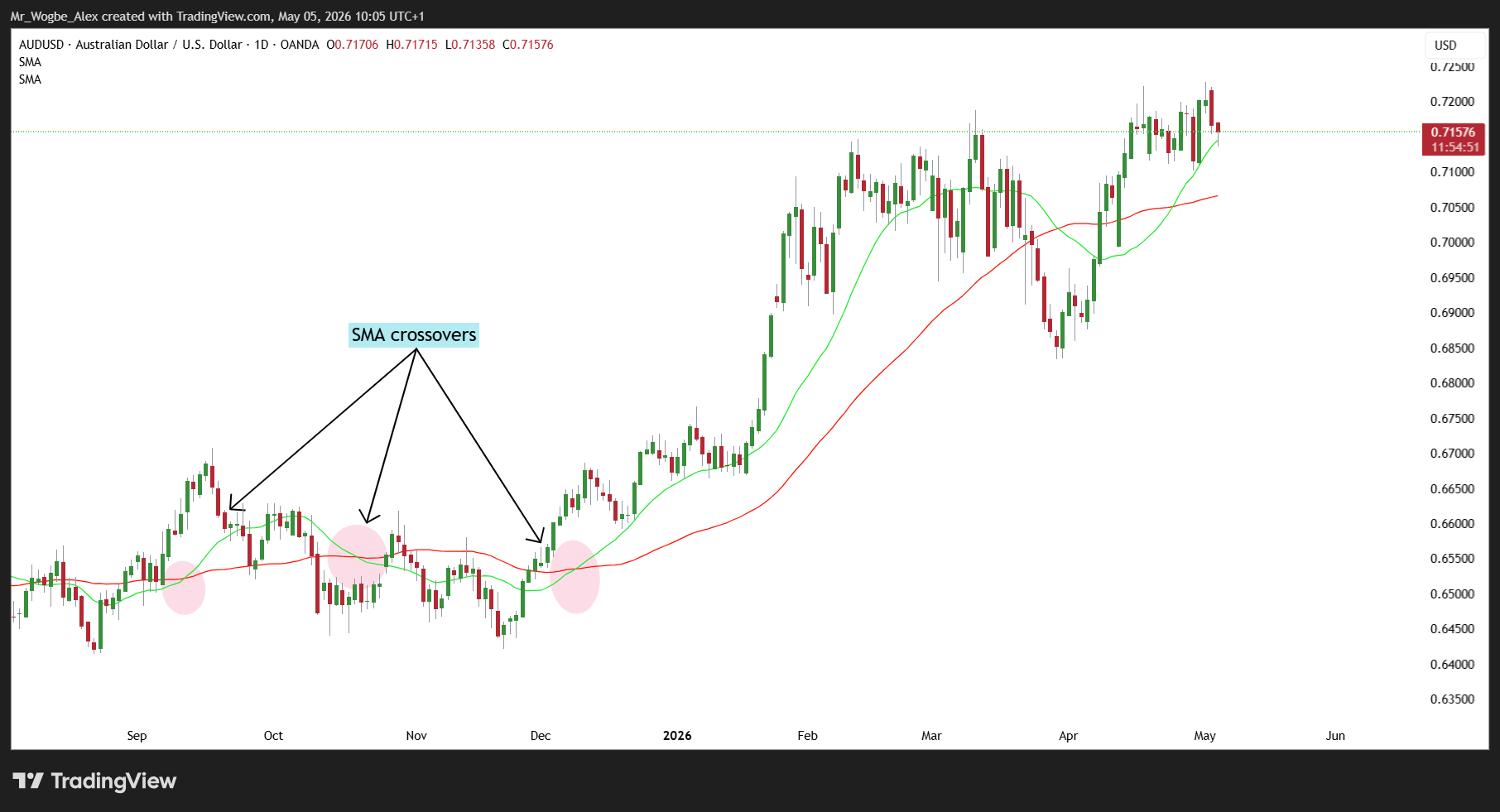
Image via TradingView: AUD/USD Daily Chart
Breakout Trading
Breakout trading involves entering a trade when price moves decisively past a key support or resistance level. Support is a price zone where an asset has historically stopped falling. Resistance is where it has historically stopped rising.
When price breaks through either level on strong volume, it often signals new momentum. Volume confirmation is important here. A breakout on low volume is more likely to be a false signal.
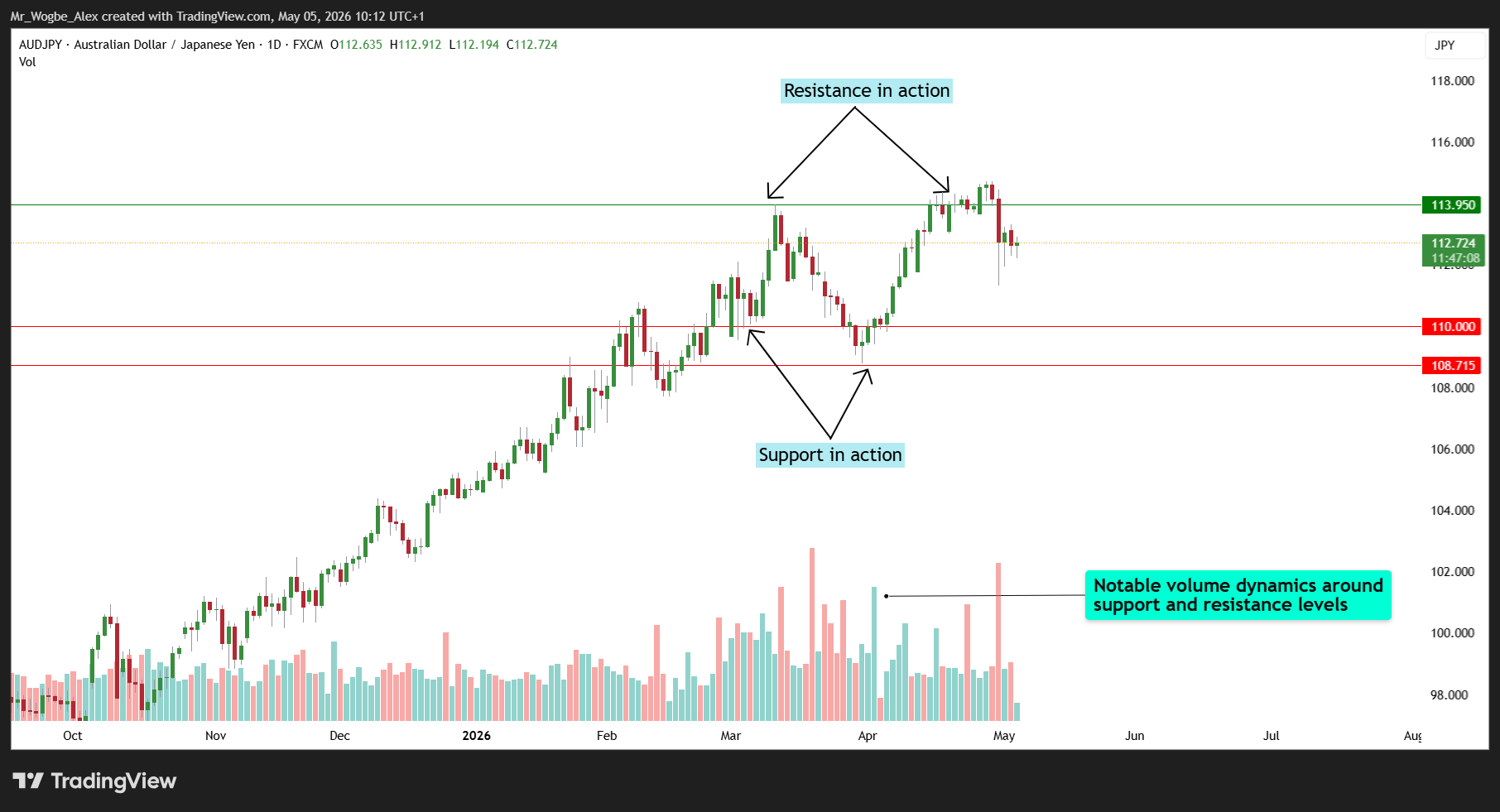
Image via TradingView: AUD/JPY Daily Chart
Momentum Trading
Momentum trading means jumping onto an asset already moving strongly in one direction, often triggered by news or a macro event.
The Relative Strength Index (RSI) measures how overbought or oversold an asset is on a scale of 0 to 100. The Moving Average Convergence Divergence (MACD) shows the relationship between two moving averages to signal momentum shifts. The key is exiting before the momentum fades.
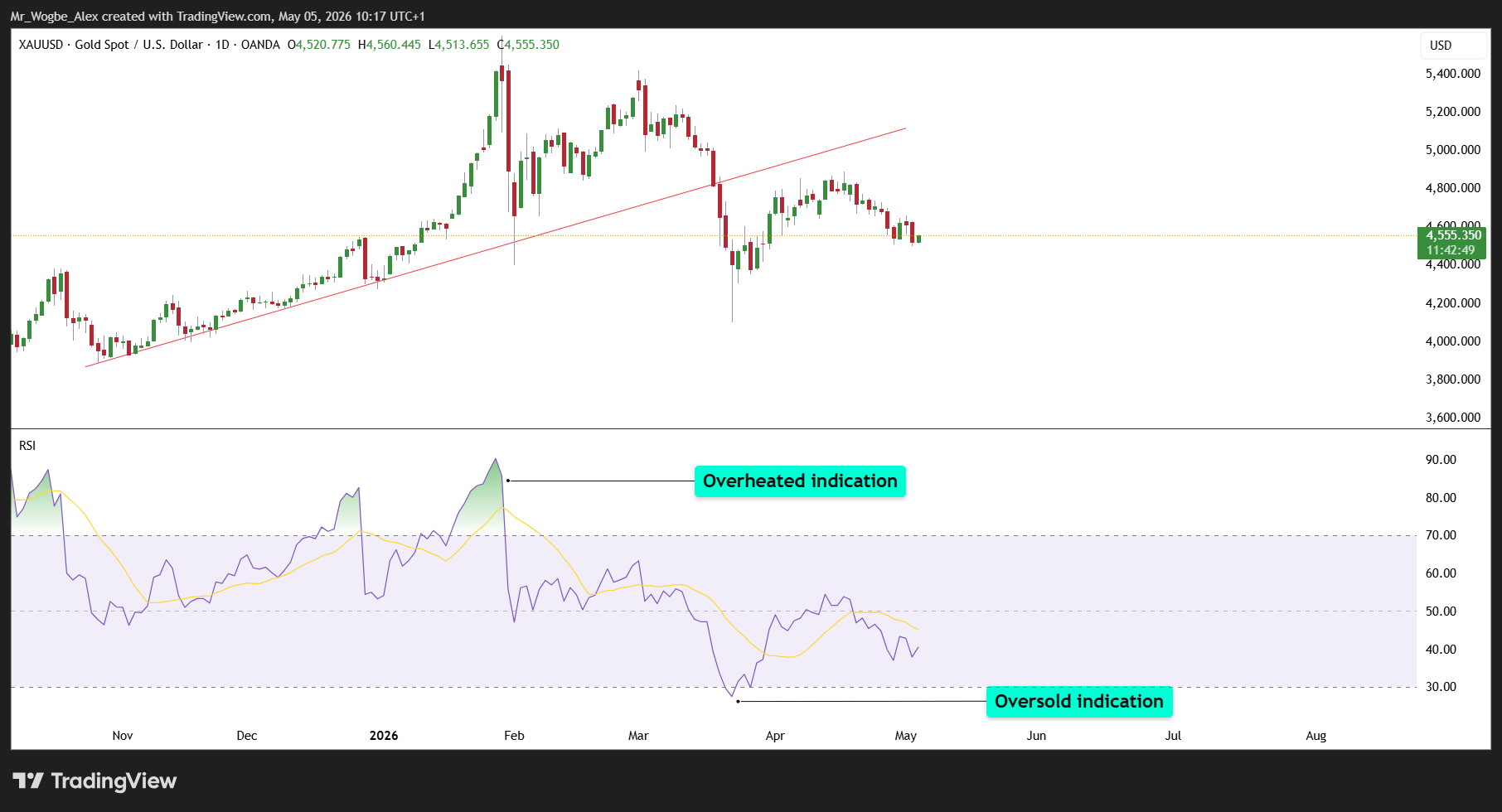
Image via TradingView: XAU/USD Daily Chart
Scalping
Scalping involves making many small trades throughout the day to capture tiny price movements. It demands intense focus, fast execution, and hours of screen time. It's better suited to experienced traders than beginners.
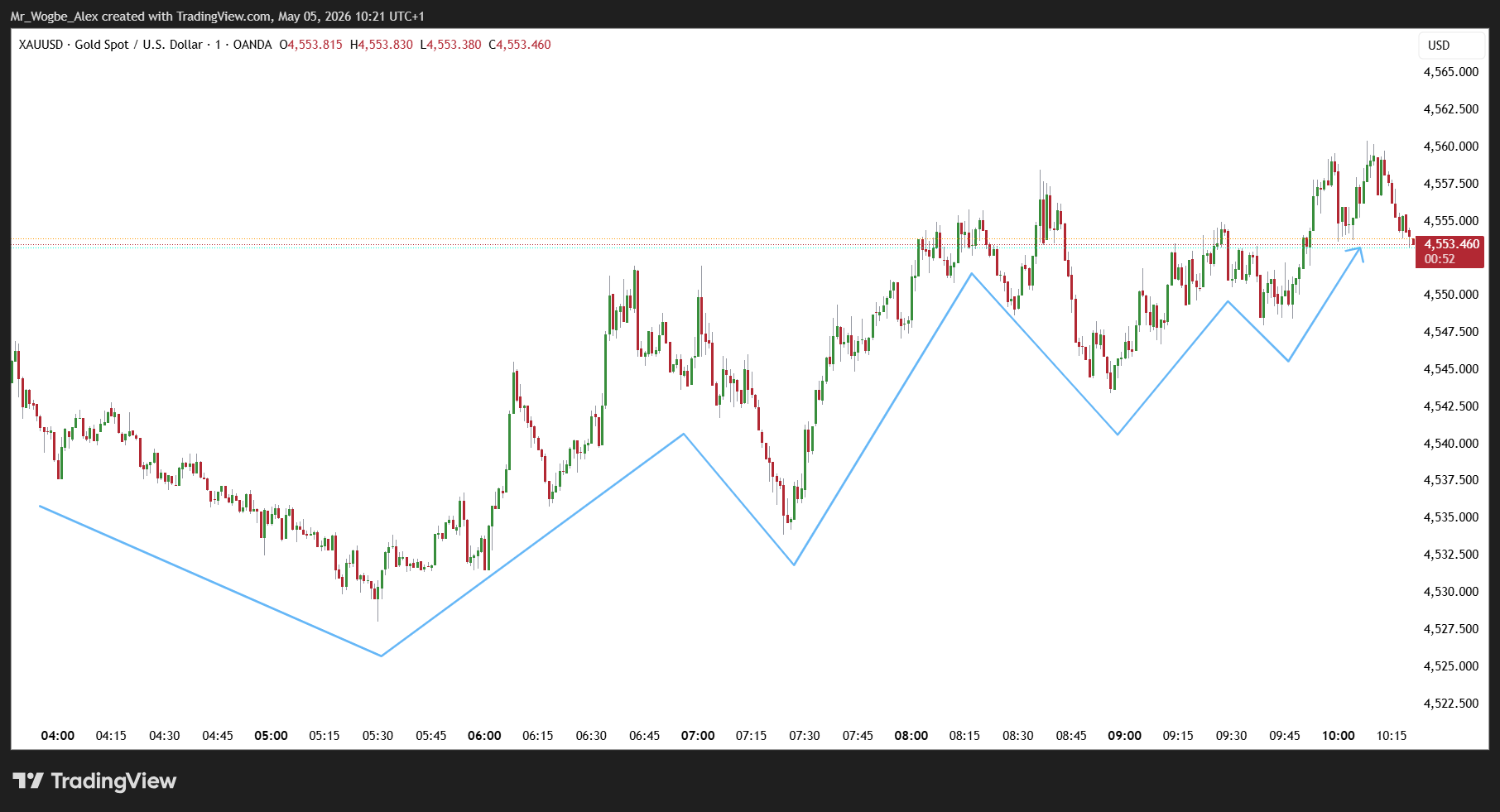
Image via TradingView: XAU/USD 1-minute Chart
Risk Management Tips for Day Traders
A solid strategy gets you into trades. But risk management is what keeps you in the game. Here are five practices every day trader should build into their routine:
Use stop-loss orders: A stop-loss is an instruction to automatically close your trade if price moves a set amount against you. It removes the temptation to hold a losing position and hope for a reversal. Research shows 88% of experienced day traders use stop-loss orders as part of their strategy.
Follow the 1-2% rule: Risk no more than 1-2% of your account on any single trade. On a $2,000 account, that's $20 to $40 per trade. It sounds conservative, but it keeps you alive through a losing streak.
Set a daily loss limit: Decide the maximum you're willing to lose in a single day and stop trading when you hit it. This protects you from revenge trading, the pattern of placing more trades after a loss to try to recover quickly, which almost always deepens losses.
Keep a trading journal: Record every trade—why you entered, what happened, and what you'd do differently. Patterns emerge over time, both good and bad.
Know your downside is capped: ASIC requires all CFD brokers to provide negative balance protection to retail traders. Your losses cannot exceed the funds in your account.
Pros and Cons of Day Trading
Day trading has real appeal, but it comes with real trade-offs. Here's an honest look at both sides.
Is Day Trading with CFDs Worth It in 2026?
CFDs are popular with Australian day traders for good reason. From one account, you can access shares, forex, indices, and commodities. You can go long or short, react to market moves in either direction, and do it all without owning the underlying asset.
ASIC's 2021 reforms, including leverage caps and mandatory negative balance protection, added a layer of structure to the CFD market. These rules exist to protect retail traders, and they've made the environment safer than it was years ago.
That said, CFDs are complex instruments. Most retail traders who use them lose money. What separates traders who last from those who don't is rarely talent. It's education, a tested strategy, and disciplined risk management applied consistently.
If you're ready to take the next step, start with a demo account on an ASIC-regulated platform like Mitrade. Pick one market, learn it thoroughly, and treat risk management as non-negotiable before you go live.
1. Is day trading legal in Australia?
Yes, day trading is legal in Australia. It's regulated by the Australian Securities and Investments Commission (ASIC), which licenses brokers and sets rules around leverage, product distribution, and consumer protection.
2. Is $100 enough to day trade?
Some brokers let you start with as little as $100. In practice, though, small accounts leave very little room for error. A few losing trades can wipe out your capital quickly, so starting with more gives you a better buffer.
3. How much can a day trader make with $1,000?
It varies widely and depends on your strategy, market conditions, and risk management. With a $1,000 account, most experienced traders risk no more than $10 to $20 per trade. Consistent small gains matter more than chasing big ones.
4. What is the biggest mistake day traders make?
Trading without a plan. Most beginners enter trades based on impulse rather than a clear strategy. Skipping risk rules, overtrading, and revenge trading after losses are also among the most common and costly habits.
5. Do day traders pay tax in Australia?
Yes. The ATO classifies most active day traders as "traders," meaning profits are taxed as ordinary income at your marginal rate. Keep detailed records of every trade and consult a tax professional for your specific situation.
6. Is Mitrade a good platform for day trading in Australia?
Mitrade is an ASIC-regulated CFD broker offering access to shares, forex, indices, and commodities from one account. It's designed with retail traders in mind, with a straightforward interface and risk management tools built in.
Disclaimer: The content presented above, whether from a third party or not, is considered as general advice only. CFD trading involves significant risk of loss. Past performance does not guarantee future results. This article serves informational purposes only and does not constitute financial advice. Consider your risk tolerance before trading.


