




Gold Breaks Above US$4,200 After Weak US Jobs Data – Buy, Wait or Trade CFDs?

Why Trade Gold CFDs with Mitrade?
Gold Price Today
Gold has staged a powerful comeback, surging above US$4,200 per ounce after weaker-than-expected US economic data, a softer US dollar and falling Treasury yields reignited demand for safe-haven assets. The rally has pushed XAU/USD to its highest level in around seven weeks, with investors increasingly expecting the Federal Reserve to pause interest rate hikes at its September meeting.
For Australian investors, the latest rebound raises an important question: Is this the start of another major gold bull market, or simply a short-term relief rally? In this guide, we'll explain why gold prices are rising, examine the latest technical outlook, explore expert forecasts for the months ahead, and compare the best ways to invest in gold in Australia—including physical bullion, gold ETFs, mining shares and Gold CFDs.
Gold Price Today (Updated: 6 August 2026)
Why Is Gold Surging Above US$4,200 Today?
Gold (XAU/USD) has surged back above US$4,200 per ounce, reaching its highest level in around seven weeks after four consecutive days of gains. The rally has been driven by a combination of weaker US economic data, a softer US dollar, declining Treasury yields and growing expectations that the Federal Reserve will keep interest rates unchanged in September. Here's a closer look at the key factors behind today's move.
1. Weak US Employment Data
The latest US labour market data has reinforced concerns that economic growth is slowing. ADP private payrolls came in significantly below market expectations, signalling that hiring momentum is cooling after months of resilience. Investors are now turning their attention to the upcoming Non-Farm Payrolls (NFP) report, which could provide further evidence that the US job market is losing steam.
A softer labour market reduces the need for the Federal Reserve to tighten monetary policy further. As traders lowered expectations for additional rate hikes, demand for gold increased, helping XAU/USD extend its recent rally.
2. US Dollar Falls Sharply
The US dollar has weakened noticeably this week as investors reassessed the outlook for US interest rates. Since gold is priced in US dollars, a weaker greenback makes bullion less expensive for overseas buyers, increasing global demand.
The decline in the US Dollar Index (DXY) has therefore provided another major tailwind for gold. Historically, gold and the US dollar tend to move in opposite directions, and this inverse relationship has once again been evident during the latest rally.
3. Treasury Yields Drop
US Treasury yields have also retreated as investors shifted into government bonds and priced in a less aggressive Federal Reserve. Lower bond yields reduce the opportunity cost of holding non-yielding assets such as gold, making the precious metal more attractive relative to fixed-income investments.
The decline in yields has encouraged both institutional and retail investors to rotate back into safe-haven assets, providing additional support for gold prices.
4. Markets Expect the Fed to Stay on Hold
Perhaps the biggest driver behind gold's latest breakout is the growing belief that the Federal Reserve will leave interest rates unchanged at its September meeting. Cooling economic data, easing inflation expectations and lower energy prices have all contributed to a more dovish outlook for monetary policy.
With markets now assigning a higher probability to a Fed pause rather than another rate hike, investors have increased their exposure to gold as a hedge against future policy uncertainty. If upcoming inflation and employment data continue to weaken, expectations for eventual rate cuts could provide further upside for bullion in the months ahead.
Gold Price Chart Analysis
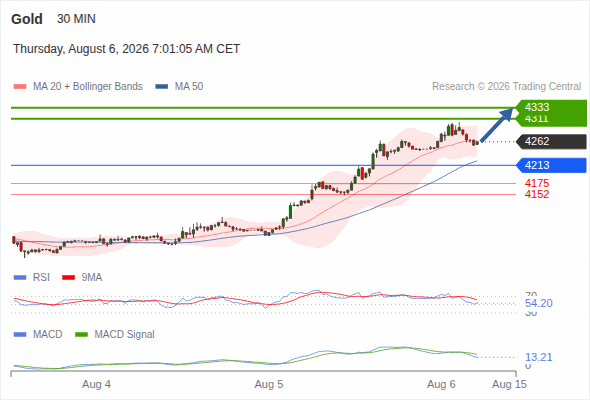
Gold's recent surge has significantly improved its technical outlook. The decisive move above US$4,200 confirms a bullish breakout from the consolidation range that dominated trading through late July. The breakout has shifted market sentiment back in favour of buyers, with momentum indicators turning increasingly positive.
From a chart perspective, the former resistance zone around US$4,150–US$4,200 has now become an important support area. As long as gold remains above this region, the broader uptrend is likely to stay intact.
Key Technical Levels
Bullish Scenario
If buyers successfully defend the US$4,200 support level, gold could continue extending its rally towards US$4,300 and US$4,350. A sustained breakout above those levels would strengthen the longer-term bullish trend and potentially open the door to US$4,500 later this year.
Bearish Scenario
On the downside, a failure to hold above US$4,200 could trigger short-term profit-taking. Initial support is expected around US$4,160, followed by the stronger support zone near US$4,100. A break below these levels would weaken the current bullish structure and increase the likelihood of a deeper pullback towards the US$4,000 psychological level.
Technical Outlook: The overall trend remains bullish while gold trades above US$4,200. Investors should continue monitoring upcoming US inflation data, Non-Farm Payrolls and Federal Reserve commentary, as these events are likely to determine whether XAU/USD can extend its advance toward US$4,300–US$4,500 or enter another period of consolidation.
Is This the Beginning of a New Gold Bull Market?
Gold's powerful rebound above US$4,200 has reignited debate over whether the precious metal is entering a new long-term bull market or simply experiencing a short-term relief rally. While no single indicator can confirm the start of a new uptrend, the current macroeconomic backdrop suggests that the medium-term outlook for gold has improved significantly.
Several bullish catalysts are now aligning. A weaker US dollar, falling Treasury yields and softer US economic data have increased expectations that the Federal Reserve will pause interest rate hikes in September. Historically, gold has performed well during periods when monetary policy becomes less restrictive. At the same time, central banks continue to hold substantial gold reserves, while geopolitical uncertainty and concerns over global growth are supporting demand for safe-haven assets.
However, investors should also remain aware of the risks. If upcoming US inflation or employment data surprise to the upside, expectations for tighter monetary policy could return, strengthening the US dollar and putting pressure on gold prices. Profit-taking after the recent rally may also trigger short-term volatility.
Factors Supporting a New Gold Bull Market
What Could Slow the Rally?
Stronger-than-expected US Non-Farm Payrolls or CPI data
A rebound in the US Dollar Index (DXY)
Higher Treasury yields
More hawkish comments from Federal Reserve officials
Short-term profit-taking after gold's rapid rebound
📌 Outlook: As long as gold remains above the US$4,200 breakout level, the technical bias remains positive. A sustained move above US$4,300 could pave the way for a retest of US$4,500 later this year, while a break below US$4,100 would suggest that further consolidation is likely.
Best Ways to Invest in Gold in Australia
In Australia, the most common ways to invest in gold include physical gold bullion, gold ETFs, gold mining stocks and gold CFDs. Each method has different advantages in terms of ownership, liquidity, costs and flexibility.
Buy Physical Gold
Buying physical gold bars and coins is the traditional way to invest in gold. Investors directly own the underlying asset and can use gold as a long-term store of value or portfolio hedge.
Direct ownership of gold
No dependence on financial markets
Often used as protection during economic uncertainty
Storage and insurance costs
Wider buy/sell spreads
Less convenient for frequent trading
Invest in Gold ETFs
Gold ETFs provide exposure to gold prices without requiring investors to store physical bullion. These funds typically track the price of gold or hold gold-related assets and can be bought and sold through stock exchanges (such as ASX).
Easy to buy and sell
No need for personal storage
Suitable for long-term investors
Management fees
You do not directly hold physical gold
ETF prices can differ slightly from spot gold prices
Buy Gold Mining Stocks
Investing in companies involved in gold exploration and production allows gold mining stocks to sometimes outperform gold prices because company profits may increase faster when gold prices rise.
Company management risk & operational issues
Fluctuating production costs
Wider equity market volatility
Trade Gold CFDs
For traders who want to take advantage of short-term gold price movements, Gold CFDs (Contracts for Difference) offer a flexible way to trade XAU/USD. Instead of owning physical metal, traders speculate on whether prices will rise or fall.
| Feature | Gold CFDs Overview |
|---|---|
| Ownership | No physical gold required |
| Trading Direction | Buy (Long) or Sell (Short) |
| Market Access | Trade gold price movements |
| Flexibility | Suitable for short-term strategies |
| Risk Management | Stop-loss and take-profit tools |
With gold trading near record levels, Australian traders can access Gold CFDs with flexible position sizes, risk management tools, and 24/5 market access via Mitrade.
Gold vs Silver: Which Precious Metal Looks More Attractive?
Gold and silver have both benefited from the recent decline in the US dollar and Treasury yields, but they serve different roles within an investment portfolio. Gold is traditionally viewed as a safe-haven asset and a hedge against economic uncertainty, while silver combines its precious metal characteristics with strong industrial demand from sectors such as solar energy, electric vehicles and electronics.
Following gold's recovery above US$4,200, silver has also rallied strongly, outperforming gold over recent trading sessions. Spot silver has gained more than 7% this week, supported by renewed investor demand and a persistent structural supply deficit.
Gold vs Silver Comparison
Why Gold May Be the Better Choice
Gold may appeal more to conservative investors who want portfolio diversification and protection during periods of economic uncertainty. If the Federal Reserve pauses interest rate hikes and the US dollar remains under pressure, gold could continue attracting institutional capital.
Why Silver Could Outperform
Silver often outperforms gold during the later stages of a precious metals bull market because it benefits from both investment demand and industrial consumption. Demand from AI infrastructure, renewable energy and solar panel manufacturing continues to tighten the physical silver market, with analysts highlighting a multi-year structural supply deficit.
Which Precious Metal Should You Choose?
The answer depends on your investment objectives:
Choose Gold if your priority is capital preservation, lower volatility and protection against macroeconomic uncertainty.
Choose Silver if you're comfortable with greater price swings and are seeking potentially higher returns driven by industrial demand.
Trade Both with CFDs if you want the flexibility to speculate on rising or falling prices without owning the underlying metals. CFDs also allow traders to diversify across both precious metals while using risk management tools such as stop-loss orders.
For many Australian investors, holding exposure to both gold and silver can provide a balanced way to benefit from safe-haven demand while participating in the long-term growth of industrial precious metals.
What Should Gold Traders Watch Next?
Although gold has broken above US$4,200, the next move will depend on several important economic and market catalysts. Traders should closely monitor the following factors:
1. US Non-Farm Payrolls (NFP)
The upcoming US jobs report will be one of the most important events for gold traders.
A weaker-than-expected employment result could reinforce expectations that the Federal Reserve will maintain a softer monetary policy stance, potentially supporting further gold gains.
However, stronger employment data could push Treasury yields and the US dollar higher, creating short-term pressure on gold prices.
2. US Inflation Data
Inflation remains a key factor influencing Federal Reserve decisions.
Traders should watch:
Consumer Price Index (CPI)
Producer Price Index (PPI)
Core inflation trends
Lower inflation may increase expectations for future rate cuts, which could benefit gold. Persistent inflation, however, may delay monetary easing.
3. Federal Reserve Policy Signals
Markets are currently focused on whether the Fed will keep rates unchanged in September.
If policymakers signal a more dovish approach, gold could receive additional support due to:
Lower expected interest rates
A weaker US dollar
Falling real yields
Conversely, a more hawkish Fed could trigger profit-taking after gold's strong rally.
4. US Dollar and Treasury Yields
Gold traders should continue monitoring the relationship between gold, the US dollar and bond yields.
Key relationships:
The recent gold breakout above US$4,200 has been supported by a weaker dollar and declining yields, making these two indicators critical for the next phase of the rally.
5. Technical Levels to Watch
After breaking above US$4,200, traders should focus on these key price zones:
A sustained move above US$4,300 could confirm another bullish continuation phase, while a fall below US$4,100 may indicate a deeper correction.


You might be interested in…
1. Why is gold price above US$4,200?
Gold has risen above US$4,200 due to a combination of a weaker US dollar, falling Treasury yields, softer US economic data and expectations that the Federal Reserve may adopt a less aggressive interest-rate policy.
2. Is now a good time to buy gold in Australia?
Whether it is the right time to buy gold depends on your investment goals. Long-term investors may view gold as portfolio diversification, while traders may focus on technical levels and market momentum.
3. Will gold reach US$4,500?
A move toward US$4,500 could become possible if gold maintains momentum above US$4,200 and receives further support from lower interest rates, a weaker US dollar and continued safe-haven demand.
4. What is the best way to invest in gold in Australia?
Australian investors can choose from physical gold, gold ETFs, mining stocks or Gold CFDs. The best option depends on whether the priority is ownership, long-term investing or active trading.
5. Are Gold CFDs better than physical gold?
Gold CFDs and physical gold serve different purposes. Physical gold focuses on ownership and long-term holding, while CFDs provide flexibility to trade both rising and falling markets.
Disclaimer: The content presented above, whether from a third party or not, is considered as general advice only. CFD trading involves significant risk of loss. Past performance does not guarantee future results. This article serves informational purposes only and does not constitute financial advice. Consider your risk tolerance before trading.


