




What You Need to Know About Storage Giant Kioxia’s Over $5 Billion Buyback Plan
TradingKey - After the Tokyo market close on July 31, Japanese NAND flash memory giant Kioxia, while releasing its first-quarter financial results for fiscal year 2027, simultaneously announced a share buyback plan of up to 800 billion yen (approximately $5.15 billion), planning to repurchase up to 30 million shares, or 5.5% of its outstanding shares.
Notably, Kioxia's stock price had already pulled back about 60% from its all-time high before the announcement of the buyback plan. Meanwhile, its major shareholder, Bain Capital, completed the liquidation of its stake in early July, with a total return of approximately $17 billion. The funds for this buyback were originally planned for capacity expansion.
Why Kioxia Is Buying Back Shares
The direct reason is Kioxia's highly robust earnings for the quarter. First fiscal quarter revenue was 1.767 trillion yen, up 415% year-on-year, with net profit reaching 842.17 billion yen, compared with just 18.28 billion yen in the same period last year. On this basis, allocating 800 billion yen for buybacks is by no means a financial strain.
However, the flip side of these stellar figures is the low base in the same period last year. Kioxia has just climbed out of a cyclical trough, and its current growth is built on a low comparison base; whether it can maintain this level of growth going forward remains to be seen.
Benefiting from robust demand for AI storage, single-quarter sales for the SSD and storage business reached 1.175 trillion yen, accounting for 66% of the company's total revenue, with datacenter and enterprise applications contributing more than 60%.
However, one set of data in the financial report is worth comparing: average prices of NAND products surged by approximately 70% quarter-on-quarter, but bit shipments only grew by a low single-digit percentage, and some shipments were deferred to the next fiscal quarter. (Bit shipments refer to the total shipment volume calculated in terms of memory chip capacity units, reflecting the actual data capacity supply of storage products.)
In other words, Kioxia's earnings surge this quarter was primarily driven by rising prices rather than a material expansion in end-market shipments. This raises questions about the quality of this growth. Although the market generally believes that AI inference will drive demand for storage capacity and become a major source of future shipment growth, this logic has not yet been reflected in the shipment data of the current earnings report, and it will still take time for demand to translate into actual orders.
Is a Buyback Bullish for Kioxia's Share Price?
Buybacks are indeed positive news. On the day the buyback announcement was made, the stock price surged 17.7%, and subsequently rose by a cumulative total of nearly 20% over the next three trading days, showing a positive market reaction.
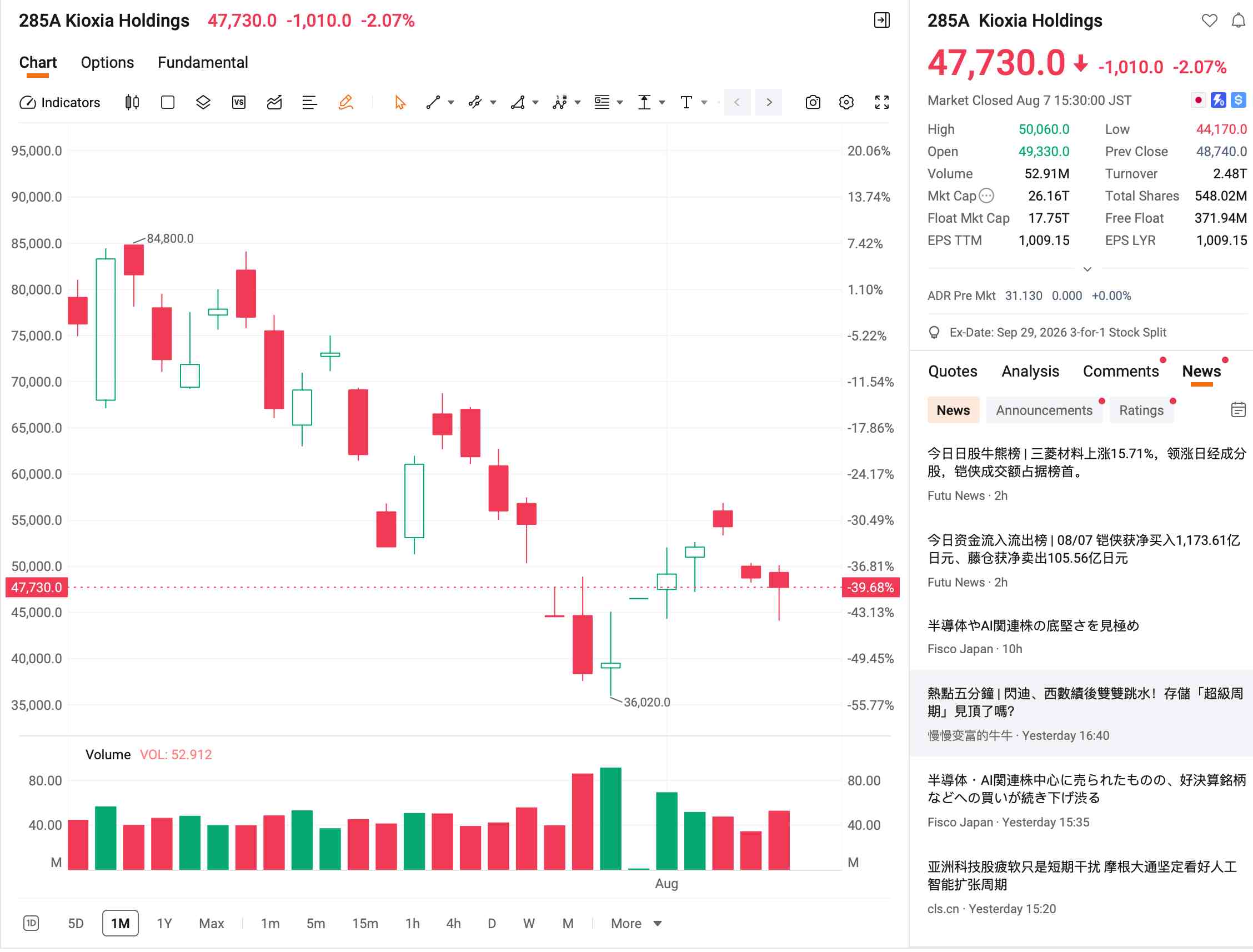
[Source: TradingView]
From a longer-term perspective, this buyback amount is equivalent to approximately 19% of the company's current market value. UBS estimates that if half of the projected net profit for fiscal year 2028 is used for buybacks, it could theoretically reduce outstanding share capital by about 19%, thereby significantly boosting earnings per share.
However, there are two warning signs that warrant vigilance.
First, the complete exit of major shareholder Bain Capital is worth pondering. It completed its liquidation near the stock's historical highs, cashing out approximately $17 billion. Even more subtle is that Bain finished its liquidation in early July, and just two weeks later, the company stepped in to buy back shares using funds originally slated for capacity expansion (the buyback amount reached 170% of the annual capital expenditure budget).
Second, the buyback time window (August to October) happens to push up the 60-day average closing price, with which management's equity incentives are precisely linked. This has raised doubts in the market as to whether the company is using shareholders' money to pave the way for management compensation.
Slowing down capacity expansion and prioritizing buybacks—is this the company actively controlling supply, or has business growth peaked? Market opinions are divided. Choosing to scale back at the peak of a cycle sometimes looks more like preparing for a downturn, and may not be the best use of capital.
Will Samsung, SK Hynix Also Follow?
Samsung and SK Hynix have shown similar moves, but the underlying logic among the three is different. Kioxia is conducting buybacks and cancellations at low levels, Samsung is buying back shares for employee incentives, while SK Hynix has yet to officially initiate a buyback, though it has made clear that it will announce a shareholder return plan in the third quarter.
Samsung's buyback is essentially to fulfill a labor agreement. Under the agreement with the union, Samsung must distribute 10.5% of its semiconductor division's projected profits over the next three years to employees in the form of stock, which is expected to require about 90 trillion won (approximately $58.6 billion) of company stock. To fulfill the commitment without diluting existing shareholders, Samsung must repurchase the corresponding volume of shares in the secondary market. The specific buyback amount and scale await further official disclosure from the company.
In July 2026, SK Hynix completed its U.S. ADR issuance and listed on Nasdaq, which diluted existing shareholder equity. While the market generally worried about pressure on the stock price, the company, backed by strong free cash flow from HBM orders, was expected to be capable of offsetting this through share buybacks and cancellations. On August 7, SK Hynix officially responded to market concerns, stating that it is actively studying shareholder return plans, including additional buybacks, and plans to finalize the details in the third quarter of this year.
As mentioned earlier, after its stock price plunged by over 60% from its peak, Kioxia utilized the lucrative profits generated from AI to conduct share buybacks and cancellations, aiming to stabilize market confidence.
Overall, this round of collective buybacks by memory giants signals that the industry is emerging from the old model of "burning cash for capacity expansion and cyclical losses" over the past decade. Against the backdrop of an unprecedented earnings explosion driven by AI demand, the industry has chosen a new path of "restraining capacity and rewarding shareholders."
Kioxia's management has clearly stated that it will control capacity growth to a level slightly above the industry average to avoid oversupply.
However, whether buybacks can sustainably support the stock price ultimately depends on the quality of earnings. Kioxia's revenue guidance for the next fiscal quarter has already fallen short of some buy-side expectations, and the liquidation and cashing out by major shareholders also reminds the market: even amidst the AI wave, the risk of valuation volatility remains very real.
Recommended Articles


