




Gold Price Forecast: XAU/USD Falls Towards $4,400 as US-Iran Conflict Raises Fed Rate Hike Risks
How to Start Trading Gold CFDs in Australia
Gold prices are facing renewed selling pressure after the United States resumed military action against Iran, highlighting an important paradox for gold traders: geopolitical escalation is not necessarily bullish for gold when it simultaneously pushes oil prices and inflation expectations higher.
Spot gold fell sharply on Monday, August 31, with XAU/USD dropping from around US$4,470 to a session low near US$4,396.60, before recovering towards the US$4,430 area.
The move came after US forces struck two Iranian launchers on Larak Island in the Strait of Hormuz. Iran subsequently retaliated with missile attacks targeting US forces in Jordan. The US Central Command described its action as “limited” and “precise”, saying the Iranian forces posed an imminent threat to shipping in the Strait of Hormuz.
The immediate market reaction was unusual.
Oil surged, while gold fell.
Brent crude climbed above US$90 a barrel, while WTI moved above US$85 as traders reassessed the risk of further disruption to energy supplies through the Strait of Hormuz.
For gold traders, this creates a crucial question:
Can XAU/USD defend the US$4,400–US$4,430 region, or is the August rally entering a deeper correction?
Gold Price Today: Why Is Gold Falling Despite Renewed Middle East Tensions?
Gold is traditionally viewed as a safe-haven asset during geopolitical crises.
So why did gold fall nearly US$80 after the latest US-Iran escalation?
The answer lies in the relationship between oil, inflation, interest rates and the US dollar.
The renewed conflict has increased concerns that the Strait of Hormuz could remain disrupted. Reuters reported that oil exports through the Gulf have recovered from their earlier lows but remain below pre-war levels, while shipping activity through the Strait remains significantly affected.
If the conflict pushes oil prices substantially higher, the resulting inflationary pressure could make the Federal Reserve less willing to ease monetary policy.
That creates a negative chain reaction for gold:
Middle East escalation → higher oil prices → higher inflation expectations → fewer Fed cuts / greater rate-hike expectations → higher yields and stronger US dollar → pressure on gold.
This is exactly what the market has started to price.
US-Iran Conflict Is Now a Double-Edged Sword for Gold
The latest military escalation creates two opposing forces for XAU/USD.
Factor 1: Safe-haven demand
A wider US-Iran conflict could increase demand for:
Gold
US dollars
Government bonds
Other defensive assets
If investors become concerned about a broader regional conflict, gold could regain its traditional safe-haven premium.
Factor 2: Inflation and higher interest rates
The more immediate problem is energy.
The Strait of Hormuz is one of the world's most important oil-transit routes. Any prolonged disruption could lift crude prices and create another wave of inflationary pressure.
Reuters reported that Brent climbed around 2.7% to approximately US$90.51 following the Larak Island strikes.
That creates a potentially bearish environment for gold.
If higher oil prices force central banks to maintain restrictive monetary policy for longer, the opportunity cost of holding non-yielding gold increases.
This is why geopolitical risk alone is no longer enough to guarantee a gold rally.
Kevin Warsh Has Changed the Gold Market's Interest-Rate Equation
Another major reason for gold's weakness is the Federal Reserve.
Fed Chair Kevin Warsh delivered his highly anticipated Jackson Hole speech on August 28 and adopted a notably hawkish tone on inflation.
Warsh said the Fed would need to act if policymakers were not confident that underlying inflation was moving back towards the central bank's 2% target. His remarks were interpreted as the strongest signal yet that another rate hike could be necessary.
The market reaction was significant.
According to Reuters, the probability of a September Fed rate hike subsequently rose to around 57%. Barclays went even further, forecasting two additional 25-basis-point rate hikes in 2026 — one in September and another in December.
This is a major change from the environment that helped gold rally earlier in August.
Why Higher Oil Prices Could Make the Fed More Hawkish
This is arguably the most important fundamental risk for gold in the coming weeks.
The US economy is currently facing a complicated combination of:
Persistent inflation
High government borrowing
Elevated Treasury yields
Geopolitical uncertainty
Higher energy prices
An uncertain labour market
If the conflict in the Middle East pushes oil substantially higher, headline inflation could accelerate.
That would make it more difficult for the Fed to justify cutting rates.
The result could be:
Higher oil → higher inflation → higher Fed rate expectations → higher Treasury yields → stronger USD → lower XAU/USD.
This mechanism explains why gold can fall even while geopolitical tensions increase.
US Dollar Becomes Another Headwind for Gold
The US dollar has also regained some support following Warsh's hawkish comments and the escalation in the Gulf.
Reuters reported that the dollar was trading near a two-week high on August 31, while markets increased expectations for a September rate hike.
This matters because gold is priced in US dollars.
When the dollar strengthens:
Gold becomes more expensive for non-US buyers.
Demand can weaken at the margin.
USD-denominated gold prices face additional pressure.
For Australian traders, this relationship is particularly important.
Australian investors should monitor both:
XAU/USD + AUD/USD
rather than looking at the US dollar gold price alone.
Global Bond Yields Remain a Key Risk
The latest gold sell-off also needs to be viewed against the broader bond-market backdrop.
Higher inflation expectations can push long-term government bond yields higher.
The problem is particularly important for the US because investors are already focused on:
Government debt
Fiscal deficits
Long-term borrowing costs
Treasury supply
Term premiums
If global bond yields rise together, gold could initially suffer because higher yields increase the opportunity cost of holding the metal.
However, there is a longer-term counterargument.
If bond-market stress eventually raises concerns about fiscal sustainability or currency credibility, gold could benefit from increased demand for alternative stores of value.
This creates a potentially important distinction:
Short term: higher yields = bearish for gold.
Medium term: fiscal stress and currency concerns = potentially bullish for gold.
Gold Price Forecast: Can XAU/USD Recover Above $4,500?
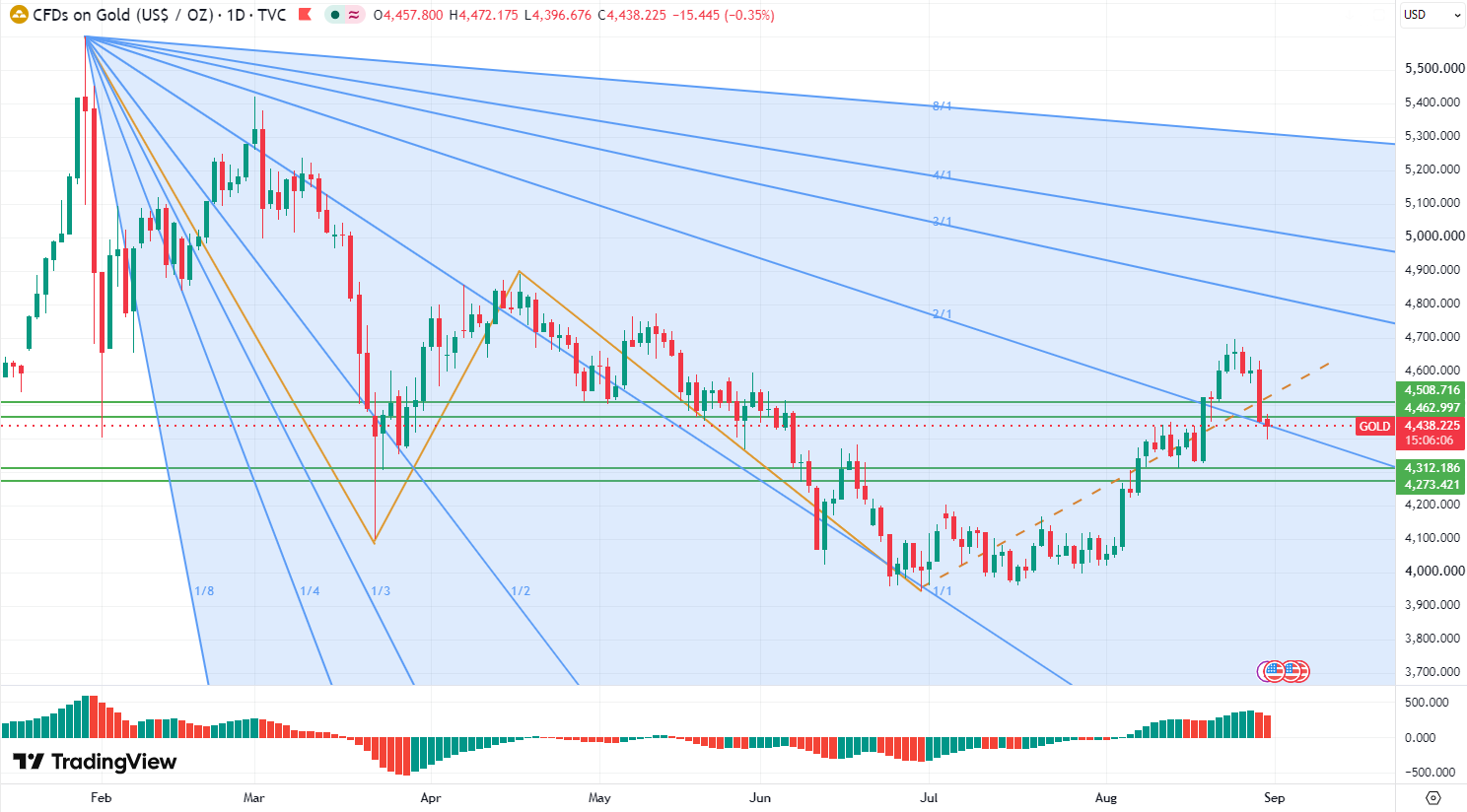
The technical picture has deteriorated significantly following Monday's sell-off.
Gold previously reached approximately US$4,696.62 on August 25, according to historical XAU/USD data. By August 28, the metal had already fallen sharply, closing around US$4,459 in some market feeds.
Monday's renewed selling therefore represents an extension of an existing correction rather than an isolated one-day move.
The key question is whether buyers can defend the US$4,400–US$4,430 region.
Key XAU/USD levels to watch
A sustained break below US$4,400 could accelerate the correction towards US$4,300, while a recovery above US$4,500 would suggest that buyers are returning.
For now, traders should pay particular attention to US August Nonfarm Payrolls, Treasury yields, oil prices and the market's changing expectations for the September Fed meeting.
The biggest variable for gold is no longer simply whether the Middle East conflict escalates.
It is whether that escalation ultimately creates safe-haven demand or a renewed inflation shock.
That distinction could determine whether XAU/USD resumes its path towards US$4,700–US$5,000, or enters a deeper correction first.
US August Nonfarm Payrolls Could Be the Next Major Gold Catalyst
The next major event for gold traders is the US labour-market report.
After July's unexpectedly weak payrolls result, markets will be watching the August data closely.
US nonfarm payrolls unexpectedly fell by 23,000 in July, while previous months were revised lower, reinforcing concerns about the strength of the US labour market.
This creates an important test for the Fed.
If August payrolls are weak
A weaker labour market could reduce the probability of another Fed rate hike.
That could:
Push Treasury yields lower
Weaken the US dollar
Support gold
XAU/USD could then attempt to reclaim US$4,500–US$4,600.
If August payrolls are strong
A strong jobs report could reinforce Warsh's hawkish stance.
That could increase expectations for a September hike and put additional pressure on gold.
The next US jobs report is therefore potentially more important than the latest geopolitical headlines.
How to Trade Gold CFDs in Australia
For Australian traders, the current market offers opportunities in both directions.
Gold CFDs allow traders to speculate on XAU/USD without owning physical bullion.
If a trader expects gold to rebound from US$4,400, they can consider a long CFD position.
If they expect the correction to continue below US$4,400, they can consider a short CFD position.
This flexibility can be particularly useful during major macroeconomic events such as:
Fed decisions
US Nonfarm Payrolls
CPI releases
Jackson Hole
Geopolitical developments
Major movements in Treasury yields
However, leverage also magnifies losses.
Trade Gold CFDs with Mitrade
Australian traders looking for flexible exposure to XAU/USD can use an ASIC-regulated CFD broker such as Mitrade.
The current setup is particularly relevant for active traders because the market is moving rapidly between macroeconomic and geopolitical catalysts.
CFDs are complex instruments and come with a high risk of losing money rapidly due to leverage. Make sure you understand how CFDs work and consider whether you can afford to take the high risk of losing your money.

Trade XAU/USD with Tight Spreads
Disclaimer: The content presented above, whether from a third party or not, is considered as general advice only. CFD trading involves significant risk of loss. Past performance does not guarantee future results. This article serves informational purposes only and does not constitute financial advice. Consider your risk tolerance before trading.


