




Gold Price Forecast September 2026: BOJ Hikes Rates as Gold Rebounds Towards US$4,400

How to Start Trading Gold CFDs in Australia
Gold has recovered from its recent sell-off, with spot prices rising almost 2% on Thursday as traders reassessed the Federal Reserve's rate hike and the outlook for oil prices.
The Bank of Japan then raised its benchmark interest rate to 1.25% on Friday, marking its highest level in 31 years. The decision came as investors monitored the impact of monetary policy normalisation, currency movements and inflation risks.
For Australian traders, the key question is whether gold can extend its recovery towards US$4,400 or whether the recent rebound will encounter resistance.
Gold Price Today Australia: Gold Rebounds as BOJ Raises Rates
The gold market is being shaped by competing forces. Higher interest rates can weigh on non-yielding assets, while easing oil prices and a weaker dollar may provide support for gold.
Latest Developments & Trader Watchlist
Why Is Gold Rising Despite Central Bank Rate Hikes?
1. The BOJ Rate Hike Was Widely Expected
The Bank of Japan increased its policy rate from 1% to 1.25% on September 18.
The decision was approved by a 7–2 vote and marked the highest policy rate in Japan since 1995. BOJ Governor Kazuo Ueda is expected to explain the central bank's outlook, including inflation, currency movements and future policy adjustments.
For gold, the impact of a BOJ rate hike is not necessarily straightforward.
A higher Japanese interest rate could influence global bond markets, currency flows and investor positioning. However, the immediate effect depends on how the decision compares with market expectations.
If traders had already priced in the hike, the announcement itself may have a smaller impact than the BOJ's forward guidance.
What does this mean for Australian traders?
Australian traders should monitor how the BOJ decision affects:
USD/JPY and broader US dollar movements
Japanese and US government bond yields
Global risk sentiment
Expectations for future central bank tightening
The BOJ decision is one factor in the gold market, rather than an independent signal that gold must rise or fall.
2. The Fed's Hawkish Policy Remains a Key Gold Risk
The Federal Reserve raised its benchmark interest rate by 25 basis points to 3.75%–4.00% on September 16.
The decision was accompanied by a signal that further tightening could follow. Reuters reported that 16 of 18 Fed policymakers projected at least one additional hike by the end of 2026.
This creates a challenging environment for gold.
When interest rates and Treasury yields rise, investors may have less incentive to hold a non-yielding asset. A stronger US dollar can also increase pressure on dollar-denominated commodities.
However, gold has still managed to rebound after the Fed decision.
The explanation is that markets do not respond only to the rate decision itself. They also respond to:
Whether the decision was already priced in
Changes in Treasury yields
Movements in the US dollar
Inflation expectations
Geopolitical uncertainty
Reuters reported that gold's rebound on Thursday was supported by a weaker dollar and falling oil prices, despite the Fed's signal that additional tightening could be required.
3. Falling Oil Prices Could Support Gold
Oil prices have recently declined from their earlier highs as concerns about supply disruptions eased.
Reports that Saudi Arabia could offer additional crude cargoes through Oman contributed to a reduction in immediate supply concerns. Reuters reported that oil prices extended their decline as the market reassessed the potential for disruptions in the Middle East.
This is relevant to gold because oil prices influence inflation expectations.
Oil prices rise
Higher energy costs can increase inflation concerns and encourage expectations of tighter monetary policy.
Oil prices fall
Lower energy prices may reduce inflation pressure and ease expectations of further rate hikes.
The relationship is not automatic, however. Geopolitical tensions can support gold through safe-haven demand even when they simultaneously increase oil prices.
For gold traders, the important variable is the interaction between oil, inflation expectations, Treasury yields and the US dollar.
Gold Price Forecast: Can Gold Reclaim US$4,400?
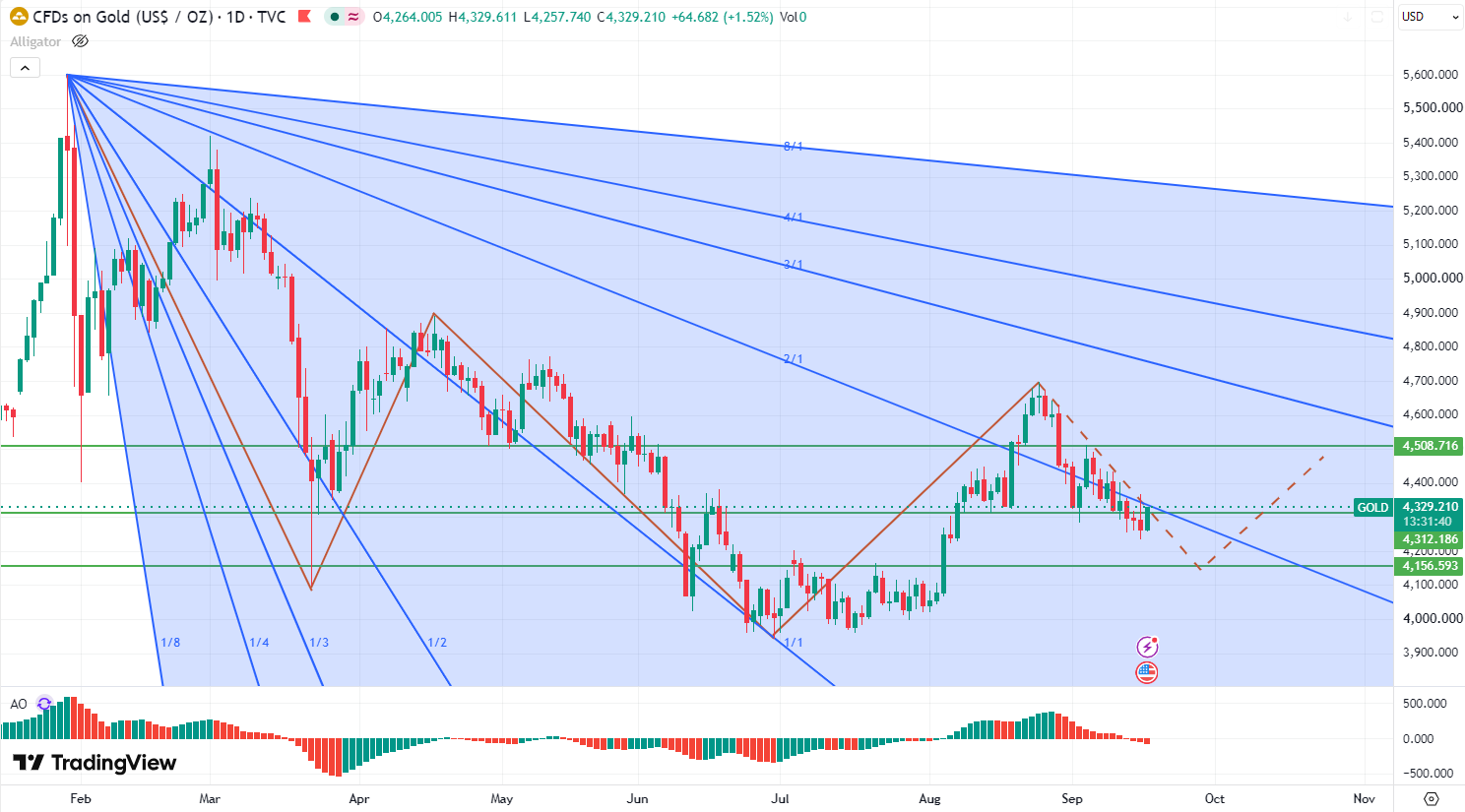
Source: Tradingview
The daily chart should be evaluated through a combination of support, resistance and price behaviour.
The key issue is whether gold can transition from a rebound into a sustained recovery.
Key technical levels
Bullish Scenario: Gold Breaks Above US$4,400
A sustained move above US$4,400 would provide stronger evidence of a short-term recovery.
However, a single intraday move above resistance would not necessarily confirm a lasting trend reversal.
The bullish scenario would be supported if:
The US dollar weakens
Treasury yields decline
Oil prices remain contained
The Fed adopts a less aggressive future policy outlook
Geopolitical uncertainty supports safe-haven demand
Bearish Scenario: Gold Fails to Hold US$4,300
The recent rebound does not eliminate downside risk.
A move below US$4,300 could indicate that the rebound is losing momentum.
If gold subsequently breaks below US$4,200, the US$4,150 area becomes a more important reference point.
These levels are illustrative technical zones based on the article's market framework. They are not guaranteed price targets.
How to Trade Gold CFDs in Australia
Gold CFDs allow eligible traders to speculate on gold-price movements without purchasing physical bullion.
Traders may take long or short positions depending on their market view.
For Australian retail clients, ASIC's product intervention rules restrict retail CFD leverage. Gold CFDs have a maximum leverage ratio of 20:1, equivalent to a 5% minimum margin requirement. The applicable conditions depend on the provider and client classification.
What to consider before trading gold CFDs
Leverage: Small price movements can have a larger impact on account equity.
Position size: Exposure should reflect the trader's risk tolerance.
Economic events: Fed decisions and inflation data can cause sharp volatility.
Stop-loss orders: These can help manage risk but may not guarantee execution at the requested price during gaps or extreme market conditions.
Trading costs: Consider spreads, overnight financing and other applicable charges.
Trade Gold CFDs with Mitrade
Follow gold-price movements and access CFD trading through Mitrade. Explore Gold CFDs and monitor rising and falling gold markets from one platform.

Trade XAU/USD with Tight Spreads
Disclaimer: The content presented above, whether from a third party or not, is considered as general advice only. CFD trading involves significant risk of loss. Past performance does not guarantee future results. This article serves informational purposes only and does not constitute financial advice. Consider your risk tolerance before trading.


