




Gold Price Forecast: Gold Rebounds Above US$4,400 — Can XAU/USD Reach US$4,700?

How to Start Trading Gold CFDs in Australia
Gold price has staged a sharp rebound, recovering above US$4,400 after briefly falling toward US$4,340. But with oil prices approaching US$100 a barrel and markets still pricing a meaningful chance of a September Fed rate hike, can gold extend its recovery — or is the rebound likely to face resistance?
For Australian traders watching XAU/USD, the next few sessions could be particularly important. The combination of US inflation data, Federal Reserve policy expectations, rising oil prices and renewed geopolitical tensions is creating a highly volatile environment for gold.
As of September 9, spot gold was trading back above US$4,400 after falling sharply following the stronger-than-expected US August jobs report. Market data showed gold around US$4,433 on September 8, while the latest session saw prices rebound from the US$4,340 area.
The key question for Australian CFD traders is therefore not simply whether gold will rise, but whether the current rebound can break above the US$4,500 resistance zone.
Gold Price Today: What Is Driving XAU/USD?
Despite the stronger US jobs data, gold has managed to recover from its recent decline.
Recent XAU/USD data shows gold fell from above US$4,600 in late August to a September low around US$4,280 before recovering. Gold then rebounded strongly in early September, with September 3 producing a gain of almost 2%.
The latest rebound suggests that buyers are still defending the lower part of the recent trading range.
The US dollar is also an important factor.
The Dollar Index has struggled around the 99 level, while the Japanese yen has strengthened sharply as expectations for Bank of Japan tightening increased. The yen's strength can contribute to broader dollar weakness and potentially support dollar-denominated commodities such as gold.
However, traders should be careful about assuming that a weaker dollar automatically means a sustained gold rally.
The upcoming US inflation data could quickly change rate expectations.
Rising oil prices are creating a new inflation problem
Oil has become one of the most important variables for gold traders again.
Brent crude recently approached US$100 per barrel, while WTI climbed toward US$94. Escalating tensions involving Iran and Houthi attacks on Saudi energy infrastructure have increased concerns about global oil supply.
This creates a complicated situation for the Federal Reserve.
Higher oil prices can push headline inflation higher. If policymakers believe the inflation shock could become persistent, they may be less willing to ease monetary policy.
That could initially be negative for gold.
But there is another potential consequence.
If higher energy prices eventually weaken consumer spending and economic growth, markets could begin pricing a slowdown in the US economy. In that scenario, expectations for future monetary easing could return, potentially supporting gold.
This is why Australian traders should watch oil, US Treasury yields and gold together, rather than analysing XAU/USD in isolation.
Middle East tensions remain a major gold-price variable
Geopolitical risk continues to provide an important underlying support for precious metals.
Reuters reported that escalating Middle East tensions pushed Brent crude toward US$100 a barrel on September 9, while markets remained cautious ahead of US inflation data and the Federal Reserve's September meeting.
Normally, an escalation in geopolitical risk supports gold through safe-haven demand.
However, the current situation is more complicated because a prolonged disruption to energy supplies could also create an inflation shock.
That means gold could experience two opposing forces at the same time:
The direction of gold will therefore depend heavily on which force dominates.
US CPI and PPI: The Next Big Test for Gold
For Australian gold traders, the next major catalyst is US inflation.
Markets are watching the August PPI and CPI reports closely because the Federal Reserve's September 15–16 policy meeting is approaching. Reuters noted that traders are looking to the inflation data for further clues after the strong August employment report.
If US inflation comes in hotter than expected
A hot CPI or PPI reading could:
Increase expectations for a Fed rate hike
Push Treasury yields higher
Strengthen the US dollar
Reduce demand for gold
Put US$4,400 support under pressure
In this scenario, XAU/USD could retest the US$4,280–4,300 region.
If US inflation cools
A softer inflation report could have the opposite effect:
Reduce Fed tightening expectations
Push Treasury yields lower
Weaken the US dollar
Improve demand for gold
Support a break above US$4,500
That would put US$4,600 and US$4,700 back into focus.
Gold Technical Analysis: US$4,400 Is the Key Battle Zone
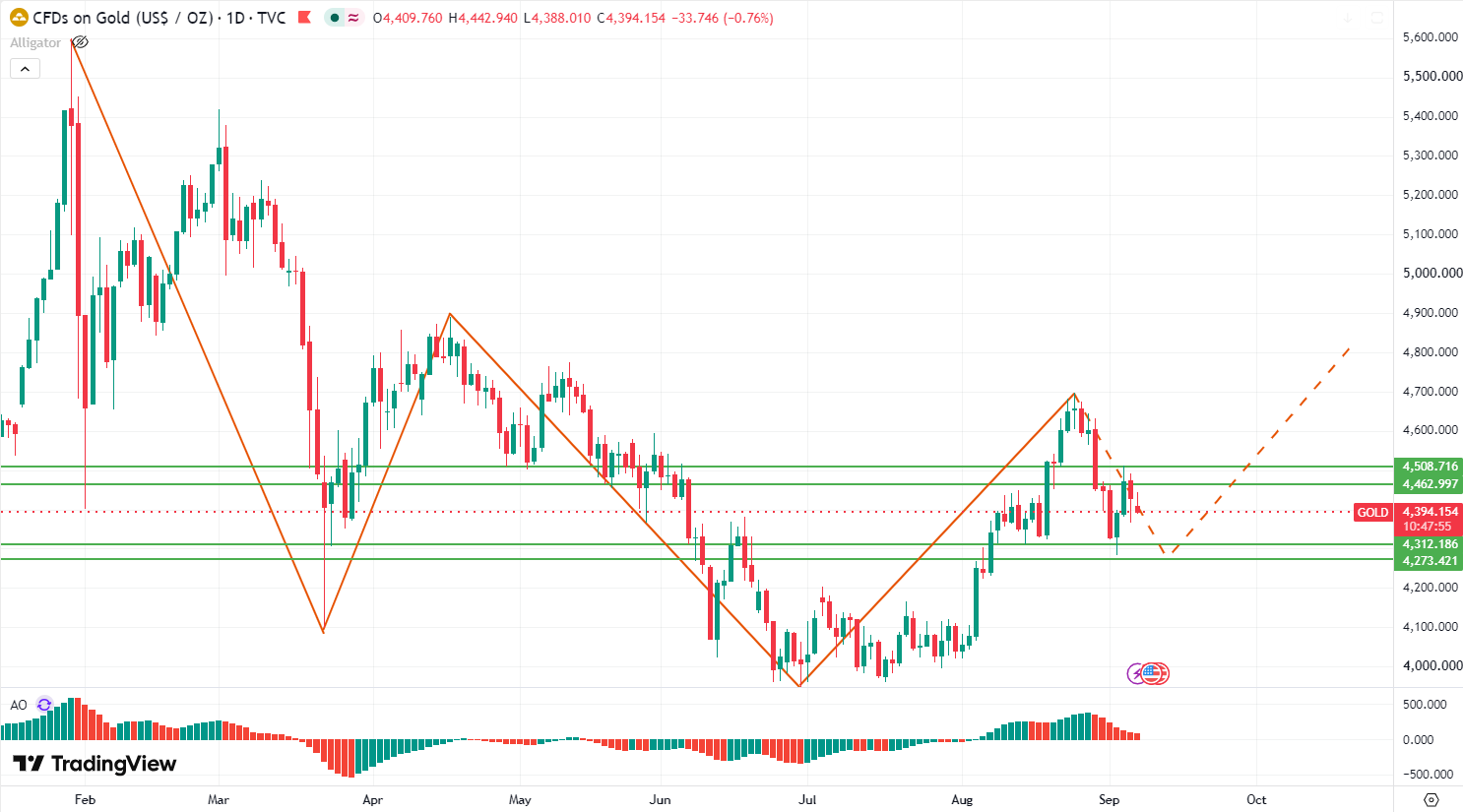
Source: Tradingview
The latest price action shows gold attempting to regain the US$4,400 area after falling toward US$4,340.
For short-term Australian CFD traders, several levels are worth monitoring.
Bullish scenario
If gold can remain above US$4,400 and subsequently break through US$4,500, bullish momentum could accelerate.
The next targets would be:
US$4,600 → US$4,700 → US$4,800
A sustained move above US$4,800 could put US$5,000 back on the radar.
Bearish scenario
If gold fails to hold US$4,400, sellers could attempt to push the market back toward US$4,300.
A decisive break below US$4,280 would weaken the medium-term bullish structure and increase the risk of a deeper correction.
For this reason, US$4,280–4,300 is arguably the most important downside zone to monitor.
How to Trade Gold CFDs in Australia
Gold CFDs allow Australian traders to speculate on both rising and falling gold prices without owning physical bullion.
Depending on the trading platform, traders can potentially:
Go long if they expect gold to rise
Go short if they expect gold to fall
Use stop-loss orders to manage downside risk
Trade gold using leverage
Monitor XAU/USD around major economic announcements
However, leverage can magnify both gains and losses.
The upcoming US CPI and Fed decision could generate significant volatility, so Australian CFD traders should consider position size, margin requirements and stop-loss levels before entering a trade.
Looking to trade the next gold move?
Trade gold CFDs with an ASIC-regulated broker and monitor XAU/USD around key US economic releases.

Trade XAU/USD with Tight Spreads
You might be interested in…
Disclaimer: The content presented above, whether from a third party or not, is considered as general advice only. CFD trading involves significant risk of loss. Past performance does not guarantee future results. This article serves informational purposes only and does not constitute financial advice. Consider your risk tolerance before trading.


