




Gold Price Forecast: XAU/USD Falls Below $4,600 Ahead of Kevin Warsh's Jackson Hole Speech

How to Start Trading Gold CFDs in Australia
Gold is facing its biggest short-term test in weeks.
After climbing to a fresh multi-month high near US$4,700 earlier this week, XAU/USD has pulled back below US$4,600 as traders take profits and wait for Federal Reserve Chair Kevin Warsh's first keynote speech at the 2026 Jackson Hole Economic Policy Symposium.
On Friday, August 28, spot gold traded around US$4,580 per ounce, down roughly 0.5% on the day. The retreat comes after gold reached approximately US$4,696.18 earlier this week, highlighting just how quickly sentiment has shifted as Treasury yields remain elevated and markets reassess the outlook for US interest rates.
The immediate question for traders is no longer simply whether gold can reach US$5,000.
Instead, the key question is:
Can XAU/USD hold above US$4,500, or will rising bond yields and a potentially hawkish Federal Reserve trigger a deeper correction?
With Warsh scheduled to deliver keynote remarks at Jackson Hole on August 28, his comments could become the next major catalyst for gold, the US dollar and Treasury markets.
Gold Price Today: Why Has XAU/USD Fallen Below $4,600?
Gold's latest decline appears to be driven primarily by a combination of profit-taking and rising uncertainty surrounding interest rates.
The metal had rallied sharply during August, supported by US dollar weakness, concerns surrounding US government debt and strong investor interest.
However, after approaching US$4,700, the rally began to lose momentum.
By August 28, traders were increasingly cautious ahead of Warsh's Jackson Hole speech, while higher Treasury yields continued to increase the opportunity cost of holding non-yielding assets such as gold. Reuters reported that spot gold fell to around US$4,580 as markets waited for signals on inflation and future Fed policy.
This means gold is currently caught between two powerful forces.
Bullish factors
Long-term concerns about US debt
Continued official-sector gold demand
Strong ETF and futures-market participation
Potential US dollar weakness
Ongoing geopolitical risks
Bearish factors
Elevated Treasury yields
Persistent inflation
The possibility of further Fed tightening
Profit-taking after August's strong rally
The outcome of this battle could determine whether the latest pullback is simply a healthy correction — or the beginning of a larger reversal.
Global Bond Yields Are Rising Again
One of the most important developments for gold traders is the renewed pressure across global bond markets.
US Treasury yields remain elevated, with the 10-year yield trading around the mid-4% area and the 30-year yield remaining above 5%. Recent reporting has linked the move to persistent inflation concerns, high government borrowing requirements and investor demands for greater compensation for holding longer-term debt.
The situation is not limited to the United States.
Japanese and European bond markets have also faced upward pressure on yields, reinforcing concerns that global financial conditions may remain tighter for longer.
For gold, rising yields are a double-edged sword.
Traditionally:
Higher bond yields can be bearish for gold because investors can earn more income from government bonds.
However, the reason yields are rising also matters.
If yields are moving higher because investors are demanding greater compensation for:
Inflation risk
Fiscal deficits
Rising government debt
Long-term policy uncertainty
then gold can still attract demand as a portfolio diversifier.
That distinction is likely to become increasingly important in the months ahead.
Japan's Inflation Adds to Global Bond Market Pressure
Japan has become another important part of the global bond story.
Tokyo's core consumer inflation accelerated for a third consecutive month in August, rising 1.8% year-on-year, according to Reuters reporting. Tokyo inflation is widely monitored as an early indicator of broader national price trends and could reinforce expectations that the Bank of Japan will continue to move cautiously towards tighter monetary policy.
The latest data adds another layer of uncertainty to global bond markets.
For years, Japan's extremely low interest rates helped support demand for overseas bonds and encouraged global carry trades.
A further shift towards higher Japanese interest rates could affect:
Japanese government bond yields
The yen
Global liquidity
Overseas bond investment flows
US Treasury demand
The Bank of Japan kept its policy rate unchanged at 1.0% in July after raising rates in June, while inflation developments remain a key factor for its future decisions.
For gold traders, the broader message is clear:
The rise in bond yields is becoming a global story rather than purely a US problem.
Kevin Warsh's Jackson Hole Speech Is the Next Major Catalyst
All eyes are now on Federal Reserve Chair Kevin Warsh.
Warsh is scheduled to deliver keynote remarks at the 2026 Jackson Hole Economic Policy Symposium on August 28. His comments will be closely watched for clues about the Fed's view on inflation, interest rates and financial conditions.
The latest core PCE data was running at 3.7% over the previous year, according to the latest Reuters market report, keeping inflation firmly at the centre of the policy debate.
What could Warsh mean for gold?
There are three broad scenarios.
Scenario 1: Warsh Delivers a Hawkish Message
If Warsh emphasises that inflation remains too high and signals that the Fed is prepared to raise rates further if necessary, Treasury yields and the US dollar could rise.
That would likely create additional short-term pressure on gold.
In this scenario, XAU/USD could test the key US$4,500 support zone.
Scenario 2: Warsh Focuses on Economic and Financial Risks
If Warsh places greater emphasis on slowing economic momentum, financial-market stability or risks associated with long-term borrowing costs, the US dollar could weaken.
That could provide fresh support for gold.
In this scenario, the pullback below US$4,600 may prove temporary, potentially opening the door for another test of US$4,700.
Scenario 3: A Balanced, Data-Dependent Message
Warsh may avoid giving the market a clear directional signal.
That could leave gold trading primarily according to movements in:
US Treasury yields
The US dollar
Inflation expectations
Global bond markets
In this case, technical support levels could become especially important.
Fed Officials Have Already Set a Hawkish Tone
The Jackson Hole meeting began against a relatively hawkish backdrop.
Several Federal Reserve officials have recently expressed concern about persistent inflation.
Kansas City Fed President Jeffrey Schmid suggested that current interest-rate settings may not be sufficiently restrictive, while other officials also highlighted the difficulty of bringing inflation back towards the Fed's 2% target.
This matters because a more hawkish Fed could keep long-term borrowing costs elevated.
Higher rates generally increase the opportunity cost of holding gold, which does not pay interest.
That said, markets are also questioning whether further tightening would actually solve the underlying fiscal issues driving pressure in the Treasury market.
This creates an important distinction:
Higher yields caused by stronger growth and tighter monetary policy
Potentially bearish for gold.
Higher yields caused by fiscal concerns and rising term premiums
Potentially supportive for gold over the medium term.
This is why gold may remain volatile rather than simply moving in a straight line.
US Debt Concerns Still Support the Medium-Term Gold Outlook
Despite the current correction, the longer-term gold story has not disappeared.
The US Treasury's recent measures to support liquidity in longer-dated bonds helped trigger part of gold's earlier rally towards US$4,700. However, these measures do not remove the underlying challenge of high government borrowing requirements.
For investors, the central issue remains whether the US can stabilise long-term borrowing costs without damaging confidence in the dollar.
This does not mean the US is entering an immediate currency crisis.
That would be an overly aggressive conclusion.
A more balanced interpretation is:
Persistent fiscal deficits and elevated long-term yields could increase pressure on the US dollar over time, particularly if investors begin demanding a larger risk premium for holding US government debt.
That environment could continue to support structural demand for gold.
Is the Gold Pullback a Buying Opportunity or a Warning Sign?
This is likely to become one of the most searched questions following Jackson Hole.
The answer depends heavily on how gold behaves around the US$4,500 area.
A controlled pullback after a sharp rally is not unusual.
In fact, if gold can consolidate above previous breakout levels, the correction could strengthen the broader technical structure.
However, a sustained break below key support would change the picture.
The next few trading sessions are therefore likely to be critical.
Gold Price Technical Analysis: Key XAU/USD Levels to Watch
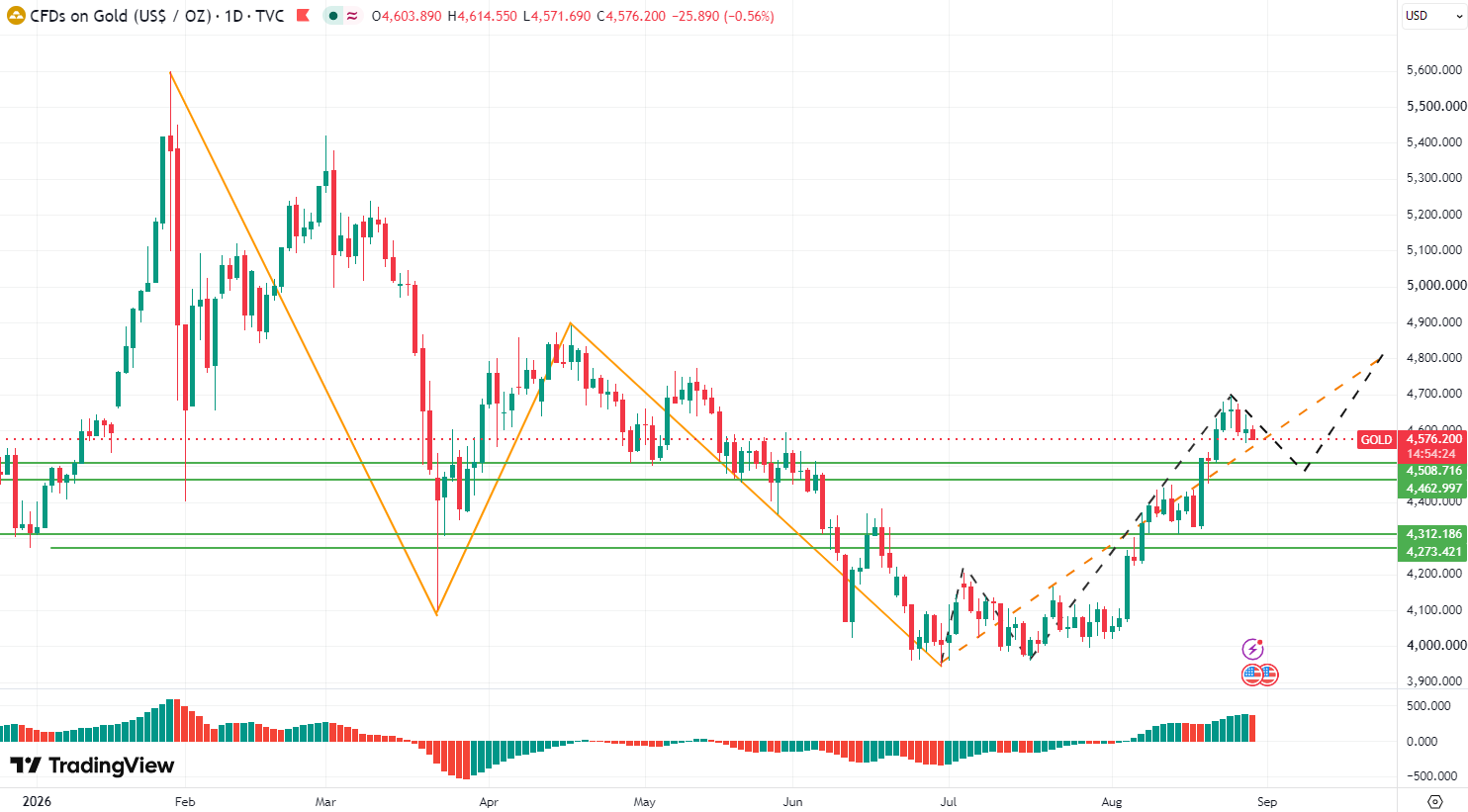
Source: tradingview
The latest decline has pushed XAU/USD below US$4,600 and increased the risk of a deeper correction.
However, gold remains above the major US$4,500 breakout zone.
Key Levels
The most important technical area is now US$4,460–US$4,500.
If gold can stabilise within this zone, the broader bullish trend could remain intact.
A rebound above US$4,600 would put US$4,700 back into focus.
However, a decisive break below US$4,460 could signal that the correction is accelerating.
In that scenario, US$4,400 could become the next major support level.
The broader August uptrend remains relevant, but momentum has clearly weakened following the retreat from the US$4,696 area.
How to Trade Gold in Australia
Australian investors can access gold through several methods, including:
Physical gold
Gold ETFs
Gold mining shares
Gold futures
Gold CFDs
Each approach involves different costs, risks and levels of flexibility.
Trading Gold CFDs
Gold CFDs allow traders to speculate on changes in the price of XAU/USD without taking physical ownership of gold.
This means traders can potentially:
Go long if they expect gold to rebound.
Go short if they expect the correction to continue.
That flexibility can be particularly relevant during high-volatility events such as:
Federal Reserve speeches
Jackson Hole
Inflation releases
Sharp movements in Treasury yields
However, CFDs are leveraged products, meaning both profits and losses can be amplified.
Trade Gold CFDs with Mitrade
For Australian traders following the latest gold price movements, Mitrade offers access to global CFD markets, including gold.
The current market setup presents two possible trading narratives: a rebound if XAU/USD successfully defends the US$4,500 area, or further downside if rising yields push gold through key support.

Trade XAU/USD with Tight Spreads
You might be interested in…
Disclaimer: The content presented above, whether from a third party or not, is considered as general advice only. CFD trading involves significant risk of loss. Past performance does not guarantee future results. This article serves informational purposes only and does not constitute financial advice. Consider your risk tolerance before trading.


