




Gold Price Forecast: Can a Weaker Dollar Push XAU/USD Towards $5,000?
How to Start Trading Gold CFDs in Australia
Gold has started the week strongly, climbing to its highest level in more than three months as the US dollar remains under pressure and investors turn their attention to a crucial week for US monetary policy.
On Monday, August 24, spot gold rose to around US$4,641 per ounce, after reaching its highest level since May 15 earlier in the session. The rally follows a strong advance last week and extends gold's recovery from the mid-year pullback.
The latest move has pushed XAU/USD further above the important US$4,500 breakout level, putting US$4,700 into focus.
However, gold is now entering a potentially volatile week.
Traders are watching two major events:
The latest US Personal Consumption Expenditures (PCE) inflation data
Federal Reserve Chair Kevin Warsh's speech at the Jackson Hole Economic Policy Symposium
The key question for traders is now:
Can gold turn the US$4,500 breakout into a sustained rally towards US$4,700 and eventually US$5,000?
Gold Price Today: XAU/USD Rises to a Three-Month High
Gold opened the week with renewed momentum.
Spot gold traded around US$4,641 per ounce, up approximately 0.8% on the day, while US gold futures also moved higher. The metal reached its strongest level in more than three months as the US dollar hovered near multi-month lows.
The weaker dollar has become one of the main short-term drivers of the rally.
When the US dollar falls, gold priced in dollars can become more attractive to buyers using other currencies.
But the latest gold rally is not only about currency movements.
Investors are increasingly focused on the interaction between:
Rising US government debt
High long-term Treasury yields
Treasury buyback operations
Persistent inflation
Federal Reserve policy uncertainty
This combination has created a favourable environment for gold as investors look for assets that may help diversify exposure to currencies and government bonds.
Could a Debt Problem Become a Currency Problem?
Persistent fiscal stress could increase the risk of longer-term US dollar weakness.
The market is already showing increased sensitivity to this issue.
The US dollar has remained under pressure despite elevated Treasury yields, suggesting that higher yields are not necessarily translating into stronger demand for the greenback.
Reuters reported that the dollar remained near multi-month lows as markets assessed Treasury debt-management plans and broader concerns surrounding US borrowing.
If this trend continues, gold could benefit from two simultaneous forces:
Investors seeking protection from inflation and fiscal uncertainty
A weaker US dollar supporting dollar-denominated gold prices
That does not mean the dollar is about to collapse.
But it does mean that currency confidence and fiscal credibility are becoming increasingly important variables for gold traders.
Higher Treasury Yields Are Both a Risk and an Opportunity for Gold
One of the most interesting aspects of the current market is that Treasury yields remain elevated.
Normally, higher yields can be negative for gold because bullion does not generate interest.
However, the market is increasingly asking a different question:
Why are yields rising?
If yields rise because economic growth is accelerating and the Federal Reserve is expected to maintain tighter monetary policy, that could be negative for gold.
But if yields rise because investors demand greater compensation for inflation, fiscal deficits and long-term government borrowing risks, gold may still attract demand.
This is why the current Treasury-market environment is more complicated than a simple:
Higher yields = lower gold
relationship.
Market commentary has increasingly focused on the possibility that higher yields reflect underlying fiscal and economic uncertainty rather than simply stronger growth.
PCE Inflation Data: The Next Major Test for Gold
The next major catalyst for XAU/USD will be the latest US PCE Price Index, the Federal Reserve's preferred inflation measure.
Markets will closely watch both headline and core inflation.
A stronger-than-expected inflation reading could:
Increase expectations for tighter Fed policy
Push Treasury yields higher
Support the US dollar
Trigger profit-taking in gold
A softer inflation reading could have the opposite effect.
It could reinforce expectations that the Fed may have more flexibility with monetary policy and potentially support further weakness in Treasury yields and the US dollar.
That could open the door for another gold rally.
This week's market calendar places PCE inflation among the most closely watched US economic releases.
Jackson Hole: What Kevin Warsh Could Mean for Gold
The other major event for gold traders is Federal Reserve Chair Kevin Warsh's speech at the Jackson Hole Economic Policy Symposium.
According to the Federal Reserve's official calendar, Warsh is scheduled to deliver keynote remarks at the 2026 Jackson Hole symposium on August 28.
Markets will be watching closely for clues about:
Inflation
Interest rates
Treasury yields
Financial-market stability
The Fed's policy outlook
Warsh has generally provided less forward guidance than previous Fed leadership, making his public remarks particularly important for markets trying to assess the future path of interest rates.
Three broad scenarios could influence gold.
A More Cautious or Flexible Fed
If Warsh acknowledges slowing economic momentum or signals flexibility on the policy path, the US dollar could remain under pressure.
That would potentially support gold.
A Hawkish Inflation Message
If Warsh focuses heavily on persistent inflation and the need for tighter monetary policy, Treasury yields and the dollar could rise.
This could trigger a correction in XAU/USD.
A Data-Dependent Message
If the Fed remains non-committal, gold could continue trading primarily on US dollar movements and Treasury-market developments.
Jackson Hole is likely to be one of the most important risk events for XAU/USD this week.
US-Iran Tensions Add Another Layer of Risk
Geopolitical risk also remains part of the gold story.
The United States has indicated that further economic measures targeting Iran and its trading partners are under consideration, while tensions in the region continue to influence energy markets and inflation expectations.
For gold, the impact of geopolitical developments can be mixed.
An escalation could increase demand for safe-haven assets.
However, higher oil prices could also increase inflation expectations, potentially forcing the Federal Reserve to maintain a more hawkish policy stance.
That could eventually push Treasury yields higher.
As a result, geopolitical risk is not automatically bullish for gold over the longer term.
The market's reaction will depend heavily on how energy prices, inflation expectations and monetary policy respond.
Gold Price Technical Analysis: Is $4,700 the Next Target?
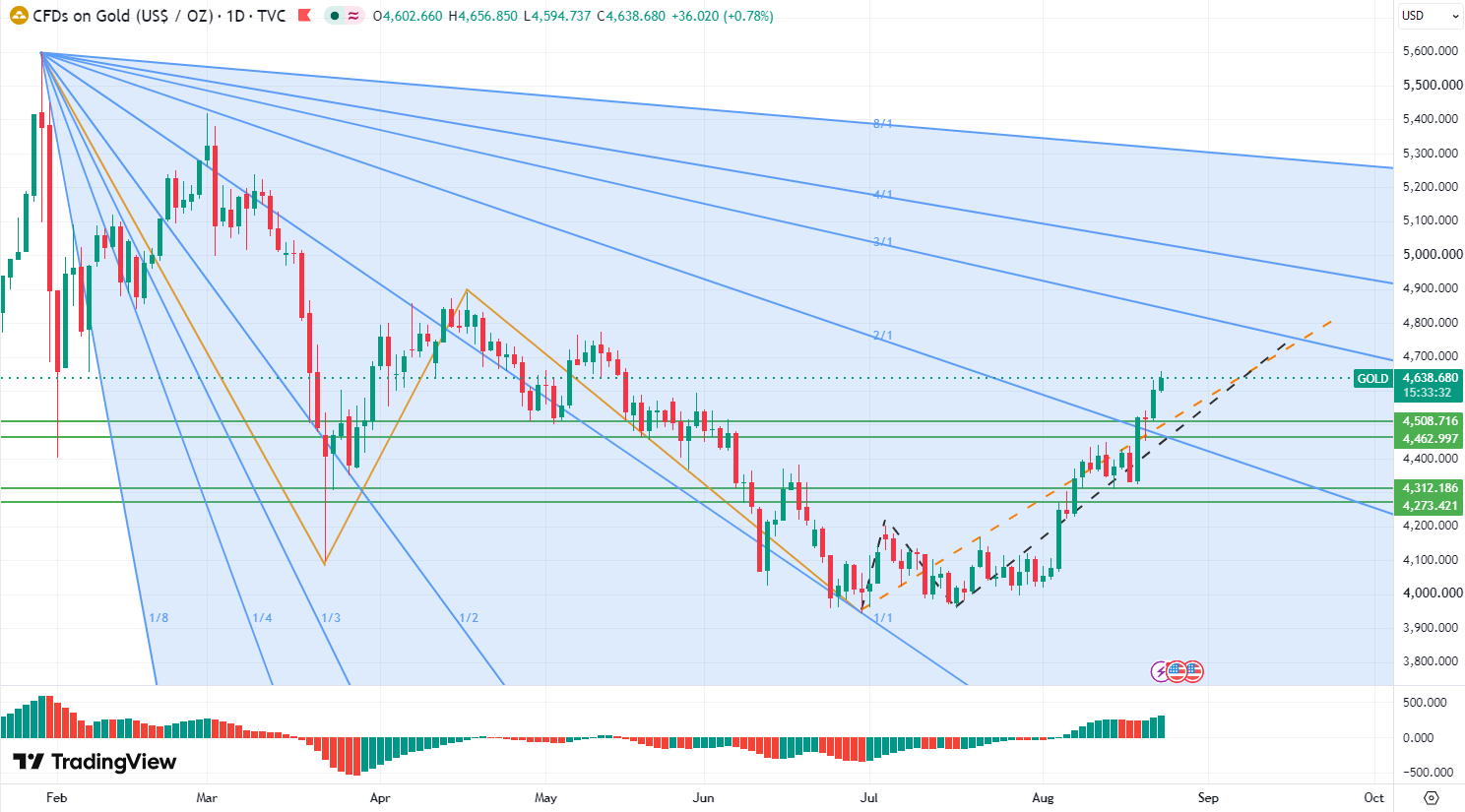
From a technical perspective, the latest rally has strengthened gold's bullish structure.
XAU/USD has now moved decisively above the US$4,500 level, which previously acted as a major psychological barrier.
The next important area is near US$4,700.
Key Gold Price Levels to Watch
The bullish structure remains intact while gold holds above the US$4,500 breakout area.
A sustained move through US$4,650 could increase the probability of a test of US$4,700.
Beyond that, US$4,800 would become the next major technical area.
The more ambitious US$5,000 target is becoming increasingly relevant as a medium-term psychological level.
However, it should not be treated as an automatic outcome.
A move back below US$4,500 would increase the risk of a deeper correction.
If US$4,460 fails to hold, traders may begin looking towards US$4,400.
How to Trade Gold in Australia
Australian investors can gain exposure to gold through several methods, including:
Physical gold
Gold ETFs
Gold mining shares
Gold futures
Gold CFDs
Each method offers different levels of flexibility, risk and market exposure.
Trading Gold CFDs
Gold CFDs allow traders to speculate on changes in the XAU/USD price without owning physical bullion.
Traders can potentially:
Go long if they expect gold prices to rise.
Or:
Go short if they expect gold prices to fall.
This can be particularly relevant during high-volatility periods surrounding events such as:
PCE inflation
Federal Reserve speeches
Jackson Hole
Treasury-market volatility
However, leverage can magnify both gains and losses.
Trade Gold CFDs with Mitrade
For Australian traders watching whether gold can break through US$4,700 or consolidate above US$4,500, Mitrade offers access to gold CFDs and other global markets through an online trading platform.
Gold CFDs allow traders to respond to both bullish and bearish market scenarios without owning physical gold.

Trade XAU/USD with Tight Spreads
What Should Australian Gold Traders Watch?
For Australian traders, analysing gold means looking beyond XAU/USD alone.
The Australian dollar can also influence local gold returns.
For example:
Gold rises in USD + AUD falls = potentially stronger gold gains in AUD
Gold rises in USD + AUD rises = Australian-dollar gold gains may be reduced
Australian traders may therefore want to monitor:
XAU/USD
AUD/USD
US Dollar Index
US 10-year and 30-year Treasury yields
US PCE inflation
Federal Reserve policy
Jackson Hole
Australian inflation data and RBA expectations
Australia's own July inflation data is also due this week, making it another potential source of volatility for AUD/USD and Australian gold investors.
Disclaimer: The content presented above, whether from a third party or not, is considered as general advice only. CFD trading involves significant risk of loss. Past performance does not guarantee future results. This article serves informational purposes only and does not constitute financial advice. Consider your risk tolerance before trading.


