



Worries about an AI bubble have grown as technology giants pour hundreds of billions of dollars into data centres and chips before AI earns enough to pay for them. Parts of the AI trade do show clear bubble signs, but the biggest AI companies earn large profits, so a sharp correction looks more likely than a dot-com-style collapse.
For investors, the question is whether this is a normal correction in a long technology cycle or the start of a bubble bursting. This article explains what the AI bubble is, weighs the evidence on both sides, compares it with the dot-com era and sets out the warning signs and scenarios to watch through 2027.
Trade AI Stocks on Mitrade Now
* Enjoy zero-commission trading and competitive low spreads—start investing with $50 today.
What Is the AI Bubble?

A stock bubble forms when prices rise far above an asset's real value because buyers expect them to keep rising. The AI bubble refers to the risk that shares linked to artificial intelligence have followed the same path. Since 2023, chipmakers such as Nvidia, cloud giants such as Microsoft, Alphabet and Amazon, and newer AI infrastructure firms have driven much of the US stock market's gains. Their prices assume that spending on data centres, chips and AI models will turn into lasting profits.
The concern is about scale and timing. The four largest US cloud companies are expected to spend about $730 billion on capital investment in 2026, up from about $410 billion in 2025, and Wall Street forecasts point to well over $1 trillion in 2027. If revenue from AI products grows more slowly than that spending, AI stock prices could prove too high.
Are AI Stocks Really in a Bubble?
Partly, yes. Parts of the AI trade show clear bubble signs, but the market as a whole is less stretched than it was in 2000, and Wall Street is divided on how far the risk goes. Fund managers in Bank of America's November 2026 survey named an AI bubble as the biggest tail risk to markets, and Goldman Sachs estimates that the AI investment boom has lifted S&P 500 earnings about 25% above trend, so profits depend on that spending continuing. Others point out that the leading AI companies earn large and rising profits, which most dot-com leaders did not. On balance, a sharp correction in AI stocks looks more likely than a market-wide collapse.
Why Some Investors See a Bubble
Investors who see a bubble usually point to four developments:
✅Spending is running ahead of revenue: Big technology companies are spending far more on data centres and chips than AI earns today. Even the fastest-growing AI developers bring in a small fraction of what they have committed to spend on computing power, so profits depend on that spending paying off later.
✅A build-out funded with debt: The largest technology companies sold almost twice as many bonds in the first nine months of 2026 as in the whole of 2025, which raises the stakes if returns disappoint.
✅Circular deals: AI suppliers increasingly invest in their own customers, with chipmakers and cloud providers buying stakes in the AI developers that rent their capacity. This can make demand look stronger than it is.
✅Heavy concentration: Technology stocks make up a larger share of the S&P 500 than they did at the 2000 peak, so a setback in AI can pull down the whole market.
Why Others See an Early-Stage Boom
Investors who see an early-stage wave rather than a bubble make three main points:
❌Real profits: Unlike most dot-com leaders, the biggest AI companies earn large and rising profits. Nvidia's quarterly revenue roughly doubled from a year earlier in late 2026.
❌Lower valuations than in 2000: The S&P 500 traded at about 19 times expected earnings in late October 2026, well below the 24 times reached in March 2000.
❌Paying customers: Businesses are paying for AI tools rather than only testing them, and most AI spending comes from cash-rich companies that can absorb a slowdown.
The weekly chart shows how quickly sentiment can turn. The Nasdaq Composite gave back its gains for the year within weeks and closed about 18% below its October 6 record on November 20, 2026.
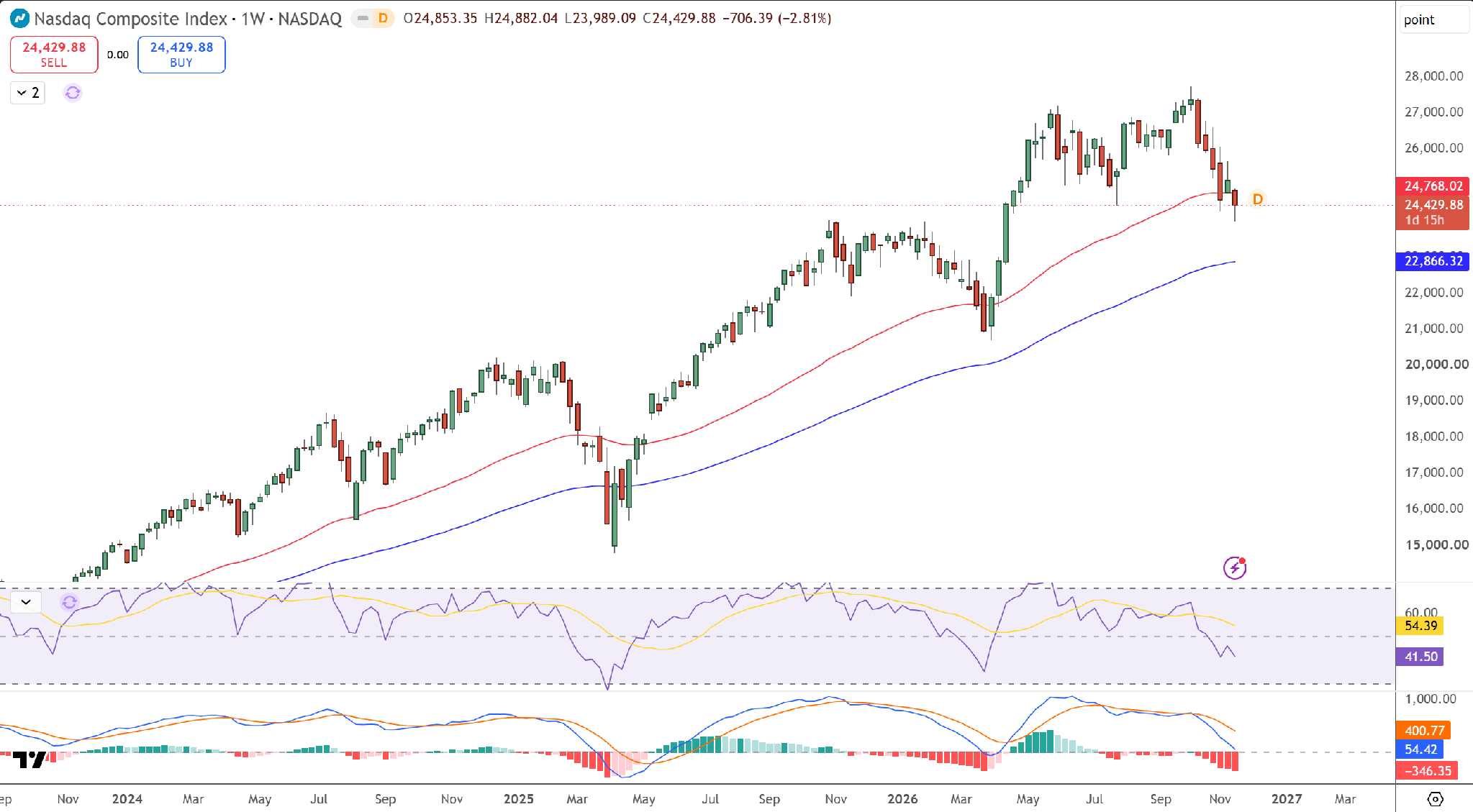
Nasdaq Composite weekly chart, September 2023 to November 2026. Source: TradingView.
The AI Bubble vs. the Dot-Com Bubble
The AI boom is often compared with the dot-com bubble of the late 1990s. The table compares the two periods on valuations, earnings, debt and concentration.
Overall, the AI boom looks less extreme than 2000 on valuations and profits, but it is more concentrated and relies more on borrowing. That points to the risk of a deep correction in AI-linked shares rather than a repeat of the dot-com collapse, although unprofitable AI companies could fall much further.
When Will the AI Bubble Burst? 5 Warning Signs to Watch
No one can time the top of a bubble, and markets can stay expensive for years. Bubbles usually burst when the money funding them slows down, so these five signals matter most through 2027:
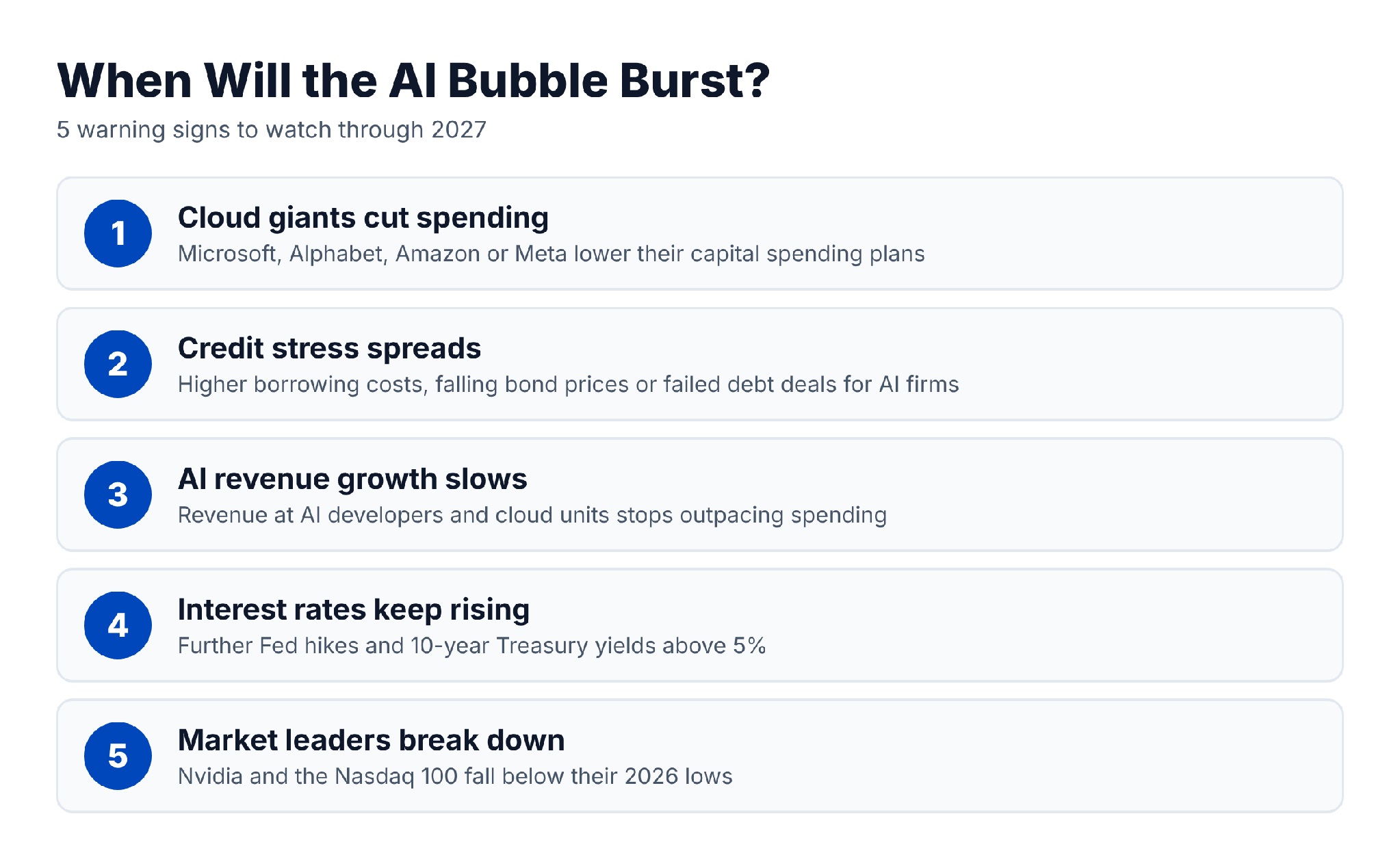
Five warning signs that the AI bubble could burst.
⚠️Cloud giants cut spending: The clearest sign would be Microsoft, Alphabet, Amazon or Meta lowering their capital spending plans in quarterly results.
⚠️Credit stress spreads: Higher borrowing costs for AI infrastructure firms, falling bond prices or failed debt deals would show lenders losing confidence. In the November 2026 Bank of America survey, 38% of fund managers named the bonds of AI cloud giants as the most likely source of a credit event.
⚠️AI revenue growth slows: If revenue at AI developers and cloud units stops growing faster than spending, the case for high valuations weakens. Nvidia's forecast of a lower gross margin, 71% to 72% for the quarter to January 2027 from 74.8%, is one figure to follow.
⚠️Interest rates keep rising: The Fed raised rates in September 2026 and signalled more hikes, while the 10-year Treasury yield rose above 5% in November. Higher rates reduce the value of future AI profits and raise the cost of debt-funded projects.
⚠️Market leaders break down: A fall in Nvidia and the Nasdaq 100 below their 2026 lows, while chip and AI infrastructure stocks keep sliding, would suggest the trend has turned.
What Happens If the Bubble Bursts? The Most Exposed Sectors
If AI spending slowed sharply, the damage would not be spread evenly. These areas would be hit hardest:
AI chipmakers and suppliers: Nvidia, AMD, Broadcom and memory makers such as Micron depend directly on data centre orders, which is why chip stocks led the November 2026 sell-off.
AI infrastructure firms: Companies that rent out computing power, such as CoreWeave, Nebius and IREN, carry heavy debt and rely on a few large customers.
New and loss-making AI companies: Recently listed AI firms have high valuations, short trading histories and large blocks of shares that insiders can sell once lock-ups end.
Data centre power and property: Utilities, power equipment makers and data centre landlords would face cancelled or delayed projects.
Broad US indices: Because AI stocks are such a large part of the S&P 500 and Nasdaq 100, both would fall. Goldman Sachs estimates that cloud companies' spending added about 12 percentage points to S&P 500 earnings growth in 2026, so a slowdown would also hit profits.
Defensive sectors such as healthcare and consumer staples, along with high-quality short-term bonds, have historically held up better during technology sell-offs. Investors worried about an AI bust could keep part of their portfolio in these areas rather than relying on technology alone, and review the balance each time the cloud giants report their spending plans.
Scenarios for AI Stocks in 2027
AI stocks have already fallen sharply from their October 2026 highs, with chipmakers leading the decline. The scenarios below describe how AI-linked shares could perform by the end of 2027. They are analytical scenarios, not institutional forecasts:
1 Bullish Case (Most 2026 Losses Recovered): The AI Build-Out Pays Off
If AI revenue at cloud providers and model developers keeps growing faster than spending, and the Fed stops raising rates in early 2027, AI stocks could recover most of their 2026 losses. Chipmakers and cloud giants would likely lead the rebound.
2 Base Case (Slow Recovery for Leaders): Winners and Losers Split
If the cloud giants slow the growth of their spending without cutting it, AI stocks could recover slowly as investors separate profitable leaders from weaker names. Leaders with strong earnings would likely hold up, while loss-making AI firms could stay well below their highs.
3 Bearish Case (Another 20% to 40% Fall): The Bubble Deflates
If one or more cloud giants cut their spending plans and credit stress spreads to AI infrastructure firms, AI stocks could fall another 20% to 40% from their November 2026 levels, with loss-making firms and recent listings falling furthest. That would be a deep correction, but still far smaller than the dot-com crash.
How Investors & Traders Can Manage AI Bubble Risk
A possible bubble is not a reason to sell every AI stock. It is a reason to size positions so that a sharp fall would not do lasting damage:
- Know your real exposure: Index funds that track the S&P 500 or Nasdaq 100 already hold large positions in AI stocks, so add these to any individual holdings.
- Rebalance and take partial profits: Trimming positions that have grown beyond their planned weight locks in gains.
- Invest in stages: Buying a fixed amount at regular intervals avoids putting all your money in at a market peak.
- Diversify beyond AI: Other sectors, regions, gold and bonds can soften the impact of a fall in technology shares.
- Use risk controls: Stop-loss orders and low or no leverage limit losses if prices fall quickly.
Short-term traders can also use contracts for difference (CFDs) to trade leading AI stocks in both directions, including hedging existing AI holdings against a sharp fall. Mitrade, authorised and regulated by the UAE Capital Market Authority, offers CFDs on US shares such as Nvidia, Microsoft and Alphabet with stop-loss and take-profit tools, and a $50,000 demo account to practise with virtual funds. Leverage magnifies losses as well as gains, so position sizes should stay small.
Risk-Free Demo Account
CMA-regulated | 24х5 | 0 commission | low spreads. Enjoy limit and stop loss for every trade!
Conclusion
AI stocks showed several classic bubble signs in 2026: record spending, more borrowing, circular deals and heavy concentration. Unlike the dot-com era, though, the leading companies earn large profits and valuations are lower. The most stretched corners of the AI market face the biggest downside, and the signals to watch are spending cuts, credit stress and slowing AI revenue.
A practical first step is to check how much of your portfolio depends on AI and set limits before the next sharp move. Traders who want to act on either outcome can use CFDs on Mitrade to go long or short on leading AI stocks such as Nvidia, Microsoft and Alphabet, with stop-loss tools and a $50,000 demo account to practise first.


When will the AI bubble burst?
No one can predict the date. A bubble usually bursts after spending or funding dries up, so watch the cloud giants' spending plans, AI credit markets and interest rates through 2027.
Is investing in AI stocks safe right now?
No stock investment is free of risk, and AI stocks were among the most volatile in the market in 2026. Spreading money across sectors, investing in stages and avoiding high leverage can reduce the damage from a sharp fall.
Is Nvidia stock a bubble?
Nvidia's revenue more than doubled to $115.8 billion in the quarter to October 2026, and the company is highly profitable, so its valuation rests on real earnings. The risk is that its sales depend on customers continuing to raise spending.
What's the difference between a correction and a bubble bursting?
A correction is a fall of 10% to 20% from a recent high, and prices often recover within months. A bubble bursting is a much deeper and longer decline, often 50% or more, as with the Nasdaq Composite's 78% fall from 2000 to 2002, because prices had risen far above their real value.
* The content presented above, whether from a third party or not, is considered as general advice only. This article should not be construed as containing investment advice, investment recommendations, an offer of or solicitation for any transactions in financial instruments.


