


SanDisk Stock Crashes Over 50% as China Chip Threat and Earnings Loom Large
TradingKey - SanDisk (NASDAQ: SNDK) is trading at $1,096.10 on Wednesday July 29, down from Monday's close of $1,278.23, with today's range $1,050.72 to $1,188.00. Shares are now more than 53% off the all-time high of $2,354.39 reached on June 25, 2026, after a 52-week run from $40.10 that briefly made SNDK one of the most extraordinary performers in the market.
The collapse began with CXMT's blockbuster Shanghai IPO on July 27, which surged 466% on debut following an $8.6 billion raise Asia's largest semiconductor IPO of 2026 reigniting fears that Chinese NAND supply could erode the pricing environment that drove SanDisk's rally. August 5 earnings are the next hard catalyst. Average analyst target: $2,217.77.
The CXMT IPO and What It Means for SanDisk's Pricing Thesis
SanDisk's bull case through the first half of 2026 rested on a single structural argument: AI-driven enterprise SSD demand was growing faster than global NAND supply, keeping prices elevated and margins wide. That argument worked while CXMT was a Chinese domestic curiosity with limited international scale. The $8.6 billion IPO that surged 466% on its Shanghai STAR Market debut changed the market's assessment of how seriously to take Chinese NAND competition.
A company that can raise $8.6 billion in a single IPO has the capital to build substantial manufacturing capacity over a two to four year horizon. Even if CXMT cannot compete with SanDisk on enterprise SSD technology today, the supply side signal is what the market is repricing.
The Apple testing report added a demand-side dimension. Reports that Apple is evaluating DRAM chips from CXMT in China even limited to domestically sold products suggest that Chinese memory technology has reached a qualification threshold with major end customers that was not previously thought achievable on this timeline. If the largest consumer electronics company in the world is testing Chinese chips, the path from testing to regional procurement is shorter than bear analysts had assumed.
SanDisk, Micron, and SK Hynix all fell sharply on this combination. SanDisk's decline was the steepest given its position as a pure-play NAND flash company without HBM diversification to provide a counterbalancing bull narrative.
The Broader Chip Sector Context
SanDisk is not falling in isolation. Micron has fallen approximately 10% over the same two-session period, SK Hynix has dropped around 14.7%, Western Digital is down approximately 7%, and the Roundhill Memory ETF (DRAM) has also declined. The selloff has a macro component alongside the CXMT-specific driver: Nvidia's circular financing concerns that triggered Monday's 5% decline and Micron's additional Apple supply chain news compounded the sector-level pressure.
SK Hynix's response was instructive — the company reported Q2 results that beat estimates and committed to increasing 2026 capex by more than 50% to above $31 billion, expressing high confidence in long-term AI demand. The market responded briefly positively to the HBM demand signal before the broader sell-off reasserted.
August 5 Earnings and What to Watch
SanDisk reports fiscal Q4 and full-year 2026 results on August 5, with Investor Day on August 13. Wall Street analysts forecast earnings of approximately $33 per share — a dramatic acceleration from approximately $0.29 a year ago — reflecting the pricing environment that prevailed through most of fiscal 2026. Revenue is expected to show strong year-on-year growth given continued enterprise SSD demand.
The critical question for August 5 is forward guidance: whether management believes the CXMT IPO and Chinese memory expansion represents a cyclical concern or a structural one, and how pricing trends in enterprise NAND have evolved through July. A guidance cut or margin warning would likely extend the selloff. A reaffirmation of the pricing environment and evidence that enterprise SSD demand remains unaffected by Chinese competition would support a relief rally from the current deeply oversold levels.
SNDK Technical Setup
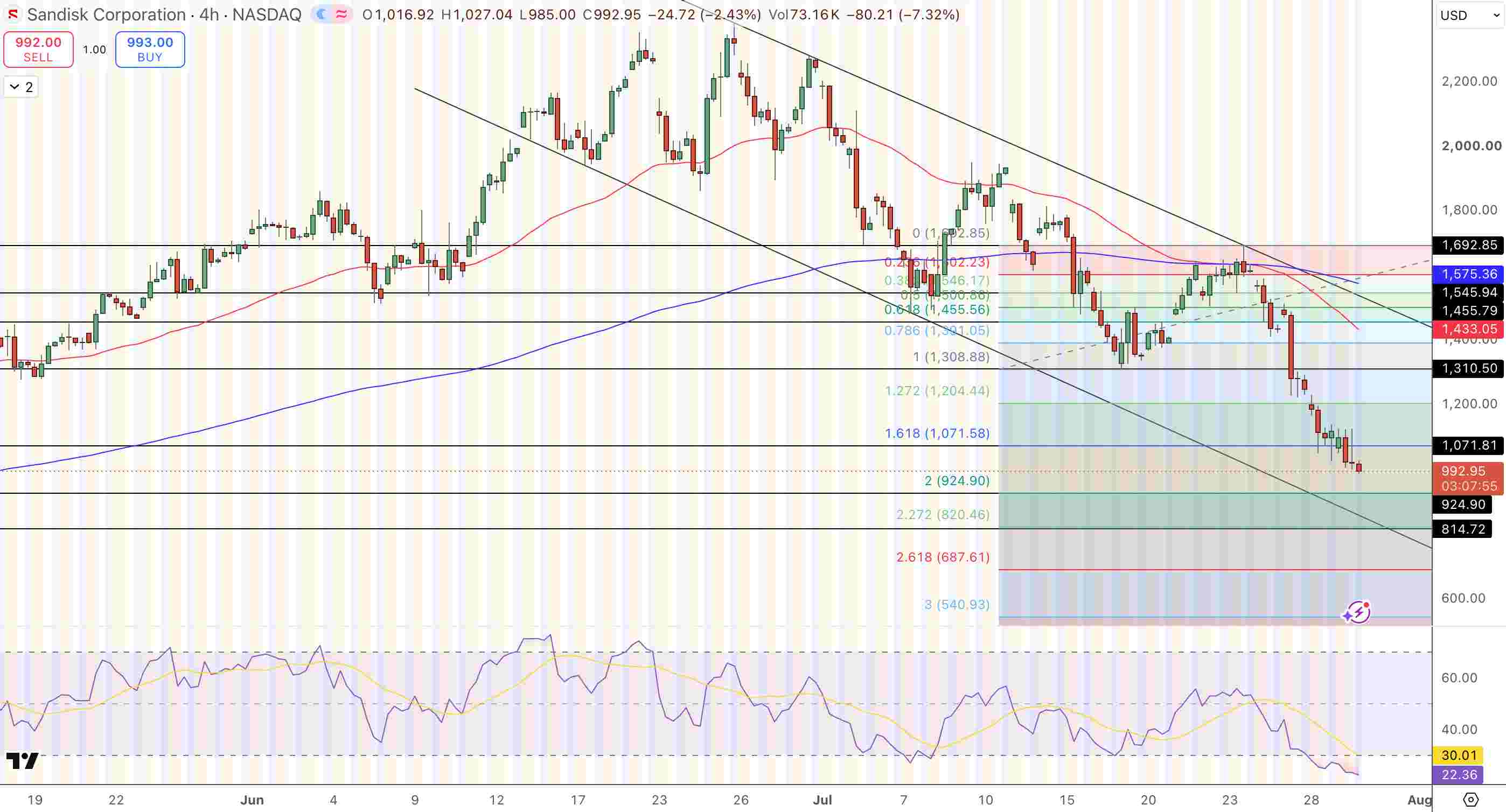
On the chart, SNDK has broken below multiple Fibonacci support levels including the 1.618 extension at $1,071.58 and is approaching the 2.0 extension near $924.90. Both the 50-period EMA at $1,433 and 200-period EMA at $1,575 are well above price and now act as resistance. RSI near 22 is in deeply oversold territory. The $1,000 psychological support is the most closely watched near-term floor — the stock has already tested it this week. Recovery resistance: $1,071.80 first, then $1,204.40 and $1,310.50. A hold above $924.90 and any bullish reversal candle heading into August 5 are the technical signals that would indicate a floor.
Source: TradingView
Key Levels
- Today: $1,096.10. Range $1,050.72 to $1,188.00. 52-week: $40.10 to $2,354.39
- Monday close: $1,278.23. Down 53%+ from $2,354.39 all-time high on June 25
- CXMT catalyst: 466% debut surge on $8.6B Shanghai IPO. Asia's largest semiconductor IPO of 2026
- Apple testing: Reports Apple evaluating CXMT DRAM chips for China-market products
- Q4 earnings: August 5. Consensus: ~$33 EPS (vs $0.29 YoY). Strong revenue growth expected
- Analyst targets: Average $2,217.77 (18 Buy, 1 Sell). Susquehanna $3,050. BofA $2,500. Wells $1,620
- Fibonacci support: 2.0 extension $924.90 (next). Above: $1,071.80, $1,204.40, $1,310.50
- Key floor: $1,000 psychological level. 200-day SMA $827
Why Did SanDisk Fall Over 50% From Its All-Time High?
SanDisk peaked at $2,354.39 on June 25, 2026 after rising from $40.10 at its 52-week low — a gain of approximately 5,776% driven by the AI-fueled NAND pricing boom. The collapse began with three overlapping catalysts in late July: CXMT's $8.6 billion Shanghai IPO surged 466% on debut, raising concerns about the long-term NAND supply picture; Apple was reported testing CXMT DRAM chips for China-market products, suggesting Chinese memory technology has matured faster than expected; and the broader semiconductor selloff triggered by Nvidia's circular financing concerns dragged high-beta chip names lower across the board. SanDisk, as a pure-play NAND company without HBM or DRAM diversification, bore the largest percentage decline.
What Should Investors Watch at August 5 Earnings?
Four specific items will determine the stock's direction after August 5. First, NAND pricing commentary: has pricing remained elevated through fiscal Q4 or have Chinese competitors already begun exerting downward pressure? Second, enterprise SSD demand update: are hyperscaler AI data centre SSD orders tracking management's prior expectations? Third, margin trajectory: gross margins in the prior quarter and the forward margin outlook will quantify how much of the bull case remains intact. Fourth, management's direct comment on CXMT and Chinese competition: any acknowledgment that pricing power is eroding would extend the selloff, while a confident dismissal backed by order book data would be the most effective catalyst for a bounce from deeply oversold levels.
Bottom Line
SanDisk is at $1,096, down 53% from its $2,354 all-time high set just five weeks ago. The CXMT IPO and Apple CXMT testing reports have repriced the NAND supply narrative that drove the stock's extraordinary rally. RSI near 22 is deeply oversold. The $1,000 psychological floor and $924.90 Fibonacci support are the levels bulls must defend. Average analyst target is $2,217.77, implying 102% upside if the fundamental thesis holds through August 5. The earnings call on August 5 is when management must address whether the pricing environment remains intact or whether the China competition concern has already changed the supply-demand balance that made SanDisk's rally possible.
Recommended Articles


