


Cathie Wood Is Buying This Up-and-Coming Biotech Stock. Should You Follow Her Lead?
Key Points
Cathie Wood continues adding shares of Beam Therapeutics.
Clinical milestones could transform Beam into a commercial biotech.
The stock remains speculative, but its upside could be substantial.
- 10 stocks we like better than Beam Therapeutics ›
Cathie Wood of Ark Invest first bought shares of Beam Therapeutics (NASDAQ: BEAM), a biotech focused on precision genetic treatments, in 2020. She's continued to acquire shares since then, with her most recent purchases last week clocking in at around $4 million.
Today, Wood's position in Beam is worth more than $300 million. That's not trivial, even for Wood. Of course, the question is: When it comes to Beam, should you follow her lead? I maintain that if you're comfortable with the risks of an early-stage biotech company, you should.
Missed Nvidia in 2009? This Rare Signal Is Flashing Again. In 2009, a "Double Down" signal flashed for a little-known chipmaker called Nvidia. For the first time in years, that same "Total Conviction" signal is flashing for a company 1/100th the size of Nvidia. Continue »
Beam is taking a different approach to gene editing
CRISPR gene editing involves cutting both strands of DNA before inserting or removing genetic material. Beam Therapeutics, however, uses a different technology called base editing.
Instead of cutting DNA, base editing changes a single DNA letter directly. Think of it as correcting a typo in a document rather than deleting an entire sentence and rewriting it. The approach is designed to make genetic edits more precise.
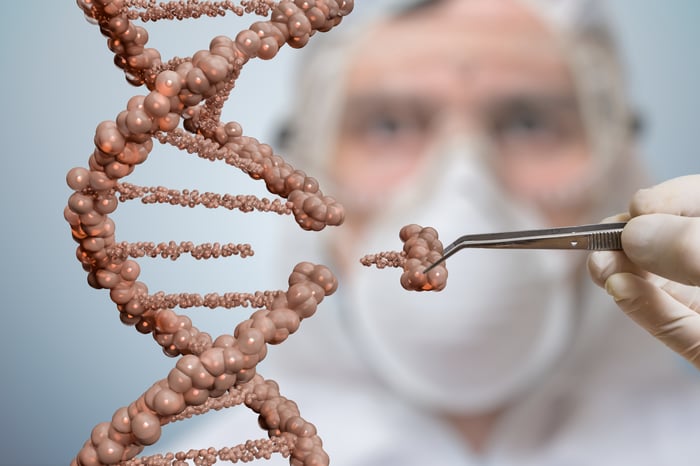
Image source: Getty Images.
That technology becomes quite attractive when you consider that among more than 50,000 documented disease-causing genetic variants, roughly 60% are point mutations (a genetic alteration in which a single nucleotide in a DNA or RNA sequence is changed), making them potential targets for base editing.
A maturing pipeline
Beam now has several clinical programs that could create significant value over the next few years. Its most advanced liver-disease program, BEAM-302, is being developed for alpha-1 antitrypsin deficiency (an inherited disorder that leaves the liver and lungs vulnerable to progressive damage).
Updated phase 1/2 data showed that a single treatment produced substantial increases in functional alpha-1 antitrypsin protein. The company has selected its optimal dose and expects to begin a global clinical trial in the second half of 2026.
Beam is also developing ristoglogene autogetemcel (risto-cel), a potential one-time treatment for sickle cell disease. So far, clinical results have been encouraging, showing that the therapy can restore healthy function to red blood cells by increasing production of fetal hemoglobin. This is a key protein that helps prevent the painful complications caused by the disease.
The company expects to file for approval from the U.S. Food and Drug Administration (FDA) by the end of 2026. If approved, risto-cel would become Beam's first commercial product, transforming it from a company focused solely on research into one capable of generating product revenue.
Beam also plans to seek FDA approval to begin human testing of BEAM-304, a potential treatment for phenylketonuria (PKU). This rare inherited disorder prevents the body from properly breaking down the amino acid phenylalanine. Left untreated, the condition can lead to serious neurological problems.
The company will also soon report its first clinical results for BEAM-301, a treatment for glycogen storage disease type Ia, a rare genetic disorder that prevents the liver from properly regulating blood sugar. While both programs are still in the early stages, they broaden Beam's pipeline and provide additional opportunities to create long-term value if the therapies prove successful.
Plenty of cash
One of the biggest risks for early-stage biotech companies is running out of cash before reaching meaningful clinical milestones. Beam appears to be in a stronger position than many of its peers.
At the end of the first quarter, the company reported $1.21 billion in cash, cash equivalents, and marketable securities. Management believes that its cash, combined with a financing deal it has with specialty finance firm Sixth Street, is sufficient to fund operations through mid-2029. That gives Beam time to advance multiple clinical programs without immediately returning to capital markets for additional financing.
Of course, none of this guarantees success. Beam Therapeutics reported a net loss of $94.3 million in Q1. Every major value driver still depends on successful clinical trials, regulatory approvals, and eventual commercialization. Failure in even one late-stage program could significantly affect the stock.
Competition also continues to intensify. Companies including CRISPR Therapeutics and Verve Therapeutics (now a subsidiary of Eli Lilly) continue advancing their own gene-editing platforms. Beam's long-term success depends not only on proving that base editing works, but also that it offers meaningful advantages over competing technologies.
Should you follow Cathie Wood?
Wood typically invests in companies capable of creating entirely new markets rather than simply improving existing ones. Beam fits that profile. The company has a differentiated gene-editing platform, multiple late-stage clinical catalysts over the next 18 months, more than $1.2 billion on its balance sheet, and enough capital to execute its development strategy well into 2029.
That doesn't make Beam a low-risk investment. Clinical-stage biotechnology rarely is. But if you're willing to accept the volatility that comes with drug development, Beam Therapeutics appears to be one of the more compelling gene-editing companies on the market today.
Should you buy stock in Beam Therapeutics right now?
Before you buy stock in Beam Therapeutics, consider this:
The Motley Fool Stock Advisor analyst team just identified what they believe are the 10 best stocks for investors to buy now… and Beam Therapeutics wasn’t one of them. The 10 stocks that made the cut could produce monster returns in the coming years.
Consider when Netflix made this list on December 17, 2004... if you invested $1,000 at the time of our recommendation, you’d have $371,842!* Or when Nvidia made this list on April 15, 2005... if you invested $1,000 at the time of our recommendation, you’d have $1,244,783!*
Now, it’s worth noting Stock Advisor’s total average return is 900% — a market-crushing outperformance compared to 207% for the S&P 500. Don't miss the latest top 10 list, available with Stock Advisor, and join an investing community built by individual investors for individual investors.
See the 10 stocks »
*Stock Advisor returns as of July 20, 2026.
Jeff Siegel has no position in any of the stocks mentioned. The Motley Fool has positions in and recommends Beam Therapeutics and Eli Lilly. The Motley Fool recommends CRISPR Therapeutics. The Motley Fool has a disclosure policy.
Recommended Articles


