


Did Meta Overbuy AI Compute, or Is the Market Asking the Wrong Question?
Key Points
Idle compute does not automatically mean Meta has reached an AI demand ceiling. Some capacity may be in the wrong place, at the wrong time, or in the wrong part of the fleet.
The real test is Meta’s behavior in the next Nvidia platform cycle. Old capacity commitments are useful evidence, but imperfect. The cleaner signal is whether Meta keeps pursuing Rubin and future platform access after investors have started questioning whether it overbuilt.
This looks more like a capex maturity signal than a capex peak. The AI build-out is shifting from “secure as much compute as possible” to “prove utilization and make the fleet earn its keep.” That raises the evidence burden, but it does not break the AI infrastructure thesis by itself.
- 10 stocks we like better than Meta Platforms ›
Recent reporting says Meta Platforms (NASDAQ: META) is exploring ways to rent out excess AI compute. That gives investors an easy worry: maybe Meta bought too much infrastructure, and the AI capital expenditure (capex) cycle is moving from shortage to surplus faster than expected.
That concern is fair. It is also incomplete.
Missed Nvidia in 2009? This Rare Signal Is Flashing Again. In 2009, a "Double Down" signal flashed for a little-known chipmaker called Nvidia. For the first time in years, that same "Total Conviction" signal is flashing for a company 1/100th the size of Nvidia. Continue »
The question is not whether Meta has some idle compute today. The better question is whether Meta still chases the next generation of Nvidia (NASDAQ: NVDA) systems with the same urgency.
If Meta keeps fighting for Rubin, and future Nvidia platform cycles through owned data centers, neoclouds, and cloud providers, then the overbought story is too simple. Meta may not be surrendering on AI capex. It may be trying to make the lower-priority parts of its compute fleet earn money while keeping the best systems for the work that matters most.
Excess Capacity Does Not Prove an AI Demand Ceiling
AI infrastructure does not come online cleanly. A hyperscaler cannot simply buy thousands of GPUs, plug them into a data center, and immediately use every chip for frontier training. Power matters. Cooling matters. Networking matters. Regional capacity matters. The shape of the cluster matters. The workload matters.
That is why idle capacity does not automatically mean Meta has reached an AI demand ceiling.
It may mean Meta has surplus capacity in the wrong place, at the wrong time, or in the wrong part of the fleet. That is different from having too much frontier compute.
A chip can be useful for one workload and still be suboptimal for another. A cluster can be good enough for generic inference and still not be the right home for frontier model training. A data center can have capacity available before Meta's internal products are ready to absorb it.
So the question is not, "Does Meta have any spare compute?"
The question is, "Does Meta have spare frontier compute?"
The Compute Waterfall
The cleanest way to think about this is a compute waterfall.
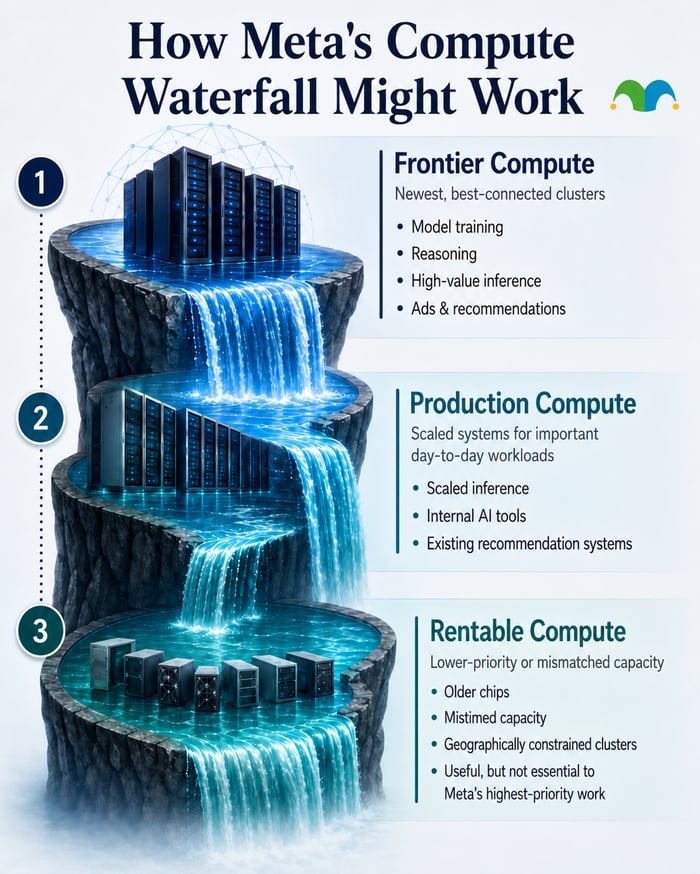
How Meta's compute waterfall might work. Image source: The Motley Fool.
At the top sits frontier compute: the newest, best-connected clusters for model training, reasoning, high-value inference, ad ranking, recommendations, and products that can move Meta's core business.
In the middle sits production compute: capacity for scaled inference, internal AI tools, existing recommendation systems, and workloads that matter but do not always need the newest platform.
At the bottom sits rentable compute: older chips, mistimed capacity, geographically constrained clusters, or systems that are useful but not essential to Meta's highest-priority internal work.
The presence of rentable capacity at the bottom does not prove saturation at the top.
That distinction matters for the AI capex thesis. The lazy version says every major AI company needs every GPU forever. The stronger version says frontier compute can remain scarce even while older, mismatched, or mistimed compute becomes rentable.
That is the more useful frame for Meta.
The Real Test Is the Next Nvidia Cycle
Meta has already raised its 2026 capital expenditure outlook to $125 billion to $145 billion, up from $115 billion to $135 billion. That is not a company publicly stepping away from AI infrastructure. It is a company still committing enormous capital to the build-out.
But investors should be careful with that evidence.
Some long-term capacity deals with neoclouds and cloud providers were signed before the current utilization debate. They show Meta wanted scarce AI capacity at the time. They do not prove Meta would sign the same deals today.
That is the trade-off in the evidence.
Old commitments are supportive, but imperfect. The cleaner signal is what Meta does next. Does Meta sign new or expanded commitments for Rubin, and later Nvidia platforms after the market has started questioning whether it overbuilt?
Does it keep using neoclouds and cloud providers as channels to reach the newest systems faster?
Does Nvidia continue naming Meta as a major next-generation customer?
Those are the signals that matter.
If Meta keeps chasing the newest capacity through every available channel, the overbought story is incomplete. If Meta slows future infrastructure guidance because utilization disappoints, the warning becomes real.
This Is a Capex Maturity Signal, Not Yet a Capex Peak
Meta's reported cloud push does not prove the AI infrastructure cycle is over. It does prove the cycle is becoming more demanding.
The first phase was about securing compute. The next phase is about proving utilization. That is a harder phase for investors because it forces every company to explain why the next dollar of capex earns an acceptable return.
For Meta, the bargain is clear. The company is spending heavily because it believes AI can improve products, ads, recommendations, models, and user experiences at massive scale. But the higher the infrastructure bill gets, the more shareholders need proof that the fleet is being used well.
Renting out spare capacity could be a smart operating move. It can help offset depreciation, create a revenue outlet for mistimed capacity, and reduce the cost of carrying infrastructure that is not yet needed internally.
But it is not automatically bullish. It can also signal that some capacity arrived before Meta had the right internal workload for it.
That is the judgment investors need to make. Is Meta showing operational discipline? Or is it exposing the first signs of overbuild? The answer depends on what happens next.
What Would Support the Thesis?
The bull case gets stronger if Meta keeps acting like frontier compute remains scarce.
The first signal would be sustained or rising AI infrastructure guidance. Meta does not need to raise capex every quarter. But if the company maintains an aggressive spending posture while explaining where the returns will come from, that supports the view that the build-out is still strategic rather than defensive.
The second signal would be new or expanded access to the newest Nvidia platforms. If Meta keeps appearing as a major buyer or launch partner for Rubin, and later systems, investors should be careful about declaring an AI capex peak.
The third signal would be continued use of neoclouds and cloud providers for the newest systems. That would suggest outside capacity providers are not being displaced. They are still useful channels for early access, faster deployment, and capacity flexibility.
The fourth signal would be better language around utilization. If Meta describes external compute sales as a way to improve fleet efficiency while reserving the best systems for internal AI work, that supports the compute waterfall thesis.
What Would Break the Thesis?
The bear case gets stronger if Meta's future language shifts from ambition to digestion.
The clearest warning would be a structural slowdown in 2027 infrastructure guidance tied to weak internal utilization. A timing shift is one thing. A demand-driven pullback is another.
The second warning would be weak rental pricing for generic GPU capacity. If multiple providers start renting older capacity at lower prices, the market may be moving from shortage to surplus in the lower tiers of compute.
The third warning would be stress in neocloud and cloud-provider contracts. Delays, renegotiations, weaker renewals, or lower pricing would suggest that long-term capacity demand was less durable than the headline backlog implied.
The fourth warning would be margin pressure that AI cannot outrun. Meta can absorb heavy infrastructure spending if AI improves ad performance, engagement, automation, and product quality. If depreciation rises faster than the business benefits, the capex story gets harder to defend.
The Investor Verdict
Meta's reported cloud push does not prove the AI capex cycle is over. It proves investors need a better vocabulary.
There is generic compute. There is production compute. And there is frontier compute. Meta may have too much of one and still not enough of another.
That is why the next Nvidia cycle matters. If Meta keeps chasing the newest systems with urgency, the overbought narrative is incomplete. If it pulls back because utilization disappoints, the warning becomes real.
For now, this looks less like a capex surrender and more like an infrastructure shuffle. The thesis is not that Meta needs every chip forever.
The better thesis is this: Meta will keep the best compute for the work that can move the business, and it will try to make the rest of the fleet pay rent.
Should you buy stock in Meta Platforms right now?
Before you buy stock in Meta Platforms, consider this:
The Motley Fool Stock Advisor analyst team just identified what they believe are the 10 best stocks for investors to buy now… and Meta Platforms wasn’t one of them. The 10 stocks that made the cut could produce monster returns in the coming years.
Consider when Netflix made this list on December 17, 2004... if you invested $1,000 at the time of our recommendation, you’d have $409,970!* Or when Nvidia made this list on April 15, 2005... if you invested $1,000 at the time of our recommendation, you’d have $1,200,223!*
Now, it’s worth noting Stock Advisor’s total average return is 916% — a market-crushing outperformance compared to 210% for the S&P 500. Don't miss the latest top 10 list, available with Stock Advisor, and join an investing community built by individual investors for individual investors.
See the 10 stocks »
*Stock Advisor returns as of July 7, 2026.
Beegee Alop has positions in Meta Platforms and Nvidia. The Motley Fool has positions in and recommends Meta Platforms and Nvidia. The Motley Fool has a disclosure policy.
Recommended Articles


