


Samsung’s Earnings Beat Triggers Slump as Kioxia Plummets Over 12%, AI Computing Power Worries Batter Storage Chip Sector
TradingKey - During the Asian session on July 7, Japanese memory chip giant Kioxia Holdings tumbled over 13% at one point, leading the decline in the Japanese and South Korean semiconductor sectors. SoftBank Group fell over 4%, while South Korean giants SK Hynix and Samsung Electronics both slumped about 10% at one point. As of press time, Kioxia was down 11.24% at 72,420 yen per share. Dragged down by the collective weakness of chip stocks, the Nikkei 225 Index fell 1.75% to 68,576.85 points.
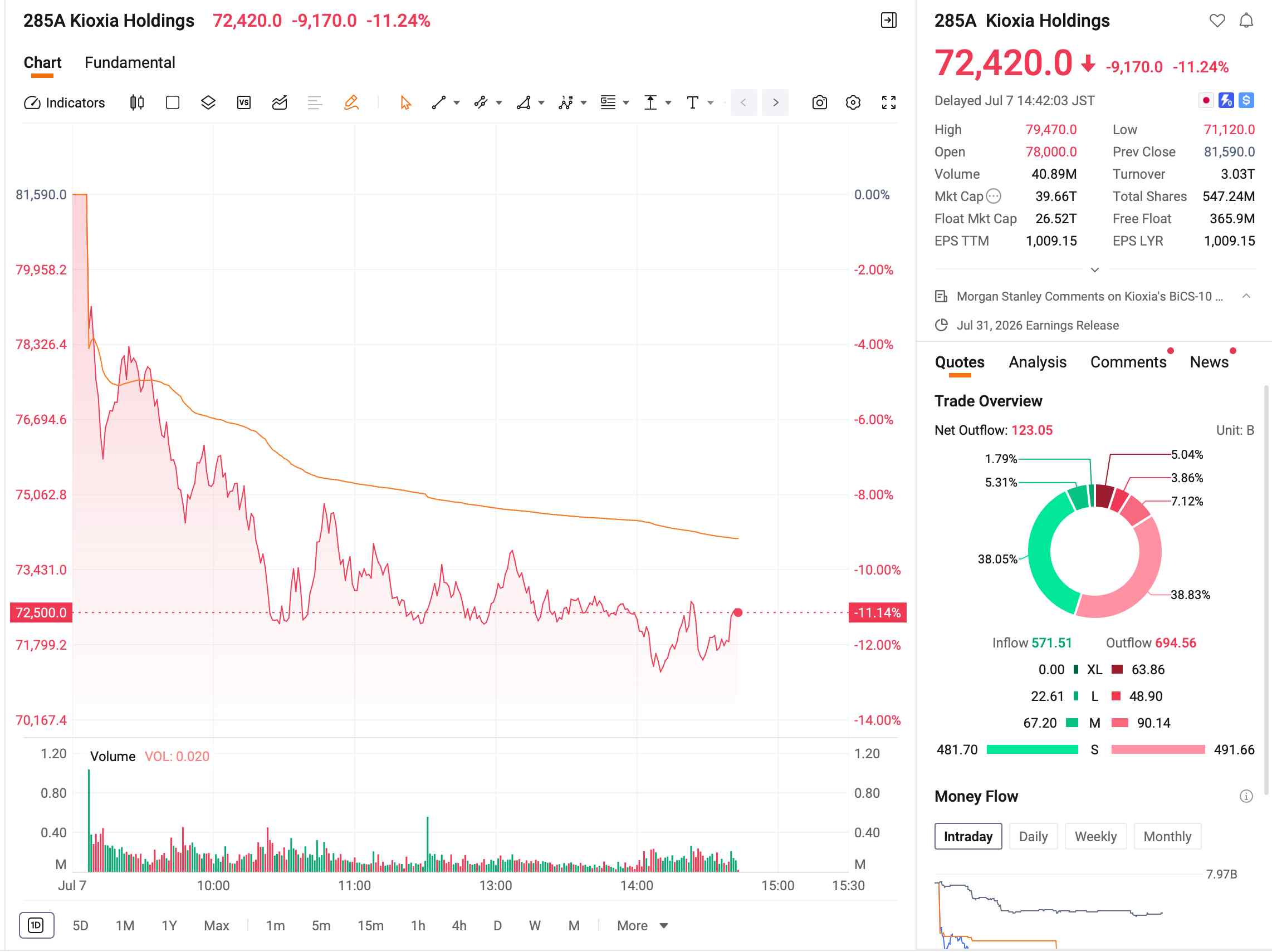
[Source: Futu]
The catalyst that triggered this round of sell-off was a "better-than-expected" earnings report from neighbor Samsung Electronics.
On the same day, Samsung Electronics released its preliminary earnings guidance for the second quarter of 2026, estimating operating profit at a whopping 89.4 trillion won (approximately $58 billion), a year-on-year surge of 1,810.2%. This exceeds the company's total profits over the past three years and far beats analysts' average estimate of 84.2 trillion won. However, this seemingly explosive report card was met with an intraday drop of up to 9% in its share price. The better the performance, the harder the fall—a typical "sell the news" logic. Analysts pointed out that the market had already fully priced in the earnings surprise brought by rising memory chip prices, and some aggressive expectations even exceeded the actual figures, leading to a rush of profit-taking.
Samsung's plunge quickly spread across the regional supply chain. Kioxia became the hardest-hit area of this round of sell-off, which is closely linked to its previously accumulated substantial gains. Kioxia's stock price hit an all-time high of 112,700 yen on June 22, representing a staggering increase from its listing price. The massive buildup of floating profits left it bearing the brunt of the blow when Samsung's "sell the news" signal propagated to the memory sector. However, Kioxia's fundamentals have not deteriorated, with NAND Flash contract prices still rising and expected to increase by another 10% to 15% in the third quarter.
Kazuaki Shimada, chief strategist at Iwai Cosmo Securities, described the decline as a "healthy correction to a distorted market," with capital rotating out of high-valuation chip stocks into value stocks that have become cheap.
A deeper concern lies in the sustainability of investments in AI computing power. Previously, Meta was reported to be planning to sell surplus AI computing power, coupled with OpenAI's optimization plans expected to significantly reduce inference costs, which has triggered vigilance in capital markets over AI investment overheating. The Bank for International Settlements had also previously issued a warning regarding this. The market is beginning to question whether cloud service providers can maintain high capital expenditures amidst the imbalance between AI computing investments and revenue returns.
Despite the severe short-term volatility, some institutions remain bullish on the medium- to long-term prospects of memory chips. Some analysts believe that since building new capacity takes several years, and AI-related demand is growing faster than capacity expansion, the current price hike cycle may be more structural than traditional cycles. However, before Samsung officially releases its full financial report and subsequent guidance, it will take time for market sentiment to recover.
Recommended Articles


