


Rivian (RIVN) Stock Price Forecast 2026: Q2 Beat Raises Guidance to 70,000 — Short Setup Intact?
TradingKey - Rivian Automotive (NASDAQ: RIVN) published its production and delivery stats for Q2 2026, showing a true beat at 12,613 vehicles made and 12,194 shipped, beating out the expected 9,000-11,000 volume driven by growth in both R1 consumer and EDV commercial vans, as well as the first deliveries of the R2. The guidance for deliveries in full year 2026 was bumped up from 62,000-67,000 vehicles to 65,000-70,000, the first such increase this year, while shares sit on the 4H chart at $18.68 with the RSI at 72.31 nearing overbought territory and a double top set to form under $19 that forecasts lower prices to $15.44 on a breakdown today, with the fundamental driver and the technical pattern going in different directions.
Q2 Beat and Guidance Raise — What the Numbers Say
But there's more to the 12,194 vehicles delivered during Q2 2026 vs. 9,000-11,000 vehicle guidance than you initially see, for two reasons.
First, the beat came from multiple sources: EDV commercial van volume increases (including Amazon), R1 consumer volume increases, and the launch of R2 deliveries all at the same time. It is more meaningful to have a beat from multiple sources than it is to have a beat from just one source.
Second, the increased guidance from 64,500 to 67,500 suggests that production for Q3 and Q4 is expected to outpace Q2, meaning the company needs to ship 42,000 to 46,000 vehicles during Q3 and Q4 to meet its guidance (12,613 vehicles produced during Q2 2026, a bit higher than 12,194).
Therefore, to reach the 67,500 vehicles guidance, the company needs to grow to 14,000 to 15,300 vehicles per quarter during Q3 and Q4 (or a 15%-25% growth quarter-over-quarter).
Q1 Financials and the Real Challenge — Automotive Gross Margin Turned Negative
What this boils down to isn’t the fact that the guidance on vehicles delivery was beaten, rather that the Q1 fiscal 2026 result really shows the weight of that cost structure, as they are trying to get the R2 platform ramping and the factories ready: auto gross margin was a $92M profit in Q1 of this year last year to a $62M loss in the last one, a negative change in cost of $154M which was mostly driven by a higher cost of revenue (which includes the R2 launch costs, tooling amortization and the mix impact to ASP’s on auto business).
Meanwhile, the software and services was able to be somewhat of an offset in Q1, up 49% year over year to $473M revenue, $181M gross profit, which demonstrates that recurring software/connected services revenue is established and scaling along with the volume, regardless of what’s going on with the auto gross margin.
The end result was first quarter 2026 total revenues of $1.38B (which just topped consensus estimates), a net loss of $416M which is lower than the prior year's first quarter net loss of $518M and $2.85B of cash plus $1.99B of short-term investments equaling $4.84B of cash available, not to mention the additional $1B of the VW equity investment in March which came out alongside the first quarter earnings call giving the balance sheet the extra buffer.
Guidance of -$2.1B to -$1.8B in full-year adjusted EBITDA and $1.95B to $2.05B in capex reflects the expected R2 ramp-up and Georgia plant building cost, which means Rivian will not achieve full-year profitability in 2026 and instead is just going to ramp up volume deliveries, with management noting that they do expect to reach a sustainable level of positive automotive gross margins in the longer term.
RIVN Technical Setup — Double Top Below $19, RSI 72.31, Short Target $15.44
The stock on the 4H chart at $18.68 appears to be setting up a double top with recent red candlestick action showing pressure near the $19 level, with the RSI at 72.31 near overbought territory with distribution signs showing in the volume; the double top would target lower prices to the $15.44 to $14.32 area, while support levels from $17.52 to $15.82 are the next major levels to watch to defend. The short below $18.47 targets $15.44 with a stop at the close above $19.00 level.
A strong Q2 delivery beat with raised guidance is fundamentally positive, but if the market is able to absorb that good news and the company moves to a close above $19.00 with rising volume, then the double top pattern is invalidated and we will look at a new pattern to take shape.
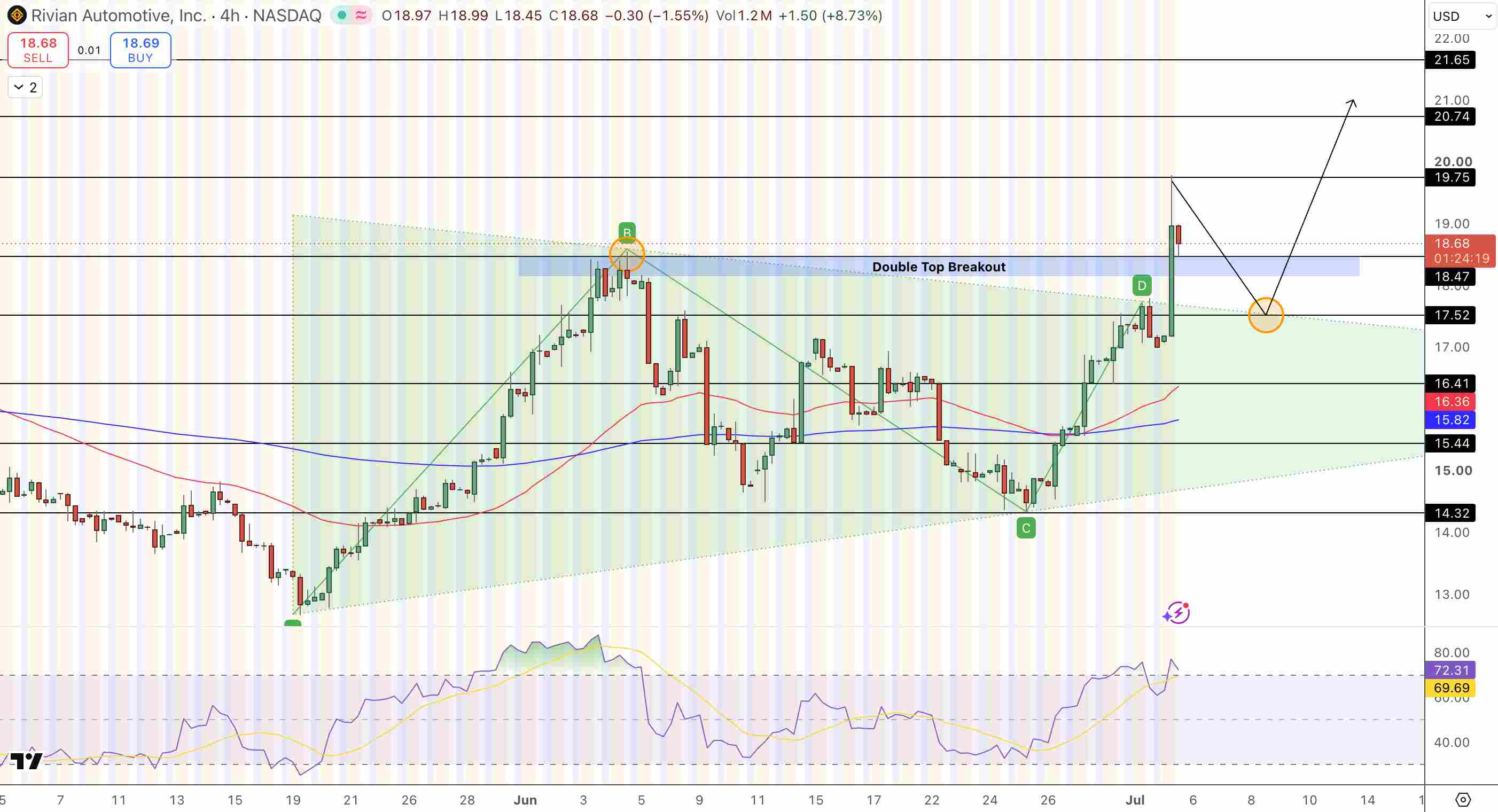
Short entry: Below $18.47, confirming the double-top breakdown.
Target: $15.44, based on the double-top measured move.
Stop-loss: Close above $19.00, invalidating the double-top pattern.
Q2 2026: Delivered 12,194 vehicles, beating guidance of 9,000–11,000. First R2 deliveries.
FY 2026 guidance: Raised to 65,000–70,000 vehicles from 62,000–67,000.
Liquidity: $4.84 bn in cash and short-term investments, plus a $1 bn investment from Volkswagen.
Why Did Rivian Raise Its 2026 Delivery Guidance?
Rivian (RIVN) raised its full-year 2026 delivery guidance in July 2, from the previous range of 62,000 to 67,000 vehicles, to 65,000 to 70,000 vehicles. In Q2 2026 the company delivered 12,194 units, beating a previously issued target of 9,000 to 11,000 units. The beat reflects strong volumes in EDV vans for Amazon and R1 consumer vehicles, as well as the initial R2 deliveries. The updated guidance requires an additional 42,000 to 46,000 vehicles over the second half (Q3/Q4), implying a 15% to 25% sequential increase from H1.
Is RIVN a Short or Buy at $18.68?
Double top chart with resistance below $19 (RSI 72.31, slightly overbought) is looking for a breakdown below $18.47, first target is $15.44, stop is $19.00. The Q2 delivery beat, R2 on track, and raised guidance make a straightforward bear thesis unwise. But the Q1 2026 automotive gross margin was -$62 million. The updated full-year adjusted EBITDA guidance is -$1.8 to -$2.1 billion with full-year capex of $2.0 billion. A RIVN close above $19.00 on a high-volume beat to the upside invalidates the double top and we shift to bullish. $19.00 is the pivot.
Bottom Line
We had Q2 2026 delivery beat with deliveries of 12,194 units, R2 deliveries started as guided, and RIVN raising 2026 full-year deliveries to 65,000 to 70,000 on July 2, the same day as double top at $18.68, RSI 72.31, slightly overbought. The guidance raise has sound fundamentals: EDV, R1, and R2 are all contributing to Q2. Double top technical breakdown target is $15.44 if RIVN breaks below $18.47, stop is $19.00. RIVN must close above $19.00 to invalidate the double top.
The Q1 2026 negative automotive gross margin is the bottom line to the bull case that we expect will hold back the stock’s upside until volume delivers the economies of scale that reduce cost per vehicle to a positive gross margin level, at these valuation multiples.
Recommended Articles


