


Gold struggles for momentum as US-Iran tensions, hawkish Fed bets weigh
- Gold gains remain limited as hawkish Fed expectations and geopolitical tensions keep the US Dollar supported.
- US-Iran tensions revive concerns over energy-driven inflation.
- Technically, XAU/USD remains in a corrective phase, with upside capped below the 20-day Bollinger middle band.
Gold (XAU/USD) consolidates modest gains on Thursday, although upside remains limited as renewed hostilities in the Middle East revive concerns over energy-driven inflation and reinforce expectations that the Federal Reserve (Fed) may need to raise interest rates.
At the time of writing, XAU/USD is trading around $4,102, up 0.66% on the day.
The United States (US) and Iran exchanged another round of attacks overnight. US President Donald Trump said on Truth Social, "This is in retribution for yesterday's bombing of ships by Iran. If it happens again, it will get much worse!"
On Wednesday, Iran reiterated its threat to close the Strait of Hormuz if fresh attacks occur, raising concerns that global Oil flows could once again be disrupted after improving following last month's interim peace agreement.
The latest escalation has weakened hopes for a permanent peace agreement, hurting risk sentiment and keeping safe-haven demand intact for the Greenback. The US Dollar Index (DXY), which tracks the Greenback against a basket of six major currencies, trades around 101.00 after touching an intraday low of 100.79.
Meanwhile, hawkish Fed expectations are providing additional support to the USD. According to the CME FedWatch Tool, markets are pricing in a 63% chance of a rate hike at the September meeting. Higher borrowing costs tend to weigh on Gold because the metal does not offer yield.
Analysts at OCBC Bank noted, "While geopolitics would normally offer some support for gold, the latest move has worked more through the oil, inflation and rates channel." They added, "Near term, unless oil stabilises or Fed/rates concerns ease, rallies in gold and silver may still struggle to sustain."
Minutes of the Fed's June 16-17 meeting showed officials remained divided on the interest rate outlook, although some saw a case for higher rates if inflation remains elevated.
Technical analysis: Sellers retain control below the Bollinger middle band
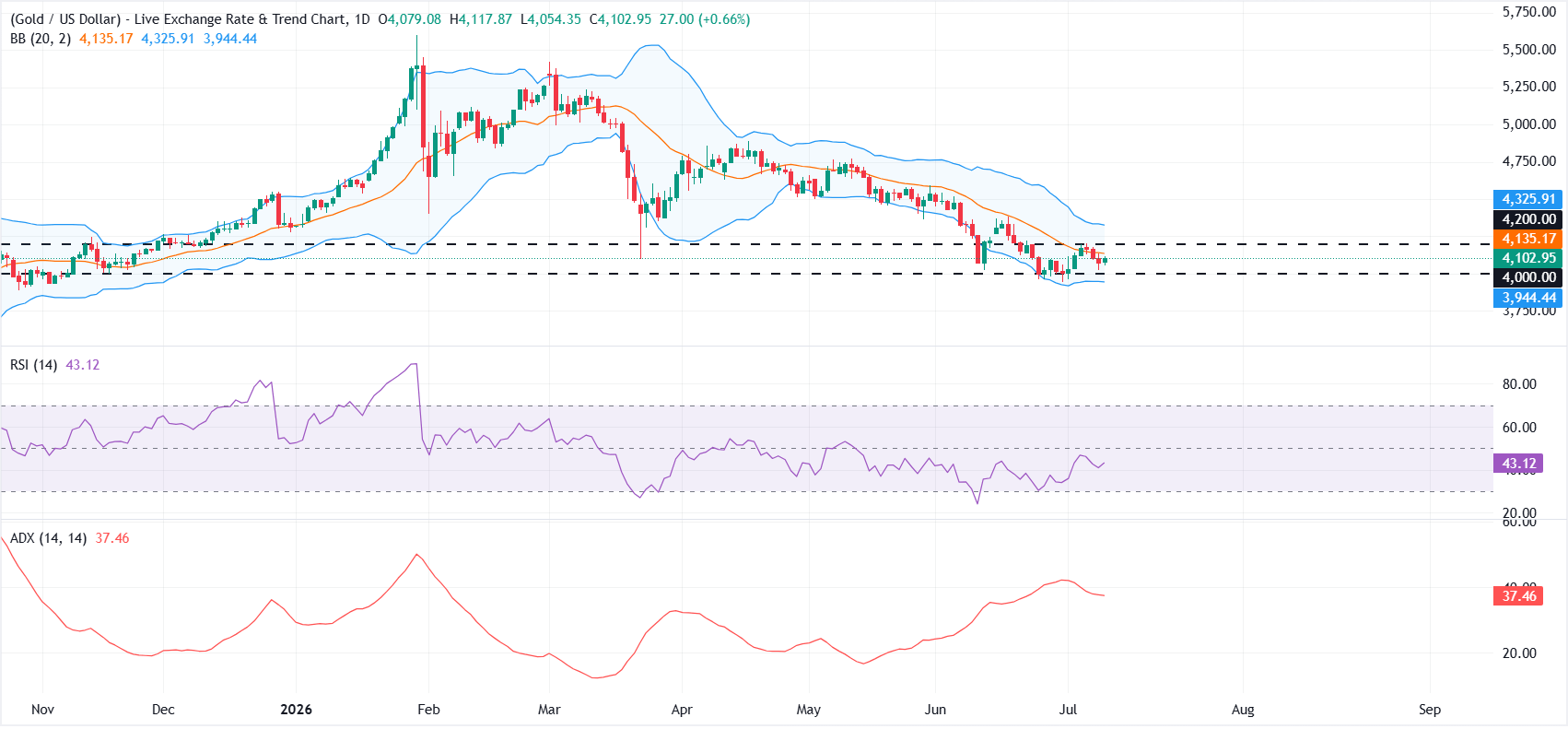
On the daily chart, XAU/USD keeps a bearish near-term bias, with price sitting below the 20-day Simple Bollinger middle band at $4,135. The Relative Strength Index (RSI) at 43.12 remains below the neutral 50 mark, hinting at subdued upside momentum, while the Average Directional Index (ADX) around 37 suggests a reasonably strong prevailing trend despite the latest consolidation.
On the topside, initial resistance emerges at the Bollinger middle band around $4,135, followed by the horizontal barrier at $4,200 and then the Bollinger upper band near $4,326.
On the downside, immediate support is seen at the psychological $4,000 handle, ahead of the lower Bollinger band clustered around $3,944, where buyers could attempt to slow the current corrective phase.
(The technical analysis of this story was written with the help of an AI tool. Know more.)
Gold FAQs
Gold has played a key role in human’s history as it has been widely used as a store of value and medium of exchange. Currently, apart from its shine and usage for jewelry, the precious metal is widely seen as a safe-haven asset, meaning that it is considered a good investment during turbulent times. Gold is also widely seen as a hedge against inflation and against depreciating currencies as it doesn’t rely on any specific issuer or government.
Central banks are the biggest Gold holders. In their aim to support their currencies in turbulent times, central banks tend to diversify their reserves and buy Gold to improve the perceived strength of the economy and the currency. High Gold reserves can be a source of trust for a country’s solvency. Central banks added 1,136 tonnes of Gold worth around $70 billion to their reserves in 2022, according to data from the World Gold Council. This is the highest yearly purchase since records began. Central banks from emerging economies such as China, India and Turkey are quickly increasing their Gold reserves.
Gold has an inverse correlation with the US Dollar and US Treasuries, which are both major reserve and safe-haven assets. When the Dollar depreciates, Gold tends to rise, enabling investors and central banks to diversify their assets in turbulent times. Gold is also inversely correlated with risk assets. A rally in the stock market tends to weaken Gold price, while sell-offs in riskier markets tend to favor the precious metal.
The price can move due to a wide range of factors. Geopolitical instability or fears of a deep recession can quickly make Gold price escalate due to its safe-haven status. As a yield-less asset, Gold tends to rise with lower interest rates, while higher cost of money usually weighs down on the yellow metal. Still, most moves depend on how the US Dollar (USD) behaves as the asset is priced in dollars (XAU/USD). A strong Dollar tends to keep the price of Gold controlled, whereas a weaker Dollar is likely to push Gold prices up.
Recommended Articles


