


The Japanese Yen gets a gift from American inflation and hands it straight back
- USD/JPY trades near 162.00, flat on the session after a round trip between 162.42 and 161.90.
- A soft producer-price print buys the Yen half a figure; the 275-basis-point carry takes it back within hours.
- Tokyo's intervention silence keeps the topside honest below the cycle high at 162.84.
USD/JPY has spent Wednesday doing an impression of volatility without any of the substance. The pair climbed to 162.42 through the London morning, was knocked down to 161.90 by the New York afternoon, bounced back to 162.28, and trades at 162.11 at writing, which is precisely where it opened. The daily bounds sit comfortably inside the territory that has held since the Yen printed its weakest levels in almost four decades at the end of June, and a whippy session that resolves to zero is this range's signature move.
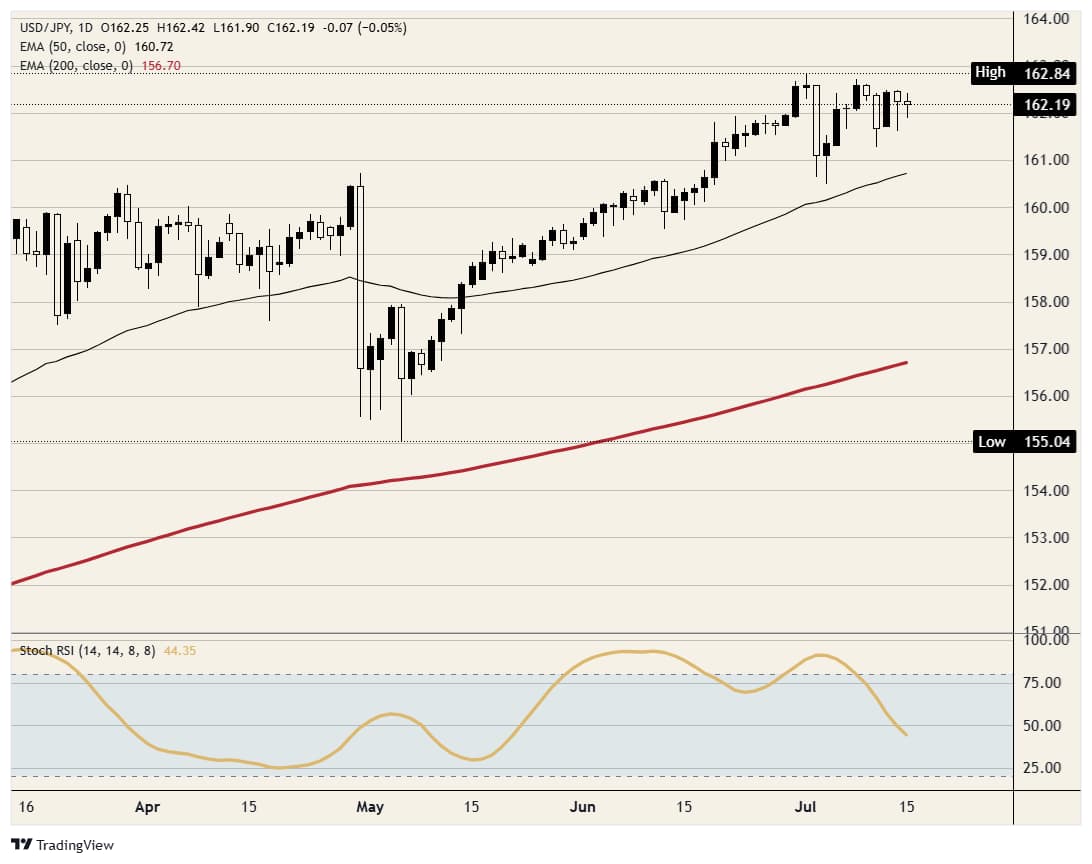
For all the intraday noise, the bigger picture has not moved a millimetre. The pair has spent July oscillating between roughly the 161.00 area and the 162.84 top after a two-month climb from below 158.00, and every dip inside that window has been bought at a higher level than the last. Momentum has cooled while price has refused to fall, which is what consolidation under a ceiling looks like rather than distribution ahead of a reversal.
A gift the Yen cannot hold
The June American Producer Price Index (PPI) fell 0.3% MoM and slowed to 5.5% YoY against a 6.2% consensus, and for roughly five hours the Yen traded like a currency with a pulse, dragging the pair from the mid-162s to the session low at 161.90 by 18:00 GMT. The Federal Reserve (Fed) Chair's Capitol Hill testimony at 14:00 GMT was scored neutral rather than hawkish, which gave the move room to breathe, and every other Dollar pair on the board was telling the same soft-Dollar story by mid-afternoon.
The market then remembered the arithmetic that has governed this pair all year. The Fed holds at 3.75% behind a dot plot that added hikes in June, the Bank of Japan (BoJ) sits at 1.00% after its own June increase, and a 275-basis-point gap pays Yen shorts every single day regardless of what one producer-price report says. A hawkish-scored Fed speech at 17:00 GMT was all the excuse required; the pair reclaimed the 162.00 handle within two hours, and the session's entire drama amounted to a rounding error.
Tokyo says nothing, which says plenty
The Finance Ministry burned a record 11.7 trillion Yen defending the currency between late April and late May, is suspected of a stealth follow-up in early July, and has stopped signalling operations in advance altogether. The market increasingly treats the low 162s as the ambush zone, which goes a long way toward explaining why rallies above 162.50 keep dying of natural causes while the cycle high at 162.84 stands untouched. Nobody wants to be the last short Yen position filled before the next unannounced sweep.
The war is doing Tokyo no favours on either side of the ledger. Renewed American strikes on Iran, a re-declared blockade of the Strait of Hormuz and elevated Crude Oil keep the safe-haven bid parked with the Dollar rather than the Yen, while inflating Japan's energy import bill in the process. One Wall Street desk lifted its twelve-month target on the pair to 165 this month, and the striking part is how little pushback the call attracted.
The docket ahead
Thursday's American Retail Sales at 12:30 GMT carry red-band weight, with consensus at 0.2% MoM after May's 0.9%, and Friday's preliminary Michigan consumer sentiment survey follows. A firm run of American data would rebuild the Fed-hike bid that Wednesday's PPI dented, and that is the cleanest available path to a test of the cycle high; a soft run merely re-rents the bottom of the range.
Japan's side of the ledger arrives next week: June trade data land on Tuesday, where the prior adjusted balance showed a 90.4 billion Yen deficit against export growth of 16.8% YoY, and national Consumer Price Index (CPI) figures follow on Thursday, July 23, last seen at 1.5% YoY with the ex-fresh-food core at 1.4%. Inflation running below the BoJ's 2% target is thin cover for another hike, and that gap between what Tokyo needs and what the data supply is precisely what the carry trade keeps pricing.
Levels and bias
Upside: The 162.50 region has capped every attempt this week, with the cycle high at 162.84 the level that matters. Through there, the intervention conversation stops being theoretical.
Downside: Wednesday's low at 161.90 guards the 161.50 shelf, and below that 161.00 is the last stop ahead of the 50-day Exponential Moving Average (EMA) down at 160.71.
Bias: Bullish drift. The carry grinds the pair higher while 161.50 holds, and Tokyo's silence controls the pace of the advance rather than its direction.
USD/JPY daily chart
Japanese Yen FAQs
The Japanese Yen (JPY) is one of the world’s most traded currencies. Its value is broadly determined by the performance of the Japanese economy, but more specifically by the Bank of Japan’s policy, the differential between Japanese and US bond yields, or risk sentiment among traders, among other factors.
One of the Bank of Japan’s mandates is currency control, so its moves are key for the Yen. The BoJ has directly intervened in currency markets sometimes, generally to lower the value of the Yen, although it refrains from doing it often due to political concerns of its main trading partners. The BoJ ultra-loose monetary policy between 2013 and 2024 caused the Yen to depreciate against its main currency peers due to an increasing policy divergence between the Bank of Japan and other main central banks. More recently, the gradually unwinding of this ultra-loose policy has given some support to the Yen.
Over the last decade, the BoJ’s stance of sticking to ultra-loose monetary policy has led to a widening policy divergence with other central banks, particularly with the US Federal Reserve. This supported a widening of the differential between the 10-year US and Japanese bonds, which favored the US Dollar against the Japanese Yen. The BoJ decision in 2024 to gradually abandon the ultra-loose policy, coupled with interest-rate cuts in other major central banks, is narrowing this differential.
The Japanese Yen is often seen as a safe-haven investment. This means that in times of market stress, investors are more likely to put their money in the Japanese currency due to its supposed reliability and stability. Turbulent times are likely to strengthen the Yen’s value against other currencies seen as more risky to invest in.
Recommended Articles


