


Indian Rupee opens sharpy lower amid higher US Dollar, oil prices
- The Indian Rupee declines to an over six-week low at around 95.80 against the US Dollar due to multiple headwinds.
- Higher oil prices and risk-off market sentiment have dragged the Indian currency.
- Investors await India and US CPI data and Fed Chair Warsh’s testimony.
The Indian Rupee (INR) opens significantly lower against the US Dollar (USD) on Monday. The USD/INR jumps to over a six-week high around 95.80, as renewed Middle East hostilities have strengthened the US Dollar and oil prices.
In the opening session of Indian markets, the US Dollar Index (DXY), which tracks the Greenback’s value against six major currencies, trades 0.15% higher to near 101.15. The MCX Crude Oil contract expiring on July 20 is up 4.6% to near Rs. 7.127.
Currencies from economies, such as India, which rely heavily on oil imports to meet their energy needs, tend to underperform in a high oil price environment.
US strikes over 300 Iranian targets in the last three days
Earlier in the day, the US Central Command (CENTCOM) reported that forces had already struck more than 300 Iranian targets over three nights, including 140 on Saturday alone, per Reuters. The Iranian media has also confirmed several explosions near Sirik, west of Bandar Abbas, Qeshm, and Jask. US forces also stated that strikes were aimed to cripple Iran’s ability to attack civilian ships in the Strait of Hormuz, a critical chokepoint to almost 20% of the global energy supply.
In the wake of renewed aggression between the US and Iran, the appeal of safe-haven assets has improved.
As part of retaliation, Iran announced over the weekend that the Hormuz would now be closed “until further notice”.
India and US inflation data awaited
On the domestic front, investors will pay close attention to the Consumer Price Index (CPI) data from both India and the US. India’s retail CPI is scheduled to be published at 04:00 PM IST (10:30 GMT). India’s retail CPI is expected to arrive at 4.3% Year-on-Year (YoY), higher from 3.93% in May. Signs of rising inflationary pressures would prompt expectations of interest rate hikes by the Reserve Bank of India (RBI).
The US inflation data is scheduled to be released on Tuesday. The US core CPI – which excludes volatile food and energy items such as food and energy – is seen rising at a steady pace of 2.9% YoY.
Apart from the US CPI data, investors will also pay attention to comments from Federal Reserve (Fed) Chair Kevin Warsh in his two-day testimony before the Treasury Committee, which will start on Tuesday.
FIIs invested a significant amount on Friday
Foreign Institutional Investors (FIIs) remained net buyers in the Indian stock market on Friday, investing a significant amount of Rs. 2,603.72 crore. This is the highest one-day buying seen since June 19.
The interest of foreign investors toward the Indian equity market seems to be improving in the past few weeks with the kickstart of the first quarter earnings season of FY2026-27. So far in July, foreign investors have remained net buyers in five out of eight trading sessions.
Technical Analysis: USD/INR jumps to near 95.80
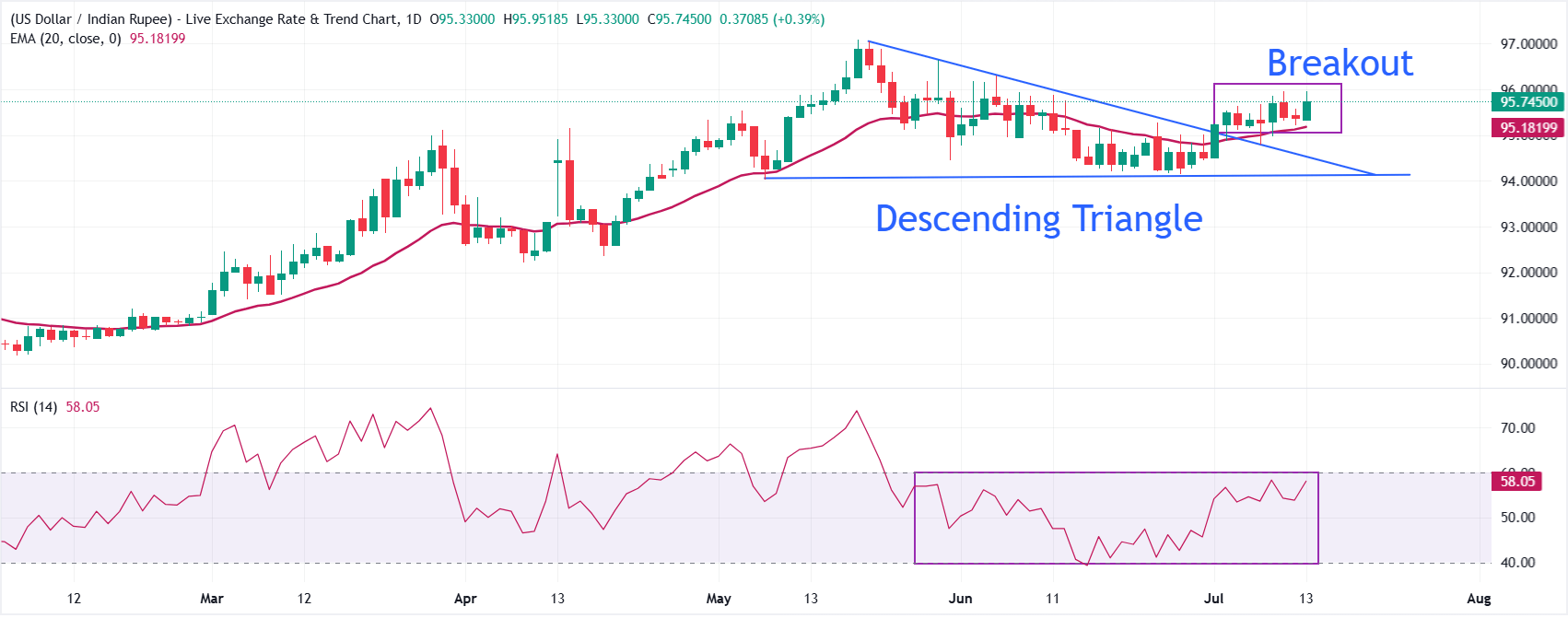
USD/INR trades higher at around 95.80, keeping a constructive near-term bias as it holds well above the 20-day Exponential Moving Average (EMA) at 95.18. The pair also holds the breakout of the Descending Triangle formation.
The Relative Strength Index (RSI) at 58.05 leans toward bullish momentum without yet signaling overbought conditions, suggesting buyers remain in control.
On the downside, initial support is seen at the 20-day EMA near 95.18, which lines up with the short-term bullish trend and could attract dip-buying interest. A deeper pullback would expose the former downtrend break zone around 94.50, ahead of the rising trend-line region between roughly 94.12 and 94.06, where a loss of this band would undermine the current bullish tone and open the door to a more pronounced correction.
Looking up, the pair would attempt to revisit the all-time high around 97.10 if it manages to break above the July 9 high at 95.96.
(The technical analysis of this story was written with the help of an AI tool. Know more.)
Indian Rupee FAQs
The Indian Rupee (INR) is one of the most sensitive currencies to external factors. The price of Crude Oil (the country is highly dependent on imported Oil), the value of the US Dollar – most trade is conducted in USD – and the level of foreign investment, are all influential. Direct intervention by the Reserve Bank of India (RBI) in FX markets to keep the exchange rate stable, as well as the level of interest rates set by the RBI, are further major influencing factors on the Rupee.
The Reserve Bank of India (RBI) actively intervenes in forex markets to maintain a stable exchange rate, to help facilitate trade. In addition, the RBI tries to maintain the inflation rate at its 4% target by adjusting interest rates. Higher interest rates usually strengthen the Rupee. This is due to the role of the ‘carry trade’ in which investors borrow in countries with lower interest rates so as to place their money in countries’ offering relatively higher interest rates and profit from the difference.
Macroeconomic factors that influence the value of the Rupee include inflation, interest rates, the economic growth rate (GDP), the balance of trade, and inflows from foreign investment. A higher growth rate can lead to more overseas investment, pushing up demand for the Rupee. A less negative balance of trade will eventually lead to a stronger Rupee. Higher interest rates, especially real rates (interest rates less inflation) are also positive for the Rupee. A risk-on environment can lead to greater inflows of Foreign Direct and Indirect Investment (FDI and FII), which also benefit the Rupee.
Higher inflation, particularly, if it is comparatively higher than India’s peers, is generally negative for the currency as it reflects devaluation through oversupply. Inflation also increases the cost of exports, leading to more Rupees being sold to purchase foreign imports, which is Rupee-negative. At the same time, higher inflation usually leads to the Reserve Bank of India (RBI) raising interest rates and this can be positive for the Rupee, due to increased demand from international investors. The opposite effect is true of lower inflation.
Recommended Articles


