


Japanese Yen finally lands a punch while Tokyo's silence does the talking
- USD/JPY slips to 162.38 on Thursday, a rare down session after fading from four-decade highs set earlier in the week.
- Spring intervention totalling a record 11.73 trillion Yen has already been overrun, with the market trading above the trigger zone while the Ministry of Finance goes quiet by design.
- Next week's United States inflation report carries a negative monthly consensus, threatening the yield gap that funds the world's most crowded carry trade.
Dollar-Yen eases about a tenth of a percent on Thursday, changing hands just below 162.50 after fading from the four-decade highs printed earlier in the week. Down sessions have been collector's items since the May low, and this one arrives on a tape built for Dollar strength: firm American jobless claims, hawkish Federal Reserve (Fed) commentary, and a fresh war premium in Crude Oil after a second night of United States strikes on Iran.
A rally that stopped responding to its own fuel
Thursday handed the Dollar everything it usually wants, starting with Initial Jobless Claims printing 215K at 12:30 GMT against a 218K consensus. A voting Federal Open Market Committee (FOMC) member delivered remarks rated firmly hawkish at 13:00 GMT, another speaks at 17:30 GMT, and American forces struck roughly 90 targets across Iran overnight after Tehran attacked commercial shipping in the Strait of Hormuz.
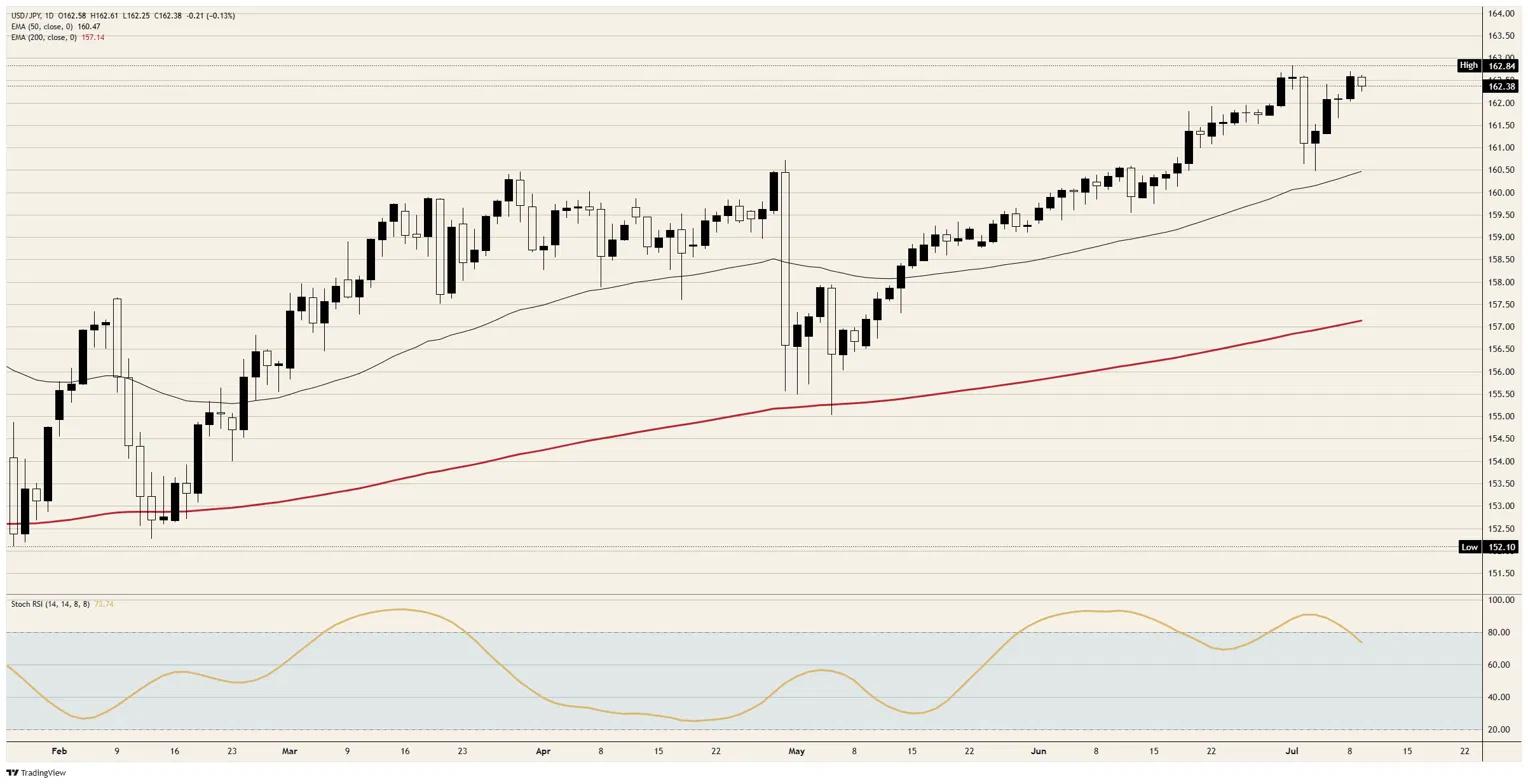
Japan imports nearly all of its energy, which makes every Hormuz headline a terms-of-trade tax on the Yen and explains how the pair reached its highest levels since 1986 in the first place. The pair going nowhere on a day this friendly is the tell: when an uptrend stops advancing on its best-case news flow, the marginal buyer is already long. The Stochastic Relative Strength Index rolling out of overbought territory near 74 while price stalls beneath 163.00 says the same thing in oscillator form.
Yentervention territory is underfoot, not on the horizon
The framing of a return to intervention danger territory gets the geography wrong, because the market never left. April's opening salvo came after the pair breached 160.00; the April and May campaigns together totalled a record 11.73 trillion Yen, roughly double the previous largest effort, and the pair still reclaimed the intervention level inside six weeks. At current prices, every fresh Dollar long is being initiated above the Ministry of Finance's last known pain threshold.
Tokyo's current doctrine trades warnings for ambushes: no public line in the sand, generic readiness language from Finance Minister Satsuki Katayama, and execution timed to inflict maximum damage on stretched short-Yen positioning. The sharp, short-lived Yen surge on July 2 remains unattributed until monthly intervention data lands late in July, which is exactly how a stealth probe is supposed to look. Constraints exist, from International Monetary Fund (IMF) free-float bookkeeping to Prime Minister Sanae Takaichi's reflationist lean, but they make the Ministry selective rather than absent.
The convergence trade Tokyo wants and Washington may deliver
The policy gap is narrowing from both ends, with the Bank of Japan having raised its policy rate to 1.00% in June and the government's revised policy agenda now calling for monetary policy that supports stable price growth, language that reads as political cover for further tightening rather than a leash on it. On the American side, markets price roughly three-in-four odds of a July Fed hold, June payrolls at 57K undercut the hike case, and the hawkish dot plot is old news to anyone holding Dollars.
Next week's Consumer Price Index (CPI) report is where the carry math gets audited. The calendar consensus shows the headline falling 0.1% MoM after a 0.5% surge, with the annual rate previously at 4.2%; a print at or below consensus compresses front-end American yields against a Bank of Japan still tightening, and crowded positioning does the rest. The kicker is geopolitical: Donald Trump declared the ceasefire over while insisting Tehran wants a deal, and any pivot back toward talks would drain the Crude Oil premium that has been the Yen's heaviest drag.
An empty Friday is exactly the Ministry's kind of window
Friday's docket is bare in both Tokyo and Washington, leaving the pair to trade Gulf headlines and pre-CPI positioning in thinning summer liquidity, terrain the Ministry of Finance historically favours for maximum effect per Dollar sold. The record April operation landed inside Japan's Golden Week holiday window, and thin tape is a feature of the playbook rather than a coincidence.
The week ahead is an American affair, since the Japanese docket offers nothing of note. CPI arrives Tuesday at 12:30 GMT, Producer Price Index data and the Fed's Beige Book follow Wednesday with core producer prices previously running 4.9% YoY, Retail Sales land Thursday at 12:30 GMT with a 0.3% consensus after 0.9%, and Friday's University of Michigan preliminaries include one-year inflation expectations last seen at 4.6%. The Yen trades American numbers and Persian Gulf headlines from here, with an ambush option running underneath all of it.
Japanese Yen technical levels to watch
Resistance: The weekly high just shy of 163.00 is the immediate cap, and a daily close above 163.00 would reopen the advance toward 163.50 with the Ministry of Finance on the clock.
Support: 162.00 guards the near-term floor, with 161.00 behind it and the 50-day Exponential Moving Average near 160.50 as the level a genuine intervention print would test within hours rather than weeks.
Bias: Bearish below 163.00; fading strength targets 161.00 first and 160.50 on any intervention headline, and only a daily close above 163.00 invalidates the fade.
USD/JPY daily chart
Japanese Yen FAQs
The Japanese Yen (JPY) is one of the world’s most traded currencies. Its value is broadly determined by the performance of the Japanese economy, but more specifically by the Bank of Japan’s policy, the differential between Japanese and US bond yields, or risk sentiment among traders, among other factors.
One of the Bank of Japan’s mandates is currency control, so its moves are key for the Yen. The BoJ has directly intervened in currency markets sometimes, generally to lower the value of the Yen, although it refrains from doing it often due to political concerns of its main trading partners. The BoJ ultra-loose monetary policy between 2013 and 2024 caused the Yen to depreciate against its main currency peers due to an increasing policy divergence between the Bank of Japan and other main central banks. More recently, the gradually unwinding of this ultra-loose policy has given some support to the Yen.
Over the last decade, the BoJ’s stance of sticking to ultra-loose monetary policy has led to a widening policy divergence with other central banks, particularly with the US Federal Reserve. This supported a widening of the differential between the 10-year US and Japanese bonds, which favored the US Dollar against the Japanese Yen. The BoJ decision in 2024 to gradually abandon the ultra-loose policy, coupled with interest-rate cuts in other major central banks, is narrowing this differential.
The Japanese Yen is often seen as a safe-haven investment. This means that in times of market stress, investors are more likely to put their money in the Japanese currency due to its supposed reliability and stability. Turbulent times are likely to strengthen the Yen’s value against other currencies seen as more risky to invest in.
Recommended Articles


