


Why does Bitcoin seem not to care about the Middle East War?
The Iran war has messed many assets, with one notable exception: Bitcoin. The price of the main crypto has been surprisingly resilient in the past few weeks and way less volatile than other assets considered risky, such as US equities. Some say Bitcoin may be becoming immune to geopolitics, but other factors also play out.
Bitcoin price reached a two-month high above $78,000 last week and has since broadly held those gains, continuing to surge higher.
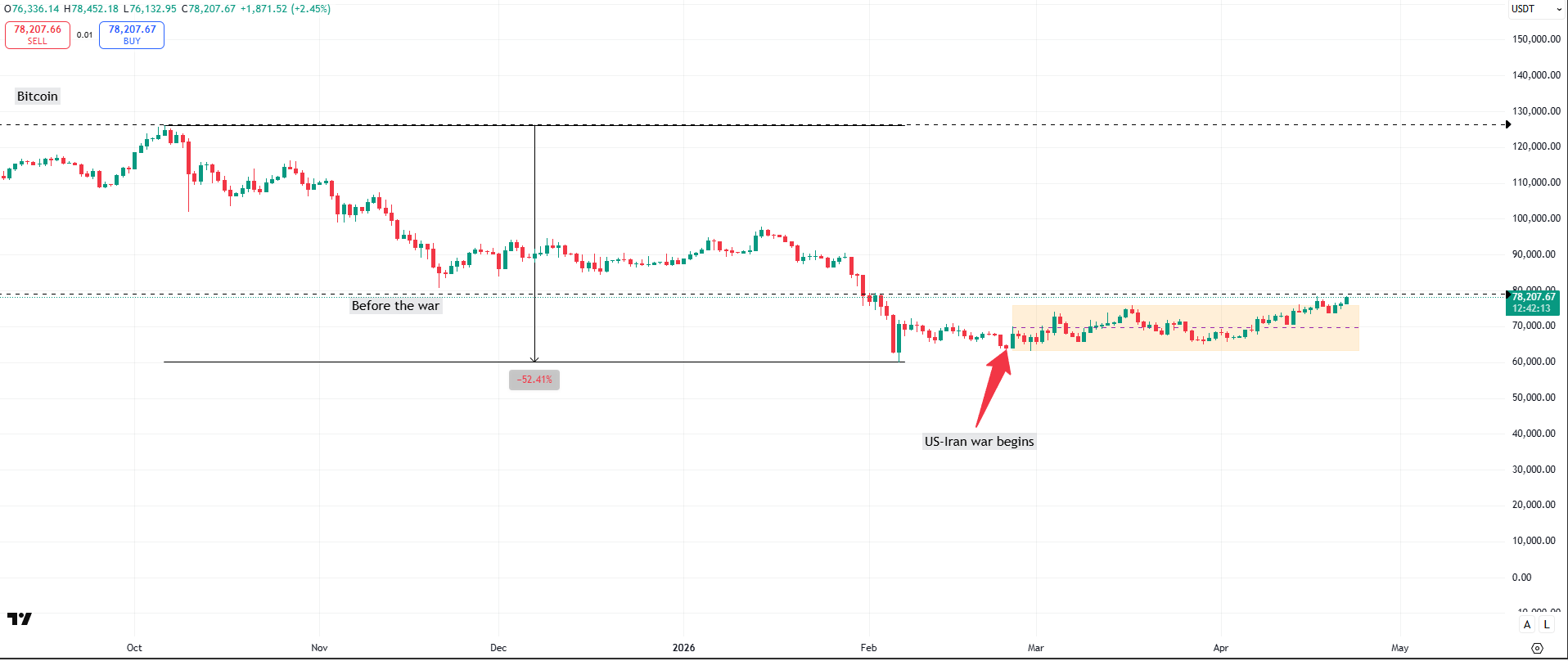
Historically, Bitcoin has not been immune to geopolitics. Its price has dipped on acute escalations (for example, during the April 2024 Iranian strikes on Israel) and remains a risk asset that can correlate with equities during extreme fear periods. However, this hasn’t happened this time, even as the Middle East war has been a major conflict.
To be fair, the US-Iran war comes after Bitcoin had already corrected by more than 50% from its all-time high before the war started on February 28.
Such resilient price action could signal that Bitcoin’s price is forming a potential bottom, especially if it continues to hold key support levels. Beyond the simple theory that crypto markets had already corrected enough, this stability during wartime may reflect stronger underlying demand and improving market structure, supported by several key factors explained below.
Institutional and corporates increase exposure
Institutional investors have accumulated over $3 billion in spot Exchange Traded Funds (ETFs) inflows (from March to now), after a mild $206 million outflow in February. This highlights that, despite the war, which began at the end of February, net flows remained positive, supporting BTC’s resilient price action as investors maintain a long-term view of BTC and increase their exposure.
On the corporate side, treasury giant Strategy, previously known as MicroStrategy, continues its aggressive accumulation, despite the geopolitical conflict and the $14.46 billion unrealized loss on its Bitcoin holdings for Q1. With this week’s purchase, MSTR’s total holdings (more than 815,000) have surpassed those of institutional giant BlackRock.
Liquidity injection
Broader liquidity dynamics have also played a key role in Bitcoin’s resilience, as BTC still remains a highly liquidity-driven asset. Global M2 money supply has been rising over the past six months. Historically, Bitcoin has shown a lagged positive correlation with global liquidity growth, as excess capital often flows into risk assets during periods of monetary expansion. This increase in global liquidity supports the view that Bitcoin’s recent strength.
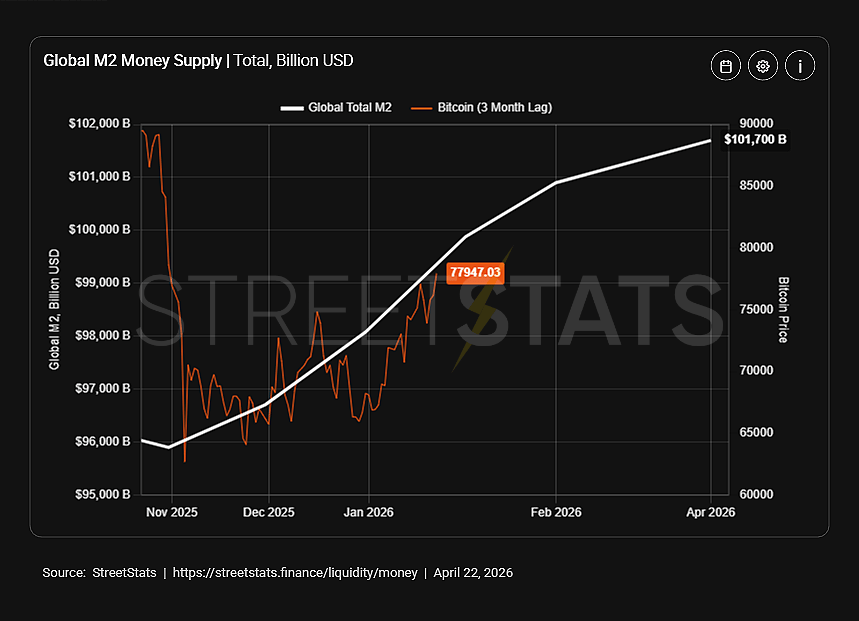
In addition, according to Barchart, the US Treasury is projected to buy back $15 billion of its own debt this week, equaling the largest Treasury buyback in history. The overall environment of expanding liquidity, driven by Treasury buybacks and Global M2 trends, provided a supportive backdrop that also helps Bitcoin shrug off war-related uncertainty more effectively than in less liquid prior cycles.
Wall Street’s crypto presence keeps growing
The growing interest among Wall Street’s big banks in Bitcoin further supports its resilience. Morgan Stanley’s Bitcoin Trust (MSBT) began trading on the New York Stock Exchange (NYSE) in early April, marking the first spot Bitcoin ETF launched by a major US bank. Goldman Sachs has also joined the ETF race.
This growing Wall Street crypto presence reinforces the view that BTC may be transitioning from a speculative asset to a more established asset class.
Iran considers using Bitcoin for toll payment
The Middle East conflict could boost Bitcoin’s utility. Iran reportedly demands that shipping companies pay tolls in cryptocurrency for Oil tankers passing through the Strait of Hormuz.
The proposal would require tanker operators to submit cargo details in advance via email for approval by Iranian authorities. Approved vessels would then pay a transit fee of approximately $1 per barrel, with payments accepted in Bitcoin and other crypto, or in Chinese Yuan. Empty vessels would be exempt from the charge.
As Iran relies on cryptocurrencies due to US sanctions, Bitcoin has served as a tool for paying for imports and settling trade. The latest proposal by Iran to accept Bitcoin and other cryptocurrencies for transit fees in the Strait of Hormuz indicates crypto’s increasing role in global trade.
If implemented, this could mark a key milestone in adoption, particularly for regions facing financial constraints. This development could boost Bitcoin demand in the near term, as 20% of global oil tankers pass through the Hormuz Strait.
Technical Analysis: Is BTC bottoming out?
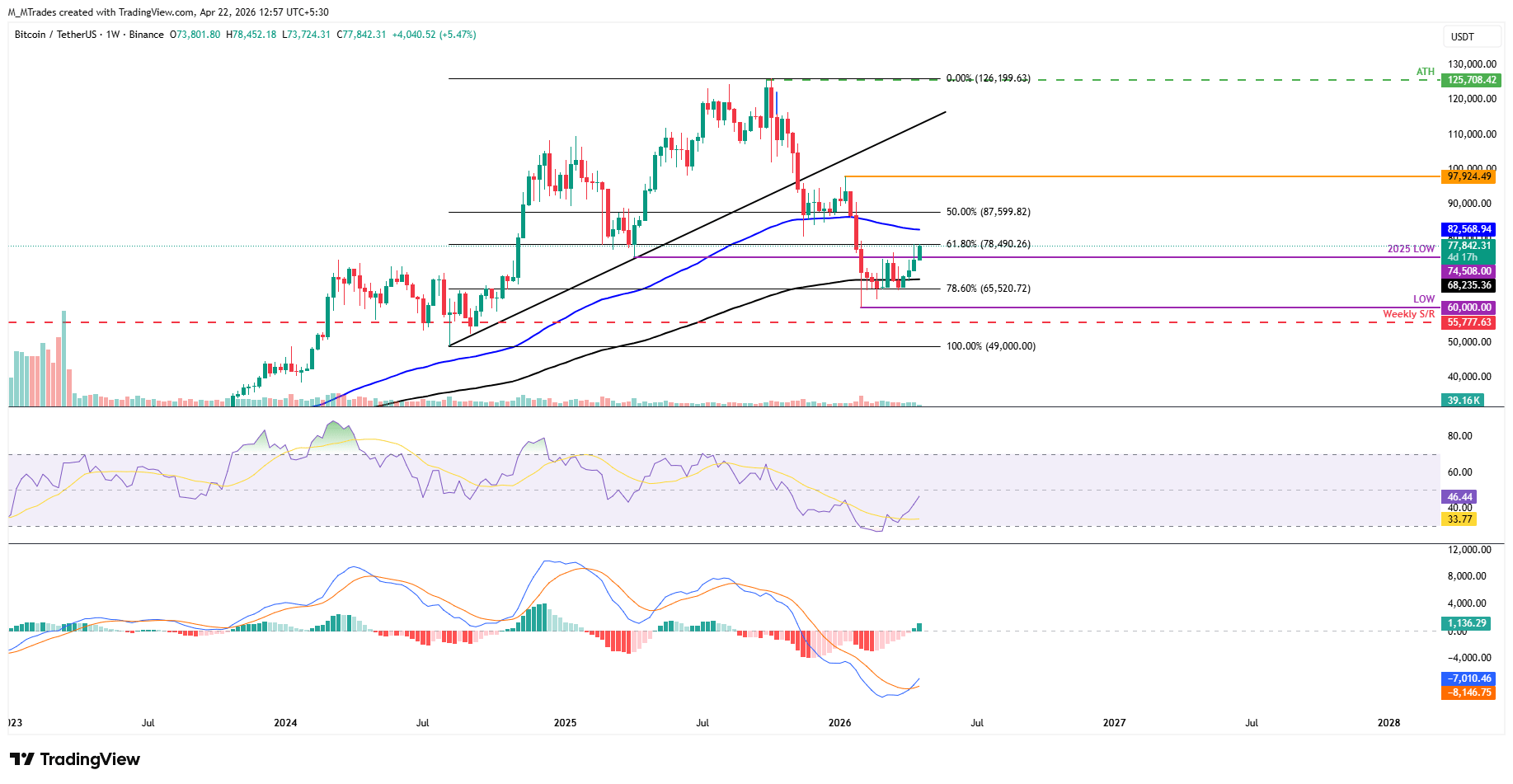
Bitcoin’s technical outlook also shows emerging positive signs. The Crypto King rose 4.33% last week, reaching an 11-week high of $78,333. BTC extended gains, up over 5% this week, trading toward the 61.8% Fibonacci retracement level at $78,490 (drawn from the August 2024 low of $49,000 to the October 2025 all-time high of $126,199).
If BTC closes above this resistance level at $78,490 on a weekly basis, it could extend the gains toward the 100-Week Exponential Moving Average (EMA) at $82,568. A decisive close above this level would form a higher high structure on the weekly timeframe, strengthening the bullish market outlook.
The Relative Strength Index (RSI) reads 46 on the weekly chart, pointing upward toward the neutral level of 50 after recovering from oversold territory, indicating fading bearish momentum. The Moving Average Convergence Divergence (MACD) indicator on the same chart showed a bullish crossover last week, with a positive histogram supporting the bullish thesis.
Bitcoin remains a risk asset, and its “inflation-hedge” and “digital Gold” nature is still too early to play in – at least until markets are more mature. Therefore, rather than suddenly becoming the place to be in times of geopolitical upheaval, the current price resilience could be the result of a combination of capital, liquidity and adoption aligning at once (apart from the hangover and deleveraging after a significant correction). Headlines will remain important for Bitcoin, as they are with all other asset classes, but for now the market seems to be following liquidity.
Bitcoin, altcoins, stablecoins FAQs
Bitcoin is the largest cryptocurrency by market capitalization, a virtual currency designed to serve as money. This form of payment cannot be controlled by any one person, group, or entity, which eliminates the need for third-party participation during financial transactions.
Altcoins are any cryptocurrency apart from Bitcoin, but some also regard Ethereum as a non-altcoin because it is from these two cryptocurrencies that forking happens. If this is true, then Litecoin is the first altcoin, forked from the Bitcoin protocol and, therefore, an “improved” version of it.
Stablecoins are cryptocurrencies designed to have a stable price, with their value backed by a reserve of the asset it represents. To achieve this, the value of any one stablecoin is pegged to a commodity or financial instrument, such as the US Dollar (USD), with its supply regulated by an algorithm or demand. The main goal of stablecoins is to provide an on/off-ramp for investors willing to trade and invest in cryptocurrencies. Stablecoins also allow investors to store value since cryptocurrencies, in general, are subject to volatility.
Bitcoin dominance is the ratio of Bitcoin's market capitalization to the total market capitalization of all cryptocurrencies combined. It provides a clear picture of Bitcoin’s interest among investors. A high BTC dominance typically happens before and during a bull run, in which investors resort to investing in relatively stable and high market capitalization cryptocurrency like Bitcoin. A drop in BTC dominance usually means that investors are moving their capital and/or profits to altcoins in a quest for higher returns, which usually triggers an explosion of altcoin rallies.
추천 기사


