


Gold price flat near $3,020 as US Dollar rebounds on Trump tariff comments
- Gold price struggles to gain traction as USD recovers despite firm support above $3,000 and cautious Fed tone.
- The US Dollar rebounds following reports of Trump auto tariff announcement.
- Solid Durable Goods data, Fed comments on sticky inflation limit upside for Bullion bulls.
Gold price has flat-lined late in the North American session, capped by the recovery of the US Dollar Index (DXY), which fell to a low of 104.18 before staging a recovery. The move was sponsored by the White House, which said that President Donald Trump would announce automobile tariffs at around 22:00 GMT. At the time of writing, XAU/USD trades at $3,019, virtually unchanged.
Bullion traders failed to gain traction on headlines that Trump is considering announcing limited tariff plans and automotive tariffs, according to The Wall Street Journal. In the meantime, the US Dollar Index (DXY), which tracks the performance of the Greenback against six currencies, rises 0.32% to 104.55.
Even though the Gold price has remained mildly, downwardly pressured, the precious metal remains firmly above the $3,000 support level, which keeps buyers hopeful of achieving higher prices.
In the data space, US Durable Goods Orders were solid in February, according to the US Department of Commerce. Aside from this, Federal Reserve (Fed) officials continued to grab the headlines with comments from the St. Louis Fed’s Alberto Mussalem and the Minneapolis Fed’s Neel Kashkari.
Musalem said that the labor market is close to full employment and underscored that current policy is appropriate, given that inflation is above target. He added that the risks of inflation stalling above 2% or rising further had increased, while stating that he doesn’t foresee a recession.
Earlier, Minneapolis Fed President Neel Kashkari stated that the Fed has made notable progress in curbing inflation. However, more work remains, Kashkari said, acknowledging that policy dynamics are making the Fed’s job more complex. Nevertheless, he expressed confidence that within the next year or two the central bank should be able to begin reducing interest rates.
Meanwhile, money markets have priced in 64.5 basis points of Fed easing in 2025, according to Prime Market Terminal interest rate probabilities.
Ahead this week, traders are eyeing the release of the Fed’s preferred inflation gauge, the core Personal Consumption Expenditures (PCE) Price Index.
Daily digest market movers: Gold price trades firm near $3,000, unfazed by Trump’s comments
- The US 10-year T-note yield is almost flat, up one basis point at 4.338%. US real yields edges down one bp to 1.973%, according to US 10-year Treasury Inflation-Protected Securities (TIPS) yields.
- US Durable Goods Orders posted a solid performance in February, rising 0.9% MoM, defying expectations of a 1% decline.
- Core Durable Goods Orders, which exclude transportation, also impressed — climbing 0.7% MoM, up from 0.1% in January and well above the 0.2% forecast, signaling resilient business investment.
- On Monday, Atlanta Fed President Raphael Bostic stated that he supports only one rate cut this year and doesn’t expect inflation to return to target until around 2027.
XAU/USD technical outlook: Gold price hovers near $3,020
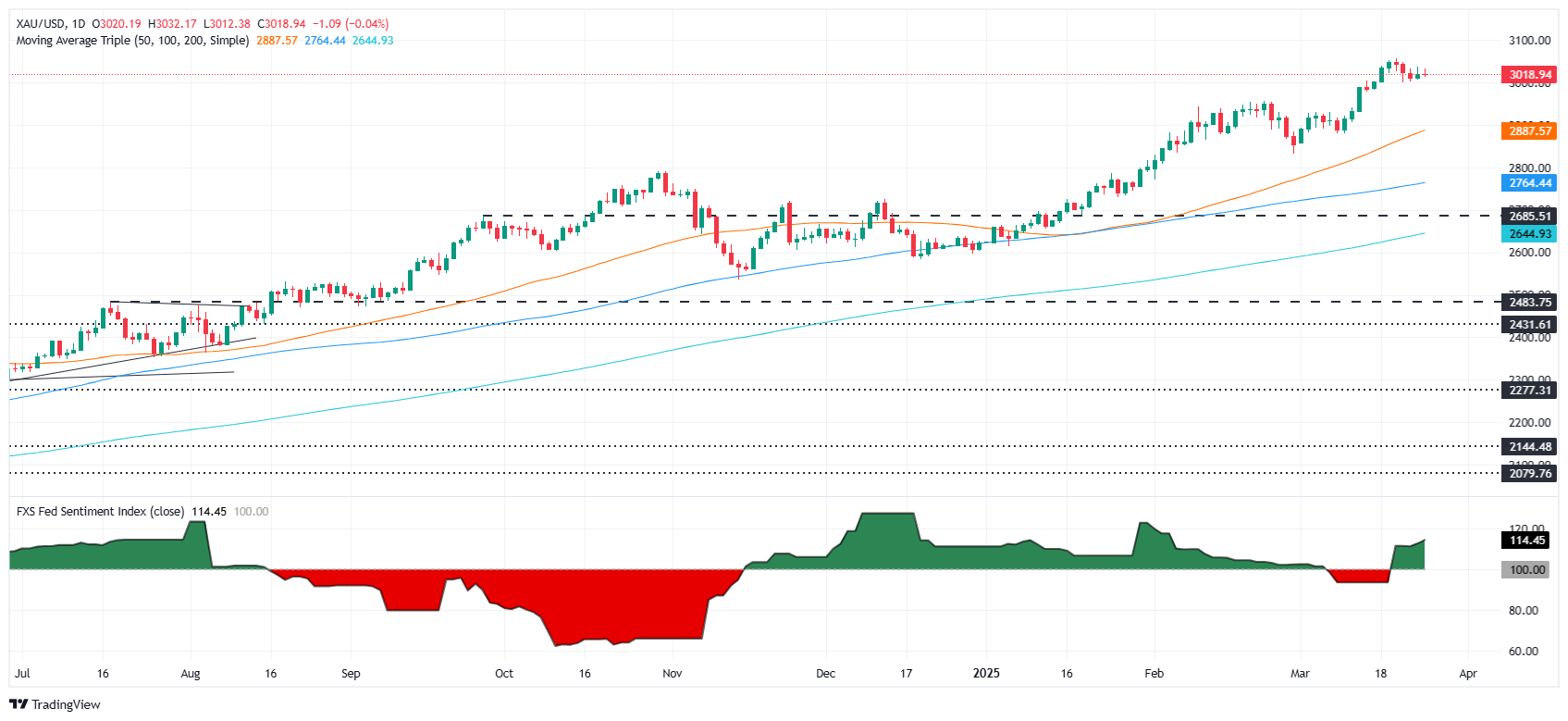
Gold price trades choppy on Wednesday with the market awaiting a fresh catalyst that could push prices toward record highs or break the strong floor at $3,000. The Relative Strength Index (RSI) is bullish but turned flat after edging lower in back-to-back days, an indication that sellers lost strength.
That said, if XAU/USD clears the current week’s high of $3,036, that could exacerbate a test of the record high price at $3,057. A breach of the latter will pave the way for testing $3,100. Conversely, if Gold slumps beneath $3,000, this will expose the February 24 swing high at $2,956, followed by the $2,900 mark and the 50-day Simple Moving Average (SMA) at $2,887.
Gold FAQs
Gold has played a key role in human’s history as it has been widely used as a store of value and medium of exchange. Currently, apart from its shine and usage for jewelry, the precious metal is widely seen as a safe-haven asset, meaning that it is considered a good investment during turbulent times. Gold is also widely seen as a hedge against inflation and against depreciating currencies as it doesn’t rely on any specific issuer or government.
Central banks are the biggest Gold holders. In their aim to support their currencies in turbulent times, central banks tend to diversify their reserves and buy Gold to improve the perceived strength of the economy and the currency. High Gold reserves can be a source of trust for a country’s solvency. Central banks added 1,136 tonnes of Gold worth around $70 billion to their reserves in 2022, according to data from the World Gold Council. This is the highest yearly purchase since records began. Central banks from emerging economies such as China, India and Turkey are quickly increasing their Gold reserves.
Gold has an inverse correlation with the US Dollar and US Treasuries, which are both major reserve and safe-haven assets. When the Dollar depreciates, Gold tends to rise, enabling investors and central banks to diversify their assets in turbulent times. Gold is also inversely correlated with risk assets. A rally in the stock market tends to weaken Gold price, while sell-offs in riskier markets tend to favor the precious metal.
The price can move due to a wide range of factors. Geopolitical instability or fears of a deep recession can quickly make Gold price escalate due to its safe-haven status. As a yield-less asset, Gold tends to rise with lower interest rates, while higher cost of money usually weighs down on the yellow metal. Still, most moves depend on how the US Dollar (USD) behaves as the asset is priced in dollars (XAU/USD). A strong Dollar tends to keep the price of Gold controlled, whereas a weaker Dollar is likely to push Gold prices up.
추천 기사


