




Gold trades cautiously as markets brace for Fed interest rate call
- Gold is under modest pressure as traders stay cautious ahead of the Federal Reserve’s interest rate decision at 19:00 GMT.
- Markets price a 25 bps cut, though speculation about a hawkish tone is lifting US Treasury yields and weighing on XAU/USD.
- Technical setup stays constructive, with XAU/USD holding above key moving averages and consolidating within the $4,150-$4,250 range.
Gold (XAU/USD) edges slightly lower on Wednesday, with price action contained inside the recent consolidation zone as markets brace for the Federal Reserve’s (Fed) interest rate decision. At the time of writing, XAU/USD is hovering near $4,200, down from the intraday high of $4,218.
The Fed will announce its policy decision at 19:00 GMT, with markets leaning toward another 25 basis point cut that would lower the Federal Funds Rate to the 3.50%-3.75% range. Expectations for reduced borrowing costs keep Bullion broadly supported, as lower interest rates reduce the opportunity cost of holding non-yielding assets like Gold.
However, speculation about a hawkish cut is pushing US Treasury yields higher and weighing on Gold, as markets scale back expectations for any near-term easing in early 2026.
Against this backdrop, attention will be squarely on Fed Chair Jerome Powell’s post-meeting press conference, along with the updated dot plot and economic projections, for clearer signals on the pace of policy adjustments heading into next year.
Market movers: Dollar steady, yields climb as markets brace for Fed decision
- The US Dollar (USD) remains steady ahead of the Fed verdict, while Treasury yields continue to climb across the curve. The US Dollar Index (DXY), which tracks the Greenback’s value against a basket of six major currencies, is consolidating just above the 99.00 mark. Meanwhile, the benchmark 10-year Treasury yield is trading around 4.20%, its highest level since September 4.
- The Fed has already eased policy twice this year, delivering back-to-back 25 bps reductions in September and October that officials described as “risk-management” cuts aimed at cushioning the economy amid evidence of softening labour-market conditions. The last dot plot in September showed the FOMC’s median rate forecast pointing to one cut in both 2026 and 2027, no change expected in 2028, and the longer-run rate held at 3.0%.
- Markets currently price a 90% probability of a quarter-point rate cut at Wednesday’s Fed decision. Expectations for further easing remain modest, with the CME FedWatch Tool showing only a 20% chance of another cut in January, rising to 33% in March and 37% in April.
- Fed Chair Jerome Powell noted at the October post-meeting press conference that there was a “growing chorus” within the Committee arguing it may be prudent to wait before taking another step. Since then, policymakers have been divided, with some warning about lingering inflation risks while others highlight concerns over the gradual cooling in the labour market. As a result, traders will be watching the vote split and any dissent very closely, seeking signals on whether the Committee is leaning more hawkish or dovish heading into 2026.
- Financial Times reported on Tuesday that President Donald Trump is preparing to begin a final round of interviews for the next Fed Chair. Administration officials told the outlet that National Economic Council Director Kevin Hassett remains the frontrunner to succeed Jerome Powell when the chair’s term ends in May.
Technical analysis: XAU/USD holds within range as traders await Fed catalyst
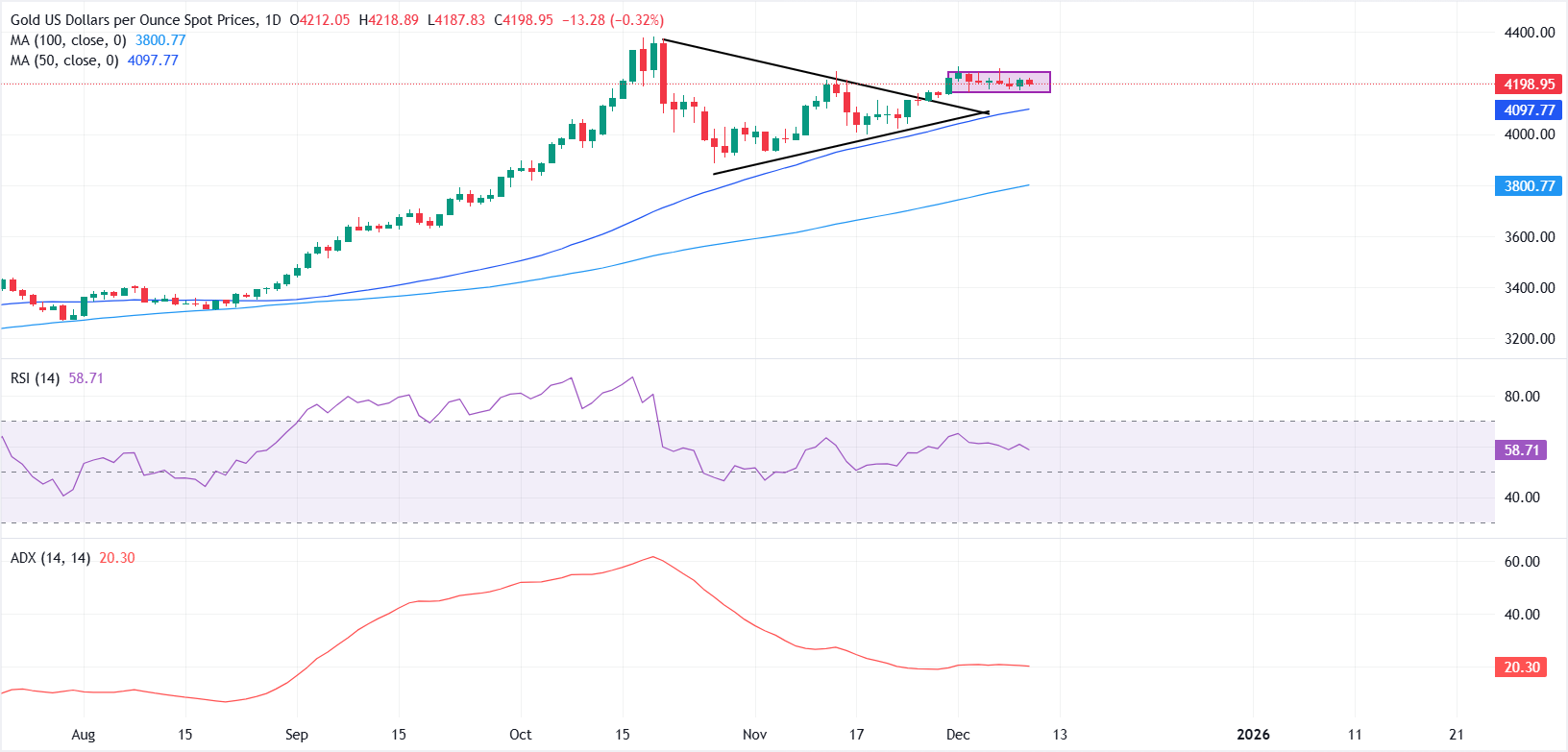
Gold remains in a holding pattern between $4,150 and $4,250 after breaking out of the symmetrical triangle formation, reflecting clear indecision among traders ahead of the Fed decision.
From a structural standpoint, the bias still leans to the upside, with the breakout intact and price action stabilising above key moving averages. A dovish outcome would leave the path of least resistance tilted higher, opening the door for a move above the $4,250 barrier. A sustained close above this zone would reinforce bullish momentum and expose the next psychological target around $4,300.
On the flip side, any hawkish tone or pushback against 2026 easing expectations could keep Gold range-bound in the near term or trigger a modest pullback. Initial support is located at $4,150, the lower bound of the current consolidation phase, with further downside toward $4,100, where the 50-day Simple Moving Average (SMA) provides an important technical floor.
Fed FAQs
Monetary policy in the US is shaped by the Federal Reserve (Fed). The Fed has two mandates: to achieve price stability and foster full employment. Its primary tool to achieve these goals is by adjusting interest rates. When prices are rising too quickly and inflation is above the Fed’s 2% target, it raises interest rates, increasing borrowing costs throughout the economy. This results in a stronger US Dollar (USD) as it makes the US a more attractive place for international investors to park their money. When inflation falls below 2% or the Unemployment Rate is too high, the Fed may lower interest rates to encourage borrowing, which weighs on the Greenback.
The Federal Reserve (Fed) holds eight policy meetings a year, where the Federal Open Market Committee (FOMC) assesses economic conditions and makes monetary policy decisions. The FOMC is attended by twelve Fed officials – the seven members of the Board of Governors, the president of the Federal Reserve Bank of New York, and four of the remaining eleven regional Reserve Bank presidents, who serve one-year terms on a rotating basis.
In extreme situations, the Federal Reserve may resort to a policy named Quantitative Easing (QE). QE is the process by which the Fed substantially increases the flow of credit in a stuck financial system. It is a non-standard policy measure used during crises or when inflation is extremely low. It was the Fed’s weapon of choice during the Great Financial Crisis in 2008. It involves the Fed printing more Dollars and using them to buy high grade bonds from financial institutions. QE usually weakens the US Dollar.
Quantitative tightening (QT) is the reverse process of QE, whereby the Federal Reserve stops buying bonds from financial institutions and does not reinvest the principal from the bonds it holds maturing, to purchase new bonds. It is usually positive for the value of the US Dollar.
추천 기사


