




AUD/USD stalls at key 0.6600 resistance amid mixed market catalysts
- AUD/USD pauses below 0.6600 as bulls near the wedge resistance.
- The Australian Dollar benefits from the hawkish tilt of the RBA, while markets await clarity on when the Fed may begin cutting rates.
- AUD/USD remains in a strong short-term bull trend as prices weigh trade risks against yield differentials.
The battle between the Australian Dollar (AUD) and the US Dollar (USD) persists on Friday, with bulls in the AUD/USD pair continuing to push for a break through the next major resistance level at 0.6600.
This psychologically significant level has become a key battleground, holding both bulls and bears in check as price action stalls just below it. As momentum pauses, market participants are increasingly turning their attention to the fundamental catalysts that could strengthen the bullish case.
From a fundamental standpoint, the Federal Reserve (Fed) remains hesitant to cut interest rates in the near term. However, the focus has shifted from whether the Fed will cut rates to when such a move might occur.
Meanwhile, the Reserve Bank of Australia (RBA) remains committed to supporting the country’s economic resilience. On Tuesday, the RBA surprised markets by holding the cash rate steady at 3.85%, a move that was perceived as more hawkish than expected. While the central bank did not rule out the possibility of future rate cuts, markets responded positively to the decision.
Australia’s limited exposure to US President Donald Trump's tariff threats, due to its modest trade deficit with the United States, has also provided the AUD with some relative insulation. With political risks priced in, technical factors are now offering further insight into current market behaviour and why the price remains firm near this key resistance zone.
AUD/USD stalls below psychological resistance at 0.6600
AUD/USD is currently trading just below the 0.6600 psychological resistance level. Prices are consolidating within a rising wedge pattern that has been forming since late April. This level continues to cap bullish momentum, with price action respecting the upper boundary of the wedge while maintaining higher lows, a sign of persistent buying interest.
Support is reinforced by the 61.8% Fibonacci retracement of the September-April decline, located near 0.6550. Below that, the 50-day Simple Moving Average (SMA) at 0.6486 and the 200-day SMA at 0.6402 are offering additional support for the short-term move.
AUD/USD daily chart
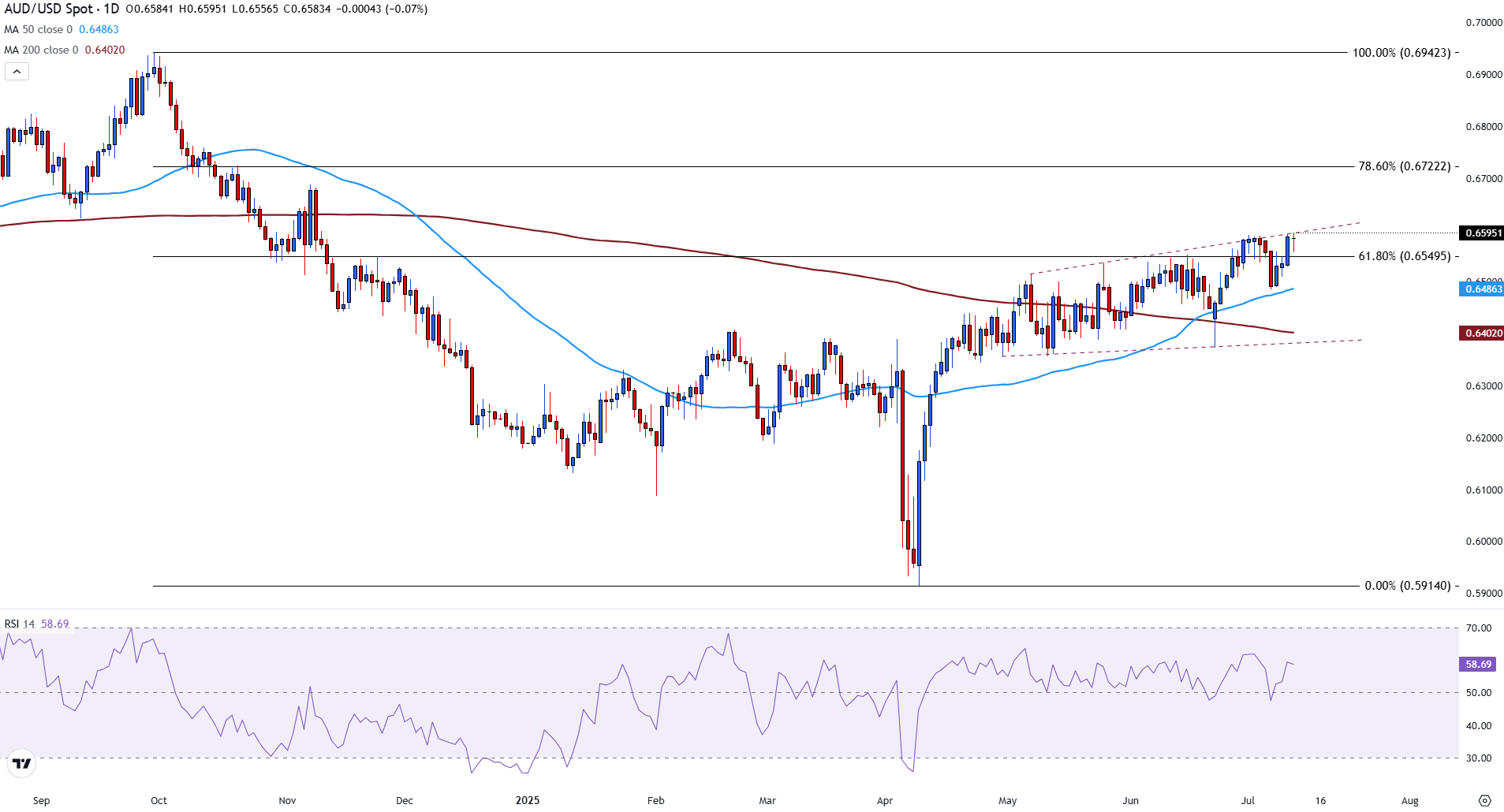
On the upside, a confirmed breakout above 0.6600 would open the door for a test of the 78.6% Fibonacci retracement at 0.6722, with further gains potentially targeting the October swing high near 0.6942. However, failure to break above current levels could result in a pullback toward 0.6500.
The Relative Strength Index (RSI) currently reads near 59, indicating bullish momentum without signaling overbought conditions. This leaves room for further upside, though the pair may require a fundamental catalyst or a clear breakout above wedge resistance to gain traction in the short term.
Australian Dollar FAQs
One of the most significant factors for the Australian Dollar (AUD) is the level of interest rates set by the Reserve Bank of Australia (RBA). Because Australia is a resource-rich country another key driver is the price of its biggest export, Iron Ore. The health of the Chinese economy, its largest trading partner, is a factor, as well as inflation in Australia, its growth rate and Trade Balance. Market sentiment – whether investors are taking on more risky assets (risk-on) or seeking safe-havens (risk-off) – is also a factor, with risk-on positive for AUD.
The Reserve Bank of Australia (RBA) influences the Australian Dollar (AUD) by setting the level of interest rates that Australian banks can lend to each other. This influences the level of interest rates in the economy as a whole. The main goal of the RBA is to maintain a stable inflation rate of 2-3% by adjusting interest rates up or down. Relatively high interest rates compared to other major central banks support the AUD, and the opposite for relatively low. The RBA can also use quantitative easing and tightening to influence credit conditions, with the former AUD-negative and the latter AUD-positive.
China is Australia’s largest trading partner so the health of the Chinese economy is a major influence on the value of the Australian Dollar (AUD). When the Chinese economy is doing well it purchases more raw materials, goods and services from Australia, lifting demand for the AUD, and pushing up its value. The opposite is the case when the Chinese economy is not growing as fast as expected. Positive or negative surprises in Chinese growth data, therefore, often have a direct impact on the Australian Dollar and its pairs.
Iron Ore is Australia’s largest export, accounting for $118 billion a year according to data from 2021, with China as its primary destination. The price of Iron Ore, therefore, can be a driver of the Australian Dollar. Generally, if the price of Iron Ore rises, AUD also goes up, as aggregate demand for the currency increases. The opposite is the case if the price of Iron Ore falls. Higher Iron Ore prices also tend to result in a greater likelihood of a positive Trade Balance for Australia, which is also positive of the AUD.
The Trade Balance, which is the difference between what a country earns from its exports versus what it pays for its imports, is another factor that can influence the value of the Australian Dollar. If Australia produces highly sought after exports, then its currency will gain in value purely from the surplus demand created from foreign buyers seeking to purchase its exports versus what it spends to purchase imports. Therefore, a positive net Trade Balance strengthens the AUD, with the opposite effect if the Trade Balance is negative.
추천 기사


