

GBP/USD climbs above 1.34 as Fed cut and soft US data weigh on Dollar
- GBP/USD extends gains as weak US jobless data amplifies expectations for deeper Federal Reserve easing next year.
- Traders shift focus to upcoming UK GDP and next week’s BoE rate decision, where a 25 bps cut is heavily priced in.
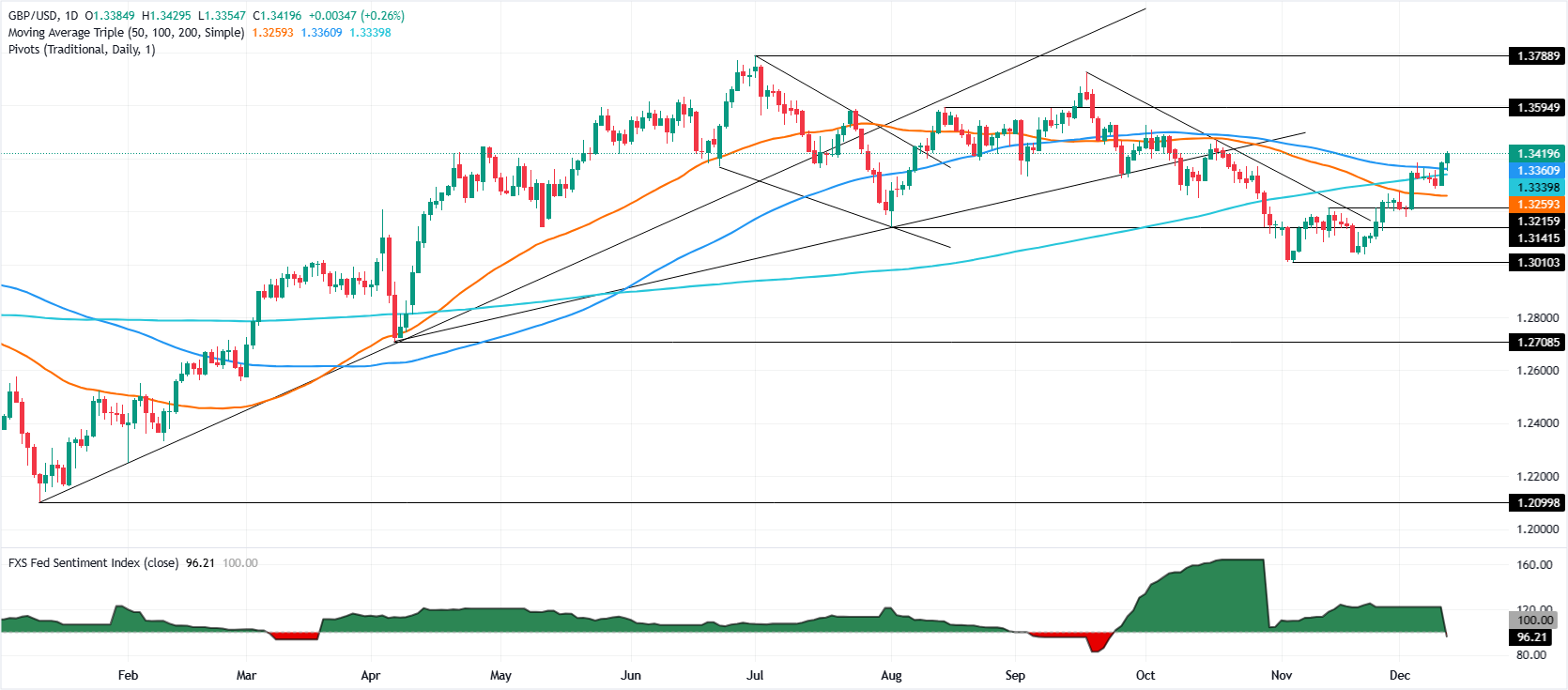
- Technical outlook turns bullish, with GBP/USD eyeing 1.3450 once a sustained daily close above 1.3400 is achieved.
Sterling rallies during the North American session, up over 0.68% after the Federal Reserve delivered as expected a 25-basis points rate cut and a softer than expected jobs report, weighed on the Dollar. At the time of writing, the GBP/USD trades at 1.3417 after bouncing off daily lows of 1.3354.
Pound rallies after the Fed delivers a widely expected rate cut, soft US labor data deepens bets on further easing
US Initial Jobless Claims for the week ending December 6 increased by 236K up from the previous week upward revised figures to 192K, revealed the Department of Labor. Continuing Claims for the week ending November 29 dipped from 1.937 million to 1.838 million.
The data highlights the ongoing weakness of the labor market, now eyes are set on next week’s Nonfarm Payrolls report. Other data showed that unexpected shrink of the US Trade Balance from $-59.8 billion in August to $-52.8 billion in September.
In the meantime, the Federal Reserve rate cut weakened the Dollar, which according to the US Dollar Index is testing levels last seen in mid-October, down 0.40% at 97.73. This despite the fact that the dot-plot’s showed that the median wanted the Fed funds rate to end 2025 within the 3.75%-4% range.
In the UK, the docket has remained light except for Friday’s release of Gross Domestic Product (GDP) figures, which are expected to show an increase of 0.1% MoM in October, above September’s -0.1% contraction.
GBP/USD traders are eyeing next week’s Bank of England (BoE) monetary policy decision. A Reuters survey revealed that economists estimate a rate cut of 25 basis points on December 18, which would leave the Bank Rate at 3.75%.
On Friday, the Fed parade begins, with speeches by Paulson, Hammack and Goolsbee.
GBP/USD Price Forecast: Technical outlook
The GBP/USD trend has shifted from neutral to neutral-upwards, with buyers regaining control, yet they have to achieve a daily close above 1.3400. This will expose the 1.3450 area, followed by the October 17 peak ahead of 1.3500. On the flip side, the first support is 1.3400, followed by the 100-day SMA at 1.3358.
Pound Sterling Price This week
The table below shows the percentage change of British Pound (GBP) against listed major currencies this week. British Pound was the strongest against the US Dollar.
| USD | EUR | GBP | JPY | CAD | AUD | NZD | CHF | |
|---|---|---|---|---|---|---|---|---|
| USD | -0.85% | -0.67% | -0.08% | -0.46% | -0.44% | -0.83% | -1.14% | |
| EUR | 0.85% | 0.20% | 0.82% | 0.43% | 0.50% | 0.08% | -0.25% | |
| GBP | 0.67% | -0.20% | 0.62% | 0.22% | 0.28% | -0.14% | -0.46% | |
| JPY | 0.08% | -0.82% | -0.62% | -0.39% | -0.34% | -0.73% | -1.04% | |
| CAD | 0.46% | -0.43% | -0.22% | 0.39% | 0.05% | -0.38% | -0.67% | |
| AUD | 0.44% | -0.50% | -0.28% | 0.34% | -0.05% | -0.40% | -0.71% | |
| NZD | 0.83% | -0.08% | 0.14% | 0.73% | 0.38% | 0.40% | -0.31% | |
| CHF | 1.14% | 0.25% | 0.46% | 1.04% | 0.67% | 0.71% | 0.31% |
The heat map shows percentage changes of major currencies against each other. The base currency is picked from the left column, while the quote currency is picked from the top row. For example, if you pick the British Pound from the left column and move along the horizontal line to the US Dollar, the percentage change displayed in the box will represent GBP (base)/USD (quote).
추천 기사


