

Stock-Split Watch: Is Nvidia Next?

Source The Motley Fool

It was nearly one year ago that Nvidia (NASDAQ: NVDA) last split its stock. That 10-for-1 stock split was the sixth in the company's history since entering the public markets in 1999. Shares proceeded to march to an all-time closing high about six months after last June's stock split.

Shares have since retreated along with many others as the Nasdaq Composite index briefly entered bear market territory in early April, declining more than 20% off recent highs. Yet Nvidia has been resilient and its share prices have recently rebounded. While the downturn in the stock market may not be over, it will eventually gain ground again. Nvidia continues to have a leading business covering artificial intelligence (AI), gaming, robotics, driver assistance, and self-driving technologies.

Where to invest $1,000 right now? Our analyst team just revealed what they believe are the 10 best stocks to buy right now. Continue »

Stock-split facts

That business is what should attract investors to Nvidia stock. Another stock split could also be in its future, though. And history shows that owning shares before they split can pay off.
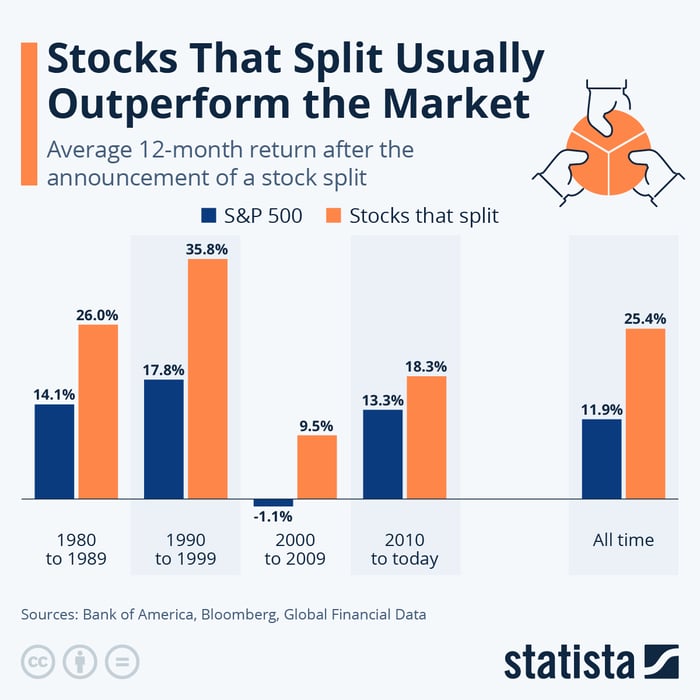
bar chart with data showing stocks that split typically outperform the market.

Image source: Statista.

To determine why that might be, let's look at reasons companies split their stocks in the first place. After all, a split doesn't affect the value of the company one bit and even adds some expenses in logistics, legal fees, and other nominal costs.

Splitting a stock can increase liquidity by making shares more affordable for a larger group of investors. Retail investors are likely part of the increased trading volume because lower-priced shares look more attractive to those just starting out or with limited funds to invest. Fractional shares are offered at many brokerages now, but most people probably don't utilize that rarely-promoted option. So a lower share price can appeal to more buyers. It is a perception of affordability.

Companies also tend to split stocks that have trended higher. Announcing a split tends to give investors added confidence that further strong performance is ahead. The stock may also be included in more major stock indexes, especially those that use price-weighted calculations. Lastly, splits may also be announced with company employees in mind. Employee share purchase plans may get more participation if shares are more affordable to participants.

Value ahead for Nvidia

So while stock splits don't directly affect the company's value, i.e., its market capitalization doesn't change, investor perception and market activity can tend to aid future performance. Nvidia management can also look beyond short-term volatility toward positive future business developments to gain confidence to announce another stock split.

Most investors are focusing on Nvidia's growing data center revenue. That segment accounted for the bulk of its revenue growth in the past fiscal year ended Jan. 26, 2025. But each of its other three segments has increased revenue annually over the last two years. Gaming is a more than $10 billion segment. It only accounted for about 9% of sales last year, though, so many investors are discounting Nvidia's other growth areas.

Perhaps its greatest growth potential comes from automotive and robotics end uses. That segment is at a much lower base than data centers, and its total addressable market could be ready to go through a growth spurt. Automakers already include advanced driver assistance packages and may be on the cusp of selling fully autonomous vehicles. Robotics technology may also be at the point of transition from stationary industrial uses to mobile, humanoid versions that can help businesses further improve efficiency.

Is a stock split coming?

Those are better reasons to buy Nvidia stock than anticipating the next stock split. History does show that a split announcement could result in market-beating returns. Yet I think Nvidia stock will outpace the market simply for fundamental reasons.

Nvidia's management and board of directors will likely wait for ongoing market turmoil to settle before announcing its next stock split. It makes sense for investors to own the stock regardless, though. That way, you can participate in a fast-growing company along with any future stock splits that might be announced.

Don’t miss this second chance at a potentially lucrative opportunity

Ever feel like you missed the boat in buying the most successful stocks? Then you’ll want to hear this.

On rare occasions, our expert team of analysts issues a “Double Down” stock recommendation for companies that they think are about to pop. If you’re worried you’ve already missed your chance to invest, now is the best time to buy before it’s too late. And the numbers speak for themselves:

  • Nvidia: if you invested $1,000 when we doubled down in 2009, you’d have $287,877!*
  • Apple: if you invested $1,000 when we doubled down in 2008, you’d have $39,678!*
  • Netflix: if you invested $1,000 when we doubled down in 2004, you’d have $594,046!*

Right now, we’re issuing “Double Down” alerts for three incredible companies, available when you join Stock Advisor, and there may not be another chance like this anytime soon.

See the 3 stocks »

*Stock Advisor returns as of April 28, 2025

Howard Smith has positions in Nvidia. The Motley Fool has positions in and recommends Nvidia. The Motley Fool has a disclosure policy.

Disclaimer: For information purposes only. Past performance is not indicative of future results.
placeholder
Bitcoin To Anchor America Party—’Fiat Is Hopeless,’ Says Elon MuskMusk Pitches Bitcoin As Pillar Of America Party
Author  Bitcoinist
Jul 07, 2025
Musk Pitches Bitcoin As Pillar Of America Party
placeholder
Bitcoin briefly loses 2025 gains as crypto plunges over the weekend.Bitcoin experienced a sharp decline this weekend, briefly erasing its 2025 gains and dipping below its year-opening value of $93,507. The cryptocurrency fell to a low of $93,029 on Sunday, representing a 25% drop from its all-time high in October. Although it has rebounded slightly to around $94,209, the pressures on the market remain significant. The downturn occurred despite the reopening of the U.S. government on Thursday, which many had hoped would provide essential support for crypto markets. This year initially appeared promising for cryptocurrencies, particularly after the inauguration of President Donald Trump, who has established the most pro-crypto administration thus far. However, ongoing political tensions—including Trump's tariff strategies and the recent government shutdown, lasting a historic 43 days—have contributed to several rapid price pullbacks for Bitcoin throughout the year. Market dynamics are also being influenced by Bitcoin whales—investors holding large amounts of Bitcoin—who have been offloading portions of their assets, consequently stalling price rallies even as positive regulatory developments emerge. Despite these sell-offs, analysts from Glassnode argue that this behavior aligns with typical patterns seen among long-term investors during the concluding stages of bull markets, suggesting it is not indicative of a mass exodus. Notably, Bitcoin is not alone in its struggles, as Ethereum and Solana have also recorded declines of 7.95% and 28.3%, respectively, since the start of the year, while numerous altcoins have faced even steeper losses. Looking ahead, questions linger regarding the viability of the four-year cycle thesis, particularly given the increasing institutional support and regulatory frameworks now in place in the crypto landscape. Matt Hougan, chief investment officer at Bitwise, remains optimistic, suggesting a potential Bitcoin resurgence in 2026 driven by the “debasement trade” thesis and a broader trend toward increased adoption of stablecoins, tokenization, and decentralized finance. Hougan emphasized the soundness of the underlying fundamentals, pointing to a positive outlook for the sector in the longer term.
Author  Mitrade
Nov 17, 2025
Bitcoin experienced a sharp decline this weekend, briefly erasing its 2025 gains and dipping below its year-opening value of $93,507. The cryptocurrency fell to a low of $93,029 on Sunday, representing a 25% drop from its all-time high in October. Although it has rebounded slightly to around $94,209, the pressures on the market remain significant. The downturn occurred despite the reopening of the U.S. government on Thursday, which many had hoped would provide essential support for crypto markets. This year initially appeared promising for cryptocurrencies, particularly after the inauguration of President Donald Trump, who has established the most pro-crypto administration thus far. However, ongoing political tensions—including Trump's tariff strategies and the recent government shutdown, lasting a historic 43 days—have contributed to several rapid price pullbacks for Bitcoin throughout the year. Market dynamics are also being influenced by Bitcoin whales—investors holding large amounts of Bitcoin—who have been offloading portions of their assets, consequently stalling price rallies even as positive regulatory developments emerge. Despite these sell-offs, analysts from Glassnode argue that this behavior aligns with typical patterns seen among long-term investors during the concluding stages of bull markets, suggesting it is not indicative of a mass exodus. Notably, Bitcoin is not alone in its struggles, as Ethereum and Solana have also recorded declines of 7.95% and 28.3%, respectively, since the start of the year, while numerous altcoins have faced even steeper losses. Looking ahead, questions linger regarding the viability of the four-year cycle thesis, particularly given the increasing institutional support and regulatory frameworks now in place in the crypto landscape. Matt Hougan, chief investment officer at Bitwise, remains optimistic, suggesting a potential Bitcoin resurgence in 2026 driven by the “debasement trade” thesis and a broader trend toward increased adoption of stablecoins, tokenization, and decentralized finance. Hougan emphasized the soundness of the underlying fundamentals, pointing to a positive outlook for the sector in the longer term.
placeholder
Gold rises on softer US Dollar, traders await Trump's address on Iran warGold price (XAU/USD) extends the rally to near $4,775 during the early Asian session on Thursday. The precious metal surges amid a weakening US Dollar (USD) and cooling geopolitical tensions in the Middle East.
Author  FXStreet
Yesterday 01: 20
Gold price (XAU/USD) extends the rally to near $4,775 during the early Asian session on Thursday. The precious metal surges amid a weakening US Dollar (USD) and cooling geopolitical tensions in the Middle East.
placeholder
Silver Price Forecast: XAG/USD falls to near $72.00 amid fading safe-haven demandSilver price (XAG/USD) continues to lose ground after registering tiny losses in the previous day, trading around $72.90 during the Asian hours on Thursday. The safe-haven demand for the precious metal fades amid rising optimism over Middle East peace.
Author  FXStreet
22 hours ago
Silver price (XAG/USD) continues to lose ground after registering tiny losses in the previous day, trading around $72.90 during the Asian hours on Thursday. The safe-haven demand for the precious metal fades amid rising optimism over Middle East peace.
placeholder
Gold retreats sharply from two-week top/$4,800 as Trump’s Iran comments boost USDGold (XAU/USD) witnessed an intraday turnaround from the $4,800 mark, or a fresh two-week high set earlier this Thursday, and for now, seems to have snapped a four-day winning streak amid resurgent US Dollar (USD) demand.
Author  FXStreet
23 hours ago
Gold (XAU/USD) witnessed an intraday turnaround from the $4,800 mark, or a fresh two-week high set earlier this Thursday, and for now, seems to have snapped a four-day winning streak amid resurgent US Dollar (USD) demand.
goTop
quote