


Elon Musk Just Delivered a 5-Word Verdict on Jensen Huang's Return. Tesla and SpaceX Investors Should Pay Attention.
Key Points
Musk warned on Nov. 14 that some of Nvidia's manufacturing arrangements may rest on informal agreements with Huang rather than written contracts.
Tesla needs heavy computing power to train its autonomous driving software.
SpaceX has pledged to use only Nvidia processors, with Vera Rubin systems coming online at its AI infrastructure business.
- These 10 stocks could mint the next wave of millionaires ›
Elon Musk was one of the most vocal supporters of Nvidia (NASDAQ:NVDA) co-founder Jensen Huang during his brief ouster from the semiconductor company. So it wasn't particularly surprising that Musk was pleased when Nvidia's board of directors reinstated Huang as CEO on Monday.
"The mistake has been corrected," Musk wrote on his X social media platform.
Missed Nvidia in 2009? This Rare Signal Is Flashing Again. In 2009, a "Double Down" signal flashed for a little-known chipmaker called Nvidia. For the first time in years, that same "Total Conviction" signal is flashing for a company 1/100th the size of Nvidia. Continue »
Nvidia shareholders were obviously pleased as well, as the stock jumped 31% on Monday. But I think investors in Musk's companies, Tesla (NASDAQ:TSLA) and SpaceX (NASDAQ:SPCX), have their own reasons to celebrate Huang's return.
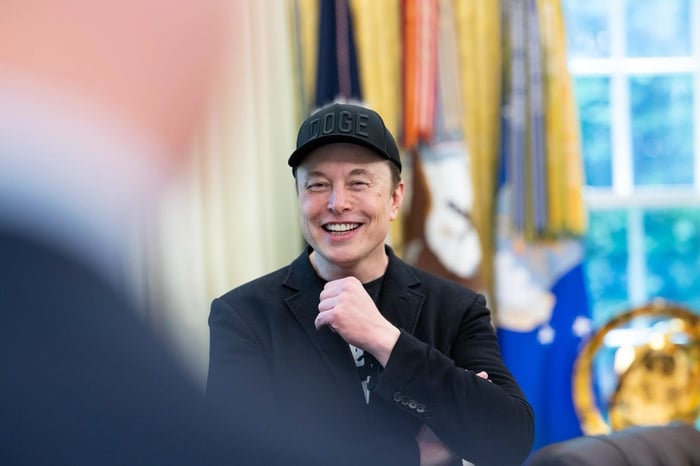
Image source: The White House.
Musk made an interesting observation about Nvidia's business last week that helps explain why he was so anxious to get Huang back on the job.
Why Musk was concerned about Nvidia's supply chain
Musk raised the possibility on Nov. 14 -- just a couple of days after Huang resigned -- that some of Nvidia's manufacturing arrangements were based on informal agreements with Huang rather than written contracts. "Without Jensen, at least some of those critical deals will be lost," he wrote.
Remember that Nvidia doesn't manufacture its own graphics processing units (GPUs). It relies on Taiwan Semiconductor Manufacturing (NYSE:TSM) to produce its most advanced chips. Nvidia also needs enormous quantities of specialized memory and relies on advanced packaging technology to integrate everything.
And TSMC has other customers competing for manufacturing capacity, including companies developing processors to compete directly with Nvidia.
Nvidia's revenue increased by 103% in the third quarter of fiscal 2027 (ending Oct. 25), and management expects revenue to reach $130 billion in the fourth quarter. Nvidia needs its suppliers to dramatically increase production to sustain that kind of growth.
I don't know how many of Nvidia's manufacturing commitments were actually dependent on Huang's personal relationships with suppliers. But it's easy to see why Musk wouldn't want to find out.
How this affects Tesla and SpaceX
Tesla makes most of its money from building electric vehicles, but it's undoubtedly becoming more of an artificial intelligence (AI) company, with ambitious plans for autonomous vehicles and humanoid robots. Much of the premium investors are willing to pay for Tesla stock today can be attributed to its potential to generate revenue from those bets.
Training the AI models that enable those products to function requires significant computing power. While Tesla has its own chip development efforts, there's a distinction between the processors that Tesla puts into its vehicles and the computing infrastructure it needs to train its autonomous driving software.
Tesla needs to keep improving its software if it's going to operate a robotaxi business at scale. Having to wait an extra six months for computing capacity, for instance, could be costly for Tesla if it delays the company's ability to expand its commercial operations.
SpaceX has an even more interesting relationship with Nvidia. Musk previously pledged that SpaceX would exclusively use Nvidia processors, and the chipmaker is already working with SpaceX on its AI computing infrastructure.
In last week's earnings report, Nvidia said its next-generation Vera Rubin computing systems were already operational at several cloud computing companies and would soon be online at SpaceX's AI infrastructure business.
That's great news for SpaceX shareholders, as AI is a key part of the company's growth ambitions. But it also illustrates how closely SpaceX's ability to expand its AI business is tied to Nvidia's ability to get increasingly sophisticated processors into customers' hands.
And unlike Nvidia, which is already making enormous profits from selling AI infrastructure, Musk's companies have considerable work ahead of them to justify their investments in the technology.
What it means for investors
One of the biggest concerns in the stock market is how long it will take companies spending billions of dollars developing AI products to generate an acceptable return on those investments.
There's no telling right now how much Tesla will spend on Optimus robots before they generate meaningful revenue. And the competitive market for AI applications means SpaceX can't afford to fall too far behind its rivals in developing increasingly capable AI models.
Neither company would benefit from having to revise its development timetable because of production problems at a semiconductor supplier.
I'm still more bullish on Nvidia as an AI investment than either of Musk's companies. But if you're investing in Tesla or SpaceX because you believe in Musk's ambitious AI plans, you should probably be rooting for Huang's success at Nvidia as well.
Musk certainly is.
Missed AI’s "Act 1"? Act 2 Could Be 14x Bigger
Most investors think they missed the AI boat because they didn't buy Nvidia in 2005.
But according to our analysts, we’re only at the end of "Act 1"—the R&D phase. "Act 2" is the global rollout, a massive technology build-out that Google’s CEO says could be more profound than fire or electricity.
While everyone watches the chip designers, one "backbone" company provides the critical technology that Nvidia and AMD literally cannot function without. We’ve detailed this under-the-radar player in our new AI Playbook.
Continue »
Patrick Sanders has positions in Nvidia. The Motley Fool has positions in and recommends Nvidia, Space Exploration Technologies, Taiwan Semiconductor Manufacturing, and Tesla. The Motley Fool has a disclosure policy.
Recommended Articles


