


2027 Is Around the Corner. Here's a Spectacular Vanguard ETF to Buy as Part of Your New Year's Resolution.
Key Points
Investors are navigating a number of headwinds heading into 2027, including rising interest rates and turmoil in the artificial intelligence industry (AI).
Being sufficiently diversified by owning the Vanguard Morningstar Total Stock Market ETF might be a sound strategy in the new year.
The ETF holds all 3,463 companies listed on American stock exchanges, from tech giants like Nvidia to up-and-coming growth stories like Bloom Energy.
- Motley Fool Issues Rare "Total Conviction" Buy Alert ›
2026 has been challenging for stock market investors. The diversified S&P 500 (SNPINDEX:^GSPC) index and the technology-heavy Nasdaq-100 index generated strong returns through the first nine months of the year, only to shed most of those gains since October. In fact, the Nasdaq-100 was recently down by more than 20% from its peak on an intraday basis.
With rising interest rates and turbulence in the artificial intelligence (AI) industry casting a cloud of uncertainty over the market, being diversified heading into 2027 might be a smart strategy. The Vanguard Morningstar Total Stock Market ETF (NYSEMKT:VTI) is one of the most diversified exchange-traded funds (ETFs) money can buy, because it tracks the Morningstar U.S. Total Market index, which holds all 3,463 companies listed on American stock exchanges.
Missed AI’s "Act 1"? Act 2 Could Be 15x Bigger. Most investors think they missed the AI boat because they didn't buy Nvidia in 2005. But according to our analysts, we’re only at the end of "Act 1"—the R&D phase. "Act 2" is the global rollout. Continue »
That means the ETF has exposure to tech giants like Nvidia and Amazon, alongside small-cap growth stocks like DigitalOcean and Duolingo. Here's why it could be a great buy for the new year.

Image source: Getty Images.
Exposure to large caps, small caps, and every stock in between
The Vanguard Morningstar Total Stock Market ETF is weighted by market capitalization, meaning the most valuable companies in the fund have a much greater influence over its performance than the least valuable. Therefore, its top five holdings also happen to be the largest companies in the U.S. (and the world): Nvidia, Apple, Microsoft, Amazon, and Alphabet.
Those five companies have a combined market cap of $18.7 trillion, so they represent 25.9% of the value of the Vanguard ETF's entire portfolio. That sounds like a very high weighting for an ETF that holds almost 3,500 different stocks, but those five giants have even bigger weightings of 29.2% in the S&P 500 and 50.1% in the Nasdaq-100.
Its lesser exposure to those tech powerhouses is the primary reason why the Vanguard ETF typically underperforms the S&P and Nasdaq-100 over the long term.
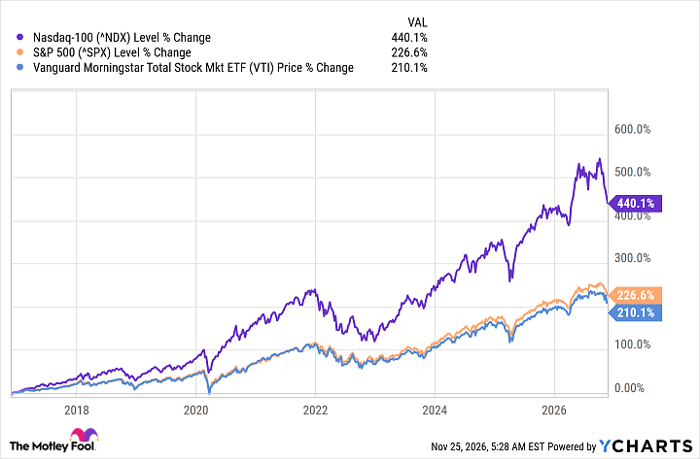
^NDX data by YCharts
However, its high level of diversification also means the Vanguard ETF tends to suffer shallower declines during volatile periods. For example, while the Nasdaq-100 was recently down by as much as 20% from its peak, the Vanguard ETF was down by just 11.5% at its lowest point.
There is another benefit to being highly diversified. The Vanguard ETF gives investors exposure to thousands of small- and mid-cap companies that aren't present in the major indexes. Here are some examples:
- Bloom Energy: This company manufactures clean energy solutions that are in high demand from AI data center operators.
- Upstart Holdings: This company developed an AI-powered algorithm that determines the credit-worthiness of potential borrowers, often more accurately than human-led alternatives.
- DigitalOcean: Most investors focus on hyperscalers like Microsoft and Amazon, but this small cloud provider is attracting AI customers at a lightning-fast pace.
- Lemonade: This insurance technology company uses AI to write quotes, pay claims, calculate premiums, and even run its operations. Its in-force premium growth has accelerated for 12 consecutive quarters.
The Vanguard ETF can help investors build life-changing wealth
The Vanguard Morningstar Total Stock Market ETF has delivered a compound annual return of 9.4% since it was established in 2001. However, thanks to the incredible growth in the technology sector, it has delivered a much faster annual return of 23.1% over the last three years.
Therefore, while its long-term returns tend to be relatively modest, the ETF is certainly capable of delivering accelerated gains in certain conditions. But even if we assume the fund delivers a compound annual return of just 9.4% going forward, that's still enough to help investors build life-changing wealth.
| Balance to Start 2027 | Compound Annual Return | Balance After 20 Years |
|---|---|---|
| $50,000 | 9.4% | $301,520 |
Calculations by author.
Not everybody can outlay $50,000 up front, so here's what consistent investments of $200 per month could look like after 20 years.
| Monthly Investment | Compound Annual Return | Balance After 20 Years | Total Investments |
|---|---|---|---|
| $200 | 9.4% | $141,871 | $48,200 |
Calculations by author.
As I highlighted earlier, those returns are likely to come with lower volatility compared to what investors might experience in larger indexes like the S&P 500 or the Nasdaq-100. That alone is an attractive proposition as we head into an uncertain 2027.
Should you buy stock in Vanguard Morningstar Total Stock Market ETF right now?
Before you buy stock in Vanguard Morningstar Total Stock Market ETF, consider this:
The Motley Fool Stock Advisor analyst team just identified what they believe are the 10 best stocks for investors to buy now… and Vanguard Morningstar Total Stock Market ETF wasn’t one of them. The 10 stocks that made the cut could produce monster returns in the coming years.
Consider when Netflix made this list on December 17, 2004... if you invested $1,000 at the time of our recommendation, you’d have $320,394!* Or when Nvidia made this list on April 15, 2005... if you invested $1,000 at the time of our recommendation, you’d have $917,381!*
Now, it’s worth noting Stock Advisor’s total average return is 776% — a market-crushing outperformance compared to 199% for the S&P 500. Don't miss the latest top 10 list, available with Stock Advisor, and join an investing community built by individual investors for individual investors.
See the 10 stocks »
*Stock Advisor returns as of November 27, 2026.
Anthony Di Pizio has positions in Duolingo. The Motley Fool has positions in and recommends Alphabet, Amazon, Apple, Bloom Energy, DigitalOcean, Duolingo, Microsoft, Nvidia, and Upstart. The Motley Fool has a disclosure policy.
Recommended Articles


