


S&P 500 Forecast: Tech Selloff May Near End, Index Poised to Rise 25% to Hit 9,000 by 2027
TradingKey - Deutsche Bank (DB) believes that the current tech sell-off may be nearing its end. As the market gradually digests uncertainties surrounding AI investment scale, corporate capital expenditures, and industry governance, risk appetite in US equities is poised to recover, driving the S&P 500 Index (US500) to 9,000 by 2027.
Since mid-October, skepticism surrounding the commercial returns of artificial intelligence has continued to mount, with investors concerned that tech giants are spending excessively on building data centers, procuring chips, and expanding computing capacity, while it remains unclear whether related revenues can cover costs in a timely manner. As a result, the Nasdaq 100 Index has fallen about 12% cumulatively, while the semiconductor sector has dropped nearly 29%.
Nvidia's management turmoil further rattled market confidence at one point, with Jensen Huang's return to helm the company after his departure exacerbating volatility across the chip sector. Meanwhile, Anthropic's post-IPO performance also failed to completely reverse investors' cautious stance on the AI trade. In addition, valuation pressures triggered by Alphabet's earnings, the US midterm elections, and tech infrastructure outages further magnified the market correction.
However, a Deutsche Bank team led by Chief US Equity & Global Strategist Binky Chadha pointed out that over the past two and a half years, the tech sector has experienced five distinct capital rotations. Historical experience shows that event-driven tech sell-offs typically take six to eight weeks to digest before volatility gradually recedes, with share prices often carving out an interim bottom during this phase. Judging by this pattern, the duration and magnitude of the current correction are gradually approaching the bottom zones of past cycles.
Deutsche Bank expects that capital expenditure growth among hyperscale cloud providers may peak in 2027, but this does not mean the AI industry will turn into a downturn. As enterprise adoption transitions from infrastructure buildout to actual deployment and commercial monetization, profit contributions from artificial intelligence could accelerate instead. A rebound in manufacturing activity, expanded hiring in cyclical sectors, and productivity improvements are also expected to provide extra support for corporate earnings.
Based on these projections, the bank forecasts that earnings per share for S&P 500 constituents will grow by about 19% in 2027 and sets its target for the index at 9,000, higher than the Wall Street consensus of around 8,700. Based on Wednesday's closing price of 7,182.78 for the S&P 500, this target implies more than 25% upside ahead.
In addition to earnings growth, supply and demand dynamics for capital may continue to support US equities. Deutsche Bank believes that as long as corporate profits continue expanding, investors still have ample reason to increase equity allocations. Although cross-asset capital inflows that took shape post-pandemic have persisted for a relatively long period, there are currently no clear signs of a reversal, and the volume of share buybacks is also likely to keep rising alongside improving corporate profits.
Meanwhile, an uptick in IPO and follow-on offering activity indicates that equity supply is expanding, which could moderate the index's pace of ascent to some extent. However, the bank believes that robust financing activity itself reflects ample market demand, and new supply is more likely to curb the slope of the bull market rather than end the upward trend.
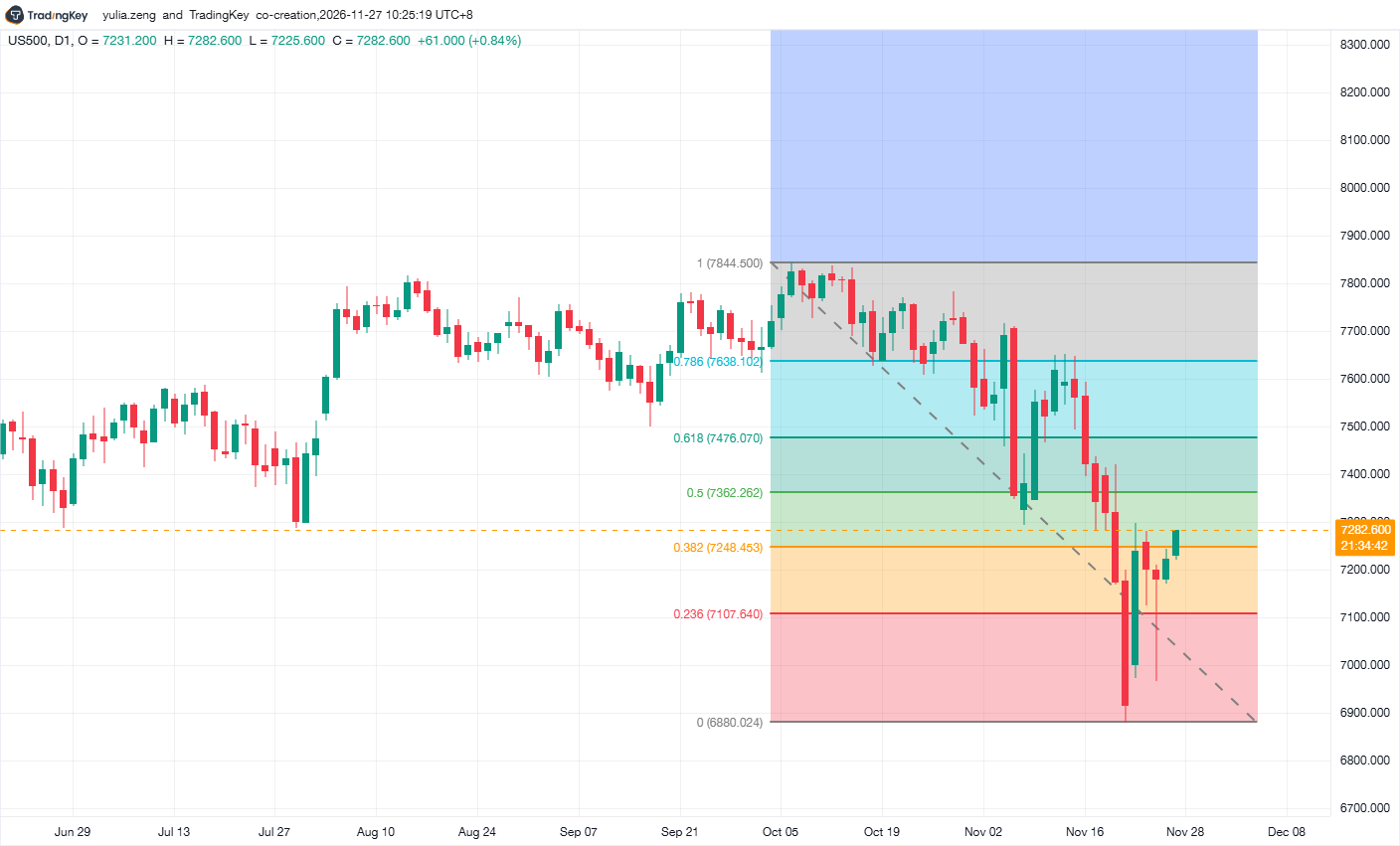
Source: TradingKey
From a daily chart perspective, the S&P 500 rebounded swiftly after falling to near 6,880, initially breaking free from the resistance of its prior downward trendline. The index has currently risen to around 7,283, reclaiming the 38.2% Fibonacci retracement level of 7,248. This indicates that buying support at lower levels is strengthening and that the pressure on the broader market from the concentrated tech sell-off is abating.
If the index maintains solid footing above 7,248, the next levels to watch are 7,362 and 7,476; a breakout could lead to further tests of the previous highs at 7,638 and 7,845. If 7,845 is effectively breached later on, the medium-term target could reach toward 8,400, and could further challenge 9,000 in 2027, an increase of roughly 25% from current levels. Conversely, if 7,248 is lost again, the index may pull back to 7,108, with 6,880 to 7,000 serving as the core support zone for this rebound.
Recommended Articles


