


Nasdaq Plunges 5%, Erasing All Year-to-Date Gains; Nvidia Tumbles 13% as AI Stock Selloff Deepens
TradingKey - On Friday, November 20, Eastern Time, U.S. stocks tumbled as the sell-off in AI stocks intensified. Anthropic gave back most of its first-day gains on its second trading day after going public, while Nvidia widened its losses following new reports of an SEC investigation. The Nasdaq Composite Index erased all of its year-to-date gains, and both the S&P 500 and the Dow fell into technical correction territory intraday.
At the close, the Dow Jones Industrial Average fell 1.93% to 48,147.33; the Nasdaq Composite Index fell 5.28% to 22,617.73; and the S&P 500 Index fell 3.70% to 6,910.39.
Tech Stock Performance
Nvidia (NVDA) fell as much as about 13% intraday on Friday, with losses widening further after Reuters reported that the U.S. Securities and Exchange Commission is reviewing its potential accounting issues.
The performance of large-cap tech stocks today is shown in the chart below:
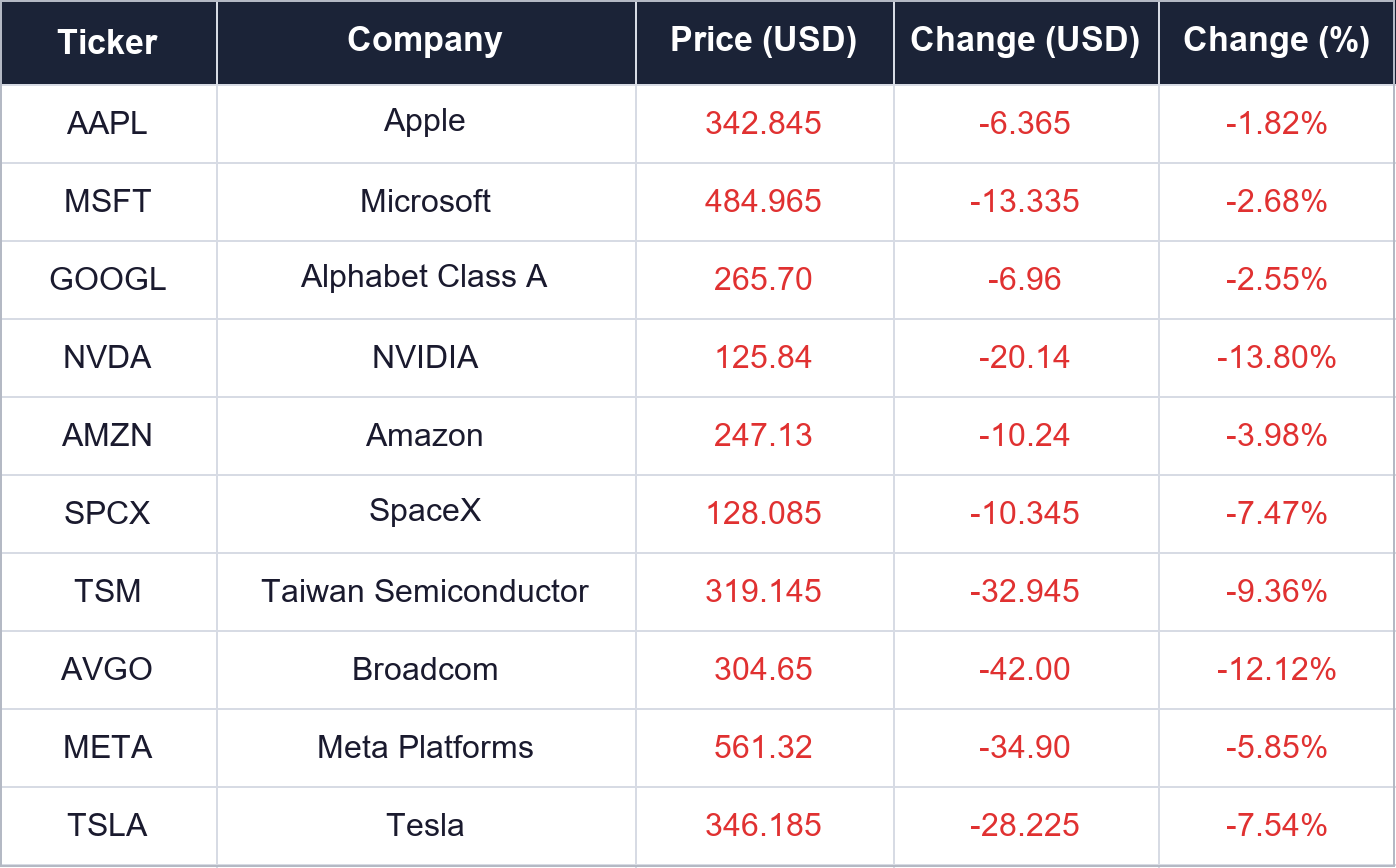
The Philadelphia Semiconductor Index fell 10.73%, with all 30 constituent stocks declining. Among them, Micron Technology (MU) fell 13.86%, Advanced Micro Devices (AMD) fell 13.26%, Applied Materials (AMAT) fell 10.75%, Lam Research (LRCX) fell 9.82%, Intel (INTC) fell 7.82%, Texas Instruments (TXN) fell 7.57%, and ASML (ASML) fell 6.44%.
Company News
Reuters: US SEC Reportedly Reviewing Nvidia Over Potential Accounting Issues
Enforcement staff at the US Securities and Exchange Commission (SEC) are reviewing potential accounting issues at Nvidia, Reuters reported on Friday, citing two people familiar with the matter. The Wall Street Journal first reported on Tuesday that the SEC was investigating Nvidia, though the focus of the probe could not be determined at that time. The SEC declined to comment, while Nvidia did not immediately respond to Reuters' request for comment. It remains unclear when the investigation began or which specific accounting matters are involved, and the inquiry itself does not imply that regulators have determined any wrongdoing occurred.
Google Reportedly Shifts to Direct Sourcing of HBM for TPUs, Bernstein Estimates Savings of About $50 Billion
According to South Korean media reports, Google (GOOGL) is seeking to directly procure the High Bandwidth Memory (HBM) needed for its in-house AI chip, the TPU, shifting away from a previous model where Broadcom (AVGO) coordinated parts of the design, packaging, and memory procurement. Research firm Counterpoint stated that in some TPU projects where Google partners with MediaTek, Google is responsible for compute chip design, while MediaTek handles input/output (I/O) chips. Bernstein estimates that if Google adopts this new division of labor and procurement model, reducing fees paid to design partners and markups in the HBM procurement process, it could save about $50 billion over the product lifecycle of the relevant TPUs and free up budget to expand procurement volumes.
Industry & Macro News
Vance did not explicitly state whether he supports renewed military action against Iran, saying military decisions are made by Trump
U.S. Vice President Vance said at a White House press conference on Friday that preventing Iran from acquiring nuclear weapons remains a U.S. goal. Regarding whether he supports renewed military action, he did not take a clear stance, saying only that military action is decided by the president and that his duty is to support the president. Trump previously defended the military action in February this year, saying it was necessary to take action at the time and that he would still make the same decision. Vance previously viewed the Iran war as a major reason for the Republican Party's midterm election defeat and participated in pushing for U.S.-Iran negotiations. Last week, Trump asked Vance to shift his focus to domestic affairs and publicly stated that the U.S. does not currently need to reach an agreement with Iran.
Recommended Articles


