


Memory Stocks Surge, Micron Jumps 11% as Morgan Stanley Says Valuation Pullback Improves Memory Stocks' Risk-Reward
TradingKey - On November 11, Eastern Time, memory stocks surged, with SanDisk (SNDK) up 13.95%, Micron Technology (MU) up 11.03%, Seagate Technology (STX) up 9.94%, SK Hynix (SKHY) up 9.40%, and Western Digital (WDC) up 7.50%. Following a month-long pullback, Morgan Stanley believes that a clear divergence has emerged between supply-chain orders and capital-market sentiment, and that the pullback in valuations has improved the risk-reward profile for memory stocks, with the firm particularly bullish on Micron Technology and SanDisk.
Morgan Stanley analyst Joseph Moore pointed out that visibility in the AI infrastructure business remains exceptionally strong. The firm's discussions with customers indicate that well-capitalized enterprises remain firmly committed to executing multi-year investment plans, with new orders continuously flowing into already-booked capacity. Even emerging cloud providers facing higher financing costs are confronting compute supply shortages.
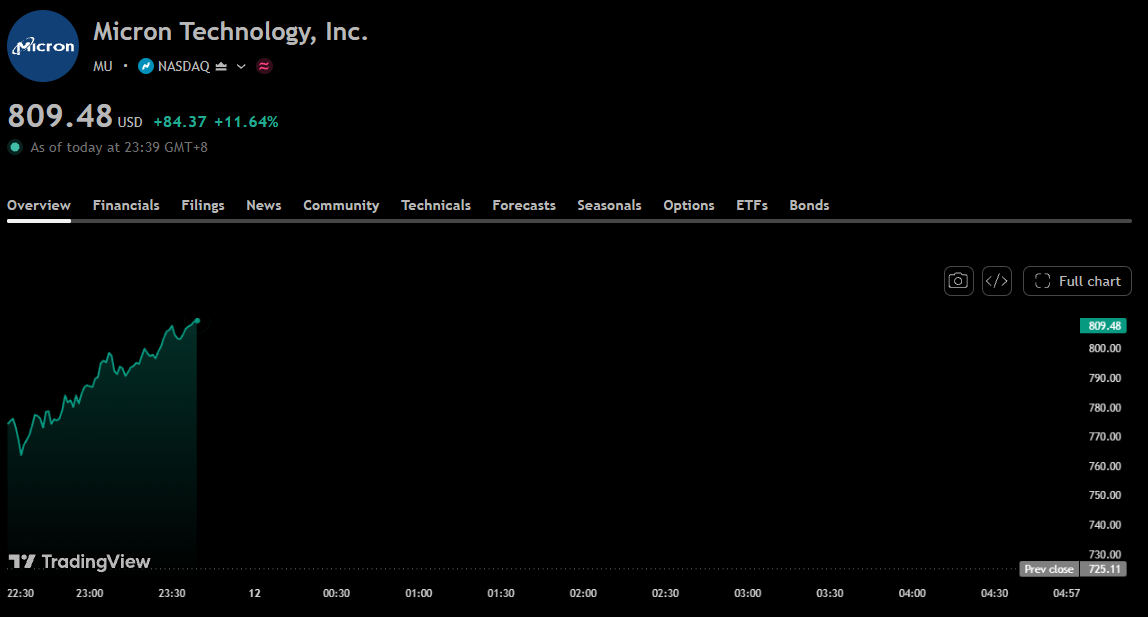
Micron stock price chart, Source: TradingView
This feedback provides support for memory demand. The ongoing deployment of AI servers and accelerators requires accompanying memory and storage equipment; the firm observed that AI compute token usage continues to grow rapidly, total related spending has rebounded to historic highs, and mainstream GPU rental prices remain relatively strong. At least based on these indicators, market concerns have not yet evolved into a broad-based demand contraction.
The market is currently most focused on land, power, and facility constraints. Morgan Stanley acknowledges that deployment slowdowns in states such as Texas and Ohio represent localized disruptions, but believes the primary bottleneck through 2027 will remain semiconductor supply: even within already approved spaces, customers lack sufficient chips to complete deployments. Meanwhile, companies are actively seeking alternative locations in other states and outside the U.S.
Based on this assessment, delays in certain projects are more likely to alter the pacing of equipment deliveries rather than eliminate procurement demand altogether. Phased construction could also lengthen the demand cycle for upstream suppliers. For memory manufacturers, the key lies in whether orders will continue to be fulfilled as projects adjust, and whether supply-demand dynamics across various product categories can support average selling prices and profit margins.
In terms of sub-sector allocation, Morgan Stanley ranks memory as its second-most preferred area after compute, arguing that valuation compression has created substantial upside, and holds an equally positive view on Micron and SanDisk. The firm also noted that free cash flow accumulated during this cycle is being deployed for share buybacks. If companies can continue to generate cash and reduce shares outstanding, it will provide additional support for earnings per share and shareholder returns.
However, Morgan Stanley still maintains a range-bound view for the sector as its baseline: near-term business fundamentals provide downside support for share prices, while capital market sentiment and construction constraints cap valuation recovery. What could genuinely derail this thesis is if customers begin cutting procurement, turning current earnings into a cyclical peak. The firm believes current supply-chain feedback continues to support demand sustainability, and therefore leans toward aggressively positioning when the sector approaches the lower end of the range. Going forward, order trends, selling prices, and cash flow performance among memory manufacturers will determine whether this pullback can translate into an investment opportunity.
Recommended Articles


