


CoreWeave Surges 17% Premarket After Earnings, Beats Revenue Estimates and Raises Full-Year Guidance
TradingKey - CoreWeave (CRWV) shares jumped as much as about 17% in premarket trading on Wednesday to near $57, reversing a prior prolonged decline. The rebound was primarily driven by third-quarter revenue topping market estimates and upward revisions to full-year 2026 revenue and adjusted operating profit guidance, which eased investor concerns over slowing demand for AI computing power.
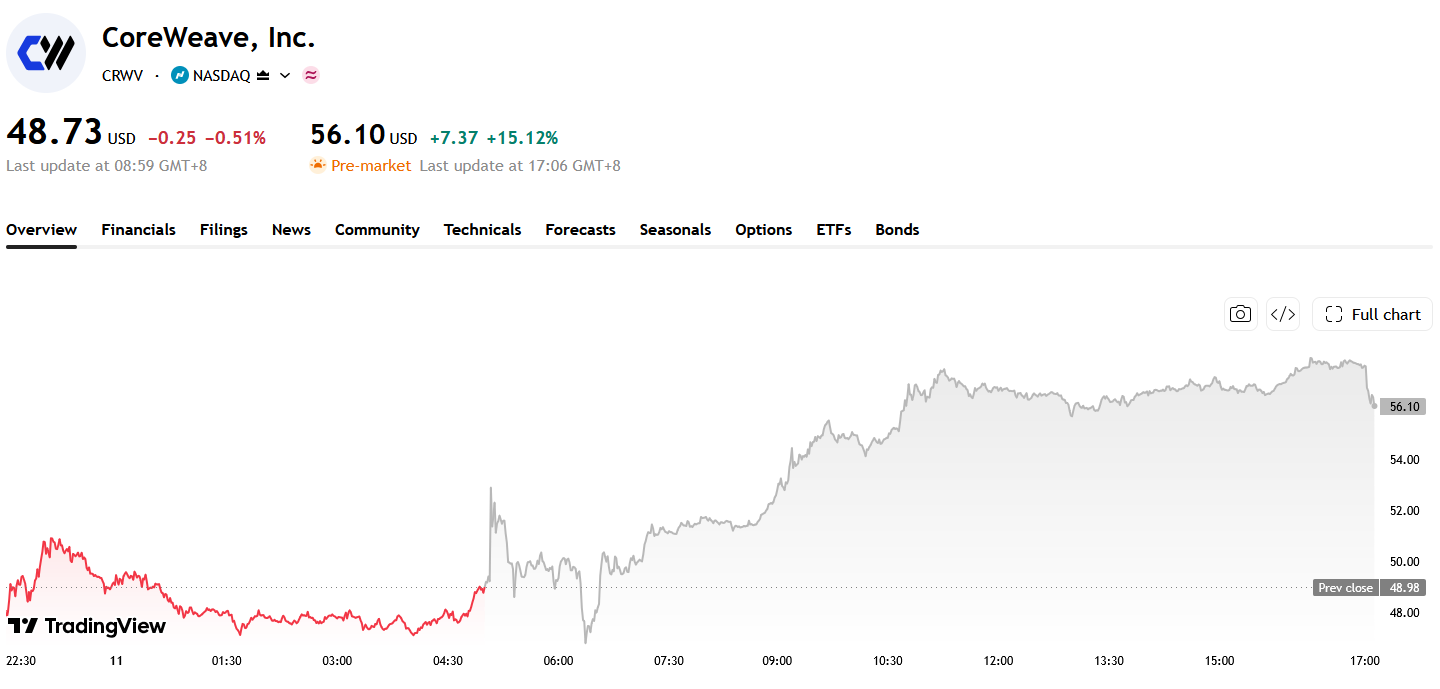
Source: TradingView
According to the earnings report, CoreWeave's third-quarter revenue reached $3.661 billion, up 168% from $1.365 billion in the same period last year, exceeding market expectations of about $35.5 billion and increasing by approximately $1 billion quarter-over-quarter. Adjusted operating income was $379 million, representing an operating margin of about 10%. The company's revenue backlog further expanded to $132.5 billion, a 138% year-over-year increase and above the $104 billion recorded at the end of the second quarter, demonstrating that demand from large tech companies for GPU cloud services and AI infrastructure remains robust.
Based on third-quarter performance and delivery progress on existing contracts, CoreWeave raised its full-year 2026 revenue guidance to between $13 billion and $13.3 billion, up from the previous forecast of $12.4 billion to $13.2 billion. The company also increased its adjusted operating profit target to between $1.275 billion and $1.375 billion, with the midpoint rising by about 26% from the original forecast. Its year-end annualized revenue run-rate expectation was concurrently lifted to between $20 billion and $21 billion.
The expansion in order backlog and revenue guidance indicates that CoreWeave maintains strong business growth momentum following the recent sell-off in the AI infrastructure sector. The company stated that customer demand for 2027 significantly exceeds currently available capacity, while its newly launched AI development platform, Forge, is also helping it secure more cloud computing customers. As signed contracts gradually convert into revenue, previous market concerns regarding an oversupply of AI computing power have temporarily eased.
As of the end of the third quarter, CoreWeave's debt stood at approximately $46.9 billion; including lease liabilities, total debt and lease obligations reached $66.2 billion, up from $51.6 billion at the end of the second quarter. The company held about $4.1 billion in cash, alongside $2.3 billion in restricted cash. The ongoing expansion of its data center footprint requires substantial external capital, and its elevated leverage remains a primary risk in market assessments of CoreWeave's valuation.
The company's third-quarter capital expenditures reached $14.5 billion, and it adjusted its full-year 2026 capex range to between $37 billion and $39 billion, compared to the prior range of $35 billion to $39 billion. Management noted that raising the lower bound was primarily due to certain infrastructure being on track for early delivery to customers. The company still expects active power capacity in operation to exceed 1.85 gigawatts by the end of the year.
To lower financing costs, CoreWeave plans to reduce its reliance on high-yield unsecured bonds and shift toward asset-backed loans collateralized by Nvidia chips and other computing equipment. The loans are expected to reach billions of dollars, with financing interest rates of about 7% to 7.5%, substantially lower than market yields of over 16% on some unsecured bonds. The company also expects to receive approximately $9 billion in prepayments and deposits from signed customer contracts over the next three months to fund data center construction.
This financing structure has helped alleviate investor concerns regarding liquidity to some extent. Customer prepayments reduce the internal capital CoreWeave needs to deploy upfront, while using GPUs and other equipment as collateral helps lower the cost of new borrowings. The company stated that through 2027, additional capital required to be raised at the parent company level is expected to be under $5 billion, and it will flexibly adjust capital expenditures based on market conditions and customer demand.
Recommended Articles


