


Data Center Stocks Just Plunged After the Midterms. Is It Time to Buy the Dip?
Key Points
Stocks of data center builders and equipment makers fell as much as 24% on Wednesday, even as the S&P 500 rose about 2%.
Texas, home to about 27% of planned U.S. data center capacity, elected a governor who wants an immediate moratorium on new data centers.
Order books are still growing fast, so the drop may be a buying window for patient investors, but expect a bumpy ride.
- Motley Fool Issues Rare "Total Conviction" Buy Alert ›
The AI building boom just ran into politics, or at least the stocks behind the buildup did. On Wednesday, the day after Democrats won control of the House and Senate, investors dumped the companies that build data centers and supply their power and cooling equipment. By midmorning, Modine (NYSE:MOD) was down about 24%, Sterling Infrastructure (NASDAQ:STRL) about 19% and Comfort Systems USA (NYSE:FIX) about 16%. Even the industry's giants weren't spared: Vertiv (NYSE:VRT) and GE Vernova (NYSE:GEV) were each down roughly 11% to 12%. Meanwhile, the S&P 500 climbed about 2%.
So, what spooked investors? And is this the kind of drop worth buying?
Missed Nvidia in 2009? This Rare Signal Is Flashing Again. In 2009, a "Double Down" signal flashed for a little-known chipmaker called Nvidia. For the first time in years, that same "Total Conviction" signal is flashing for a company 1/100th the size of Nvidia. Continue »
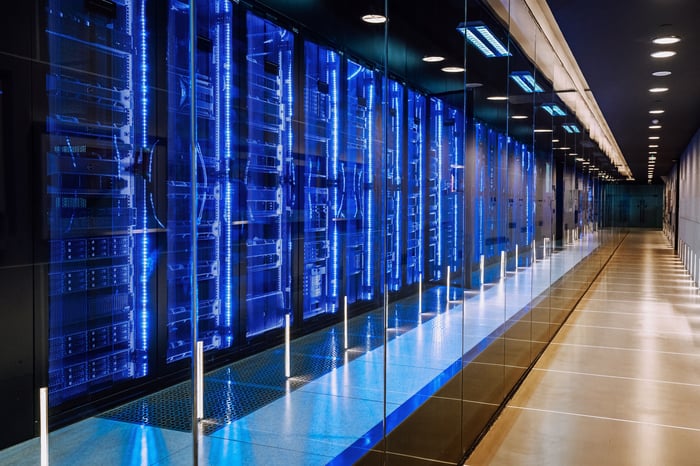
Image source: Getty Images.
Why Data Center Stocks Fell
A Democratic House was largely expected, so much of that was largely priced in, but one of the bigger shocks came from Texas, where Democrat Gina Hinojosa defeated Republican Gov. Greg Abbott after campaigning for an immediate moratorium on new data centers. That's a big deal, because Texas holds about 27% of the data center capacity planned in the U.S., according to Wells Fargo.
And it may not stop at Texas. Goldman Sachs analysts expect Democratic governors in Texas, Georgia and Michigan "to impose conditional moratoria pending new legislation restricting data centers." That legislation, they wrote, could end certain tax breaks and tighten environmental, water and electricity rules. By Goldman's estimate, the states likely to add restrictions account for 45% of planned U.S. data center capacity.
Dan Ives of Yorkville Ives & Co. didn't mince words: "There is no way to sugarcoat that Democrats taking control especially over the Senate will create some major hurdles for AI and tech legislation in the Beltway over the next 2 years."
What Didn't Change: The Order Books
But long-term investors should find comfort in what the sell-off seems to be ignoring. Within the past two weeks, several of these companies told investors that demand is booming.
Vertiv's third-quarter sales jumped 61% to $4.3 billion, its organic orders more than doubled, and it raised its full-year sales forecast by $650 million. As it updated the guidance, the firm noted that the data center market "continues to generate strong, broad-based global demand," which of course extends well beyond the U.S. Meanwhile, GE Vernova's backlog grew by $20 billion in a single quarter to $197 billion, and the company expects it to top $200 billion by year-end. It also raised its guidance and doubled its buyback authorization to $20 billion.
The builders look just as busy. Comfort Systems' backlog hit $17.8 billion, nearly double the $9.4 billion of a year earlier. Sterling's revenue more than doubled, rising 127%, and its combined backlog grew 78% to $6.1 billion. And Modine, the hardest-hit on Wednesday, saw its data center sales nearly double, up 95% to $440 million, as it reported record orders and backlog in that business after the market closed on Tuesday.
Backlog is work customers have already committed to, and nothing that happened on Tuesday automatically cancels it. In fact, the companies paying for the buildout had a good day. Amazon (NASDAQ:AMZN) and Microsoft (NASDAQ:MSFT) were each up about 6% late Wednesday morning.
The Risks Are Real, Though
Policy moves slowly, but it can raise costs. Lost tax breaks, stricter power and water rules, and local moratoria could delay projects that haven't broken ground yet. If that happens, it would show up first in new orders, and later in sales for 2027 and beyond.
It's also important to note that there are already a few soft spots. Sterling booked slightly less new signed work than it completed in the third quarter, and Modine's data center gross margin fell by 4.7 percentage points to 19.7%, a sign that its growth is getting more expensive and surely something that impacted the stock on Wednesday as well. Separately, some of these stocks had run up a lot: Comfort Systems was up over 30% this year before Wednesday's drop, so there was plenty of room to fall.
So, Is It Time to Buy Data Center Stocks?
For long-term investors, Wednesday's sell-off looks more like an overreaction than a broken story, at least for the strongest companies. Their backlogs should keep them busy well into 2027, and a slowdown in a few states doesn't end the global demand for computing power.
But not every name deserves the same confidence. GE Vernova sells power equipment to utilities around the world, not just to data centers, and Vertiv's growth is spread across every region, with sales up 75% in the Americas, 50% in Asia-Pacific and 23% in Europe, the Middle East and Africa. Those two ight be the sturdier ways to buy the dip, while smaller, more concentrated builders like Sterling and Modine carry more risk if projects in Texas stall.
If you're buying, consider doing it in stages rather than all at once because policy headlines will almost certainly keep these industrial stocks volatile. The thing to watch is what Hinojosa actually does once she takes office, how the legislative agenda evolves once the new Congress gets started, and whether orders hold up when these companies report again early next year.
Missed AI’s "Act 1"? Act 2 Could Be 14x Bigger
Most investors think they missed the AI boat because they didn't buy Nvidia in 2005.
But according to our analysts, we’re only at the end of "Act 1"—the R&D phase. "Act 2" is the global rollout, a massive technology build-out that Google’s CEO says could be more profound than fire or electricity.
While everyone watches the chip designers, one "backbone" company provides the critical technology that Nvidia and AMD literally cannot function without. We’ve detailed this under-the-radar player in our new AI Playbook.
Continue »
Jonathan Ponciano has no position in any of the stocks mentioned. The Motley Fool has positions in and recommends Amazon, Comfort Systems USA, GE Vernova, Microsoft, Modine Manufacturing, Sterling Infrastructure, and Vertiv. The Motley Fool has a disclosure policy.
Recommended Articles


