


What a $1,000 Investment in Palantir Could Be Worth by the End of 2027 (The Answer May Surprise You)
Key Points
Palantir's revenue growth rate has continuously climbed in recent years.
During the second quarter, its profit margin was an incredible 55%.
Trading at 122 times forward earnings, the stock carries an unusually expensive premium.
- 10 stocks we like better than Palantir Technologies ›
Palantir (NASDAQ: PLTR) has been among the top artificial intelligence stocks to invest in for a while. It has delivered strong returns year after year, although 2026 has been an exception. It has risen only about 10% this year, which is disappointing compared to prior years. However, those who are bullish on Palantir may interpret this as a period of consolidation for the stock, one that's positioning it for an incredible 2027.
But is this true, or is there something else going on with Palantir? I think there's more to this story, and I'd suggest that investing in the stock right now might not be the best idea.
Missed AI’s "Act 1"? Act 2 Could Be 15x Bigger. Most investors think they missed the AI boat because they didn't buy Nvidia in 2005. But according to our analysts, we’re only at the end of "Act 1"—the R&D phase. "Act 2" is the global rollout. Continue »
Image source: The Motley Fool.
Palantir is growing at a strong pace
Palantir develops AI-powered data analytics software that helps its users deliver actionable insights from live data streams. This software was originally marketed to the U.S. government and was eventually sold to other allied nations. Palantir established a major foothold as a service provider to the government sector, and eventually expanded its reach to the commercial market. Its products have been hugely successful there, and its latest success has been driven by its Artificial Intelligence Platform (AIP), which allows users to deploy AI agents.
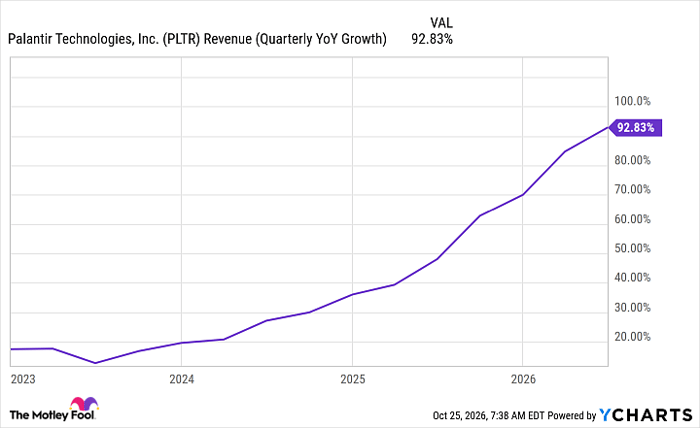
Palantir's software integrates smoothly with the most widely used business systems, and in an environment where many companies are looking for ways to adopt and implement AI, its top line has been growing rapidly.
PLTR Revenue (Quarterly YoY Growth) data by YCharts.
Despite forecasts that its revenue growth would slow, Palantir continues to outperform expectations quarter after quarter. We'll see what its third-quarter results look like in a few weeks, but as of Q2, Palantir's growth rate was still accelerating.
Another bonus for Palantir shareholders is that it isn't a growth-at-all-costs company. During Q2, its profit margin was an incredible 55%. There were no weird accounting tricks being used, either -- that was actual profit that Palantir was generating. For investors who only want to invest in companies with positive cash flows, that impressive result will look attractive.
Between the high-growth investors and the positive-cash-flow investors, there's an army of investors who would find these shares potentially appealing, which is probably why Palantir's stock has held up as well as it has this year. However, there's one glaring red flag, and it could lead to a disappointing performance going forward.
Palantir's stock is very expensive
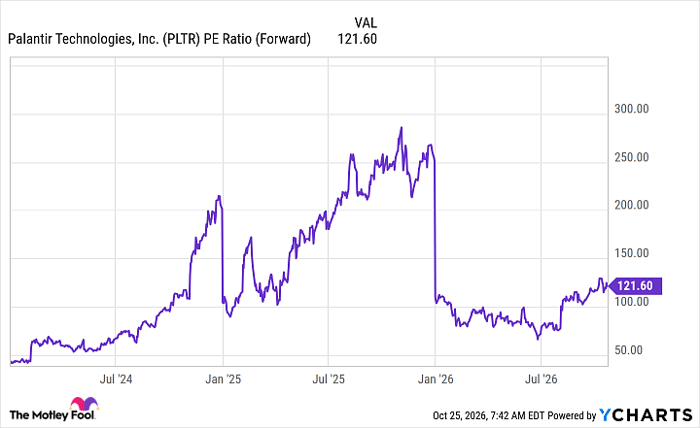
Because Palantir's profit margins are high, the best way to value the stock is via the price-to-earnings ratio. And because it's growing rapidly, weighing its value based on 2026 earnings projections makes the most sense.
PLTR PE Ratio (Forward) data by YCharts.
Trading at 122 times forward earnings, Palantir's stock is downright expensive. You'd be hard-pressed to find a company that trades at a similar valuation that also has Palantir's high profit margins.
A far more reasonable valuation for Palantir would be around 30 times forward earnings. For its valuation to contract to that level without the stock slumping would require its profits to triple after 2026 wraps up. That would demand a lot of growth. Given that, on average, Wall Street analysts estimate that Palantir's earnings growth rate will be about 50% next year, it could take a long time for Palantir stock to reach a reasonable valuation solely via bottom-line growth.
So, what will a $1,000 investment made in Palantir today be worth in late 2027? I think it will actually lose value. The reality is there is far too much hoped-for growth priced into Palantir's stock now, and with other AI software giants on course to go public, investors may be more attracted to companies like Anthropic or OpenAI. This pivot could put heavy selling pressure on Palantir's stock, bringing the price down to a far more reasonable level.
As a result, I think investors would be better off buying different AI stocks, as Palantir will have a tough time justifying further share price growth for quite a while.
Should you buy stock in Palantir Technologies right now?
Before you buy stock in Palantir Technologies, consider this:
The Motley Fool Stock Advisor analyst team just identified what they believe are the 10 best stocks for investors to buy now… and Palantir Technologies wasn’t one of them. The 10 stocks that made the cut could produce monster returns in the coming years.
Consider when Netflix made this list on December 17, 2004... if you invested $1,000 at the time of our recommendation, you’d have $337,166!* Or when Nvidia made this list on April 15, 2005... if you invested $1,000 at the time of our recommendation, you’d have $1,339,143!*
Now, it’s worth noting Stock Advisor’s total average return is 904% — a market-crushing outperformance compared to 213% for the S&P 500. Don't miss the latest top 10 list, available with Stock Advisor, and join an investing community built by individual investors for individual investors.
See the 10 stocks »
*Stock Advisor returns as of October 29, 2026.
Keithen Drury has no position in any of the stocks mentioned. The Motley Fool has positions in and recommends Palantir Technologies. The Motley Fool has a disclosure policy.
Recommended Articles


