


1 Glorious Growth Stock Down 78% to Buy on the Dip in September
Key Points
Demand for Docusign's digital agreement tools soared at the height of the COVID-19 pandemic.
But that changed once lockdowns were lifted, resulting in a steep sell-off in Docusign stock.
Docusign now has a new platform that uses AI to transform contract management processes.
- 10 stocks we like better than Docusign ›
When the COVID-19 pandemic triggered widespread lockdowns and social restrictions in 2020, businesses turned to Docusign (NASDAQ: DOCU) to help them remotely draft, negotiate, and close commercial agreements. The soaring demand for its platform drove its stock to a record high of $310 in late 2021, a whopping tenfold increase from its initial public offering (IPO) price of $29 just three years earlier.
But Docusign suffered a sharp slowdown in demand for its platform when social conditions mostly returned to normal in 2022, and its sales growth has been sluggish ever since. As a result, its stock is down 78% from its peak, closing at $68.41 last Friday, Sept. 4.
Missed Nvidia in 2009? This Rare Signal Is Flashing Again. In 2009, a "Double Down" signal flashed for a little-known chipmaker called Nvidia. For the first time in years, that same "Total Conviction" signal is flashing for a company 1/100th the size of Nvidia. Continue »
But this might be a great long-term opportunity for investors, because Docusign's new Intelligent Agreement Management (IAM) platform could be the key to turning its fortunes around. It uses artificial intelligence (AI) to transform contract management processes for businesses, and it's proving to be very popular with customers.

Image source: Getty Images.
The IAM platform continues to expand
Docusign says around 65% of organizations still use four or more tools to manage their agreement workflows, creating friction and significant inefficiencies. In 2024, global consulting firm Deloitte found that businesses were collectively wasting around 55 billion hours per year due to poor contract management processes, resulting in $2 trillion in lost economic value. IAM was designed to help them recover some of that time and money.
IAM features a unique digital repository called Agreement Manager, where businesses have collectively stored over 300 million contracts. It uses AI to extract valuable information from each document and make it discoverable via a search function, so managers can quickly find expiry dates to get ahead of sales agreements that are about to lapse, or stop auto-renewals for contracts they no longer need.
In August, Docusign expanded IAM significantly with a series of new features. There is now an AI assistant powered by the company's AI engine, Iris, which stands ready to answer questions about any contract within the organization's ecosystem. Then there is Agent Studio, which allows businesses to build custom AI agents to help draft, negotiate, and close agreements.
IAM launched in 2024, so it's still a relatively new platform. Around 40,000 of Docusign's 1.9 million paying customers have adopted it so far, leaving significant room for growth.
Steady growth in revenue and profits
Docusign generated $875.7 million in revenue during its fiscal 2027 second quarter (ended July 31), topping management's forecast of $865 million to $869 million. It represented a modest 9% increase over the year-ago period, so the company isn't growing at a lightning-fast pace right now.
However, management is deliberately sacrificing some top-line growth to focus on profitability, resulting in a more sustainable business over the long term. While Docusign's revenue increased by 9% during the second quarter, its total operating expenses grew by just 2%, allowing more money to flow to the bottom line. This resulted in a 23% increase in the company's generally accepted accounting principles (GAAP) net income, which came in at $77.7 million.
Docusign delivered an even higher net income of $224.4 million on an adjusted (non-GAAP) basis, which excluded one-off and non-cash expenses. But investors shouldn't automatically dismiss items like the company's $148.6 million in stock-based compensation just because it's a non-cash expense. Whenever new shares are issued to employees as part of their compensation package, it dilutes the value of every existing share in circulation, which is a drag on investors' potential returns.
Docusign's valuation leaves room for upside
Docusign stock is currently trading at a price-to-sales (P/S) ratio of 4.1, which is a steep discount to its average of 11.8 since the company went public in 2018.
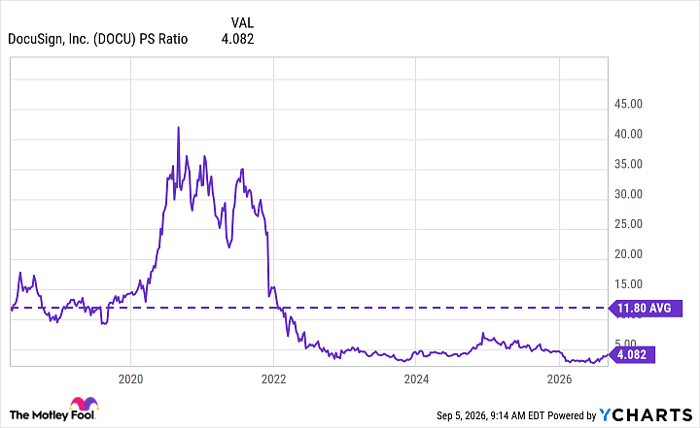
DOCU PS Ratio data by YCharts
I think Docusign stock looks attractively valued right now, particularly because IAM has the potential to reignite the company's top-line growth. Management is forecasting $3.55 billion in total annual recurring revenue (ARR) by the end of fiscal 2027, with around 18.5% expected to come from IAM alone. At the end of fiscal 2025 (roughly 18 months ago), IAM represented just 2.3% of ARR, so adoption is ramping up at an explosive pace.
Therefore, Docusign stock could be a solid buy at the current price, given IAM could soon become a significant part of the business.
Should you buy stock in Docusign right now?
Before you buy stock in Docusign, consider this:
The Motley Fool Stock Advisor analyst team just identified what they believe are the 10 best stocks for investors to buy now… and Docusign wasn’t one of them. The 10 stocks that made the cut could produce monster returns in the coming years.
Consider when Netflix made this list on December 17, 2004... if you invested $1,000 at the time of our recommendation, you’d have $421,997!* Or when Nvidia made this list on April 15, 2005... if you invested $1,000 at the time of our recommendation, you’d have $1,413,876!*
Now, it’s worth noting Stock Advisor’s total average return is 978% — a market-crushing outperformance compared to 213% for the S&P 500. Don't miss the latest top 10 list, available with Stock Advisor, and join an investing community built by individual investors for individual investors.
See the 10 stocks »
*Stock Advisor returns as of September 8, 2026.
Anthony Di Pizio has no position in any of the stocks mentioned. The Motley Fool has positions in and recommends Docusign. The Motley Fool has a disclosure policy.
Recommended Articles


