


BioNTech vs. Moderna: Which Is the Better Cancer Vaccine Stock to Buy Now?
Key Points
BioNTech and Moderna are no longer generating significant revenue from their coronavirus vaccines.
Both have attractive pipelines that could lead to important new approvals over the next few years.
One of them has had much more impressive clinical progress recently.
- 10 stocks we like better than BioNTech Se ›
BioNTech (NASDAQ: BNTX) and Moderna (NASDAQ: MRNA) burst onto the scene during the pandemic. Both developed and marketed some of the most successful mRNA-based coronavirus vaccines and were handsomely rewarded for it. However, their financial results have worsened as the pandemic has waned, and they have lagged broader equities over the past five years. Now for the good news: BioNTech and Moderna may have bright futures as they advance their vaccine candidates. But which one will deliver stronger returns?

Image source: Getty Images.
Missed Nvidia in 2009? This Rare Signal Is Flashing Again. In 2009, a "Double Down" signal flashed for a little-known chipmaker called Nvidia. For the first time in years, that same "Total Conviction" signal is flashing for a company 1/100th the size of Nvidia. Continue »
The case for BioNTech
BioNTech boasts a deep pipeline of candidates. One of the most promising products it is working on is called pumitamig. The biotech is developing it in collaboration with Bristol Myers Squibb (NYSE: BMY). What's so special about pumitamig? It is one of those newer cancer drugs dubbed potential "Keytruda Killers," or medicines that could challenge Merck's (NYSE: MRK) Keytruda, the world's best-selling cancer drug. BioNTech is testing pumitamig across several potential indications, including lung cancer, the leading cause of cancer death. We should see more clinical trial data from pumitamig within the next 18 months. Positive results could send BioNTech's shares soaring.
The company is working on several other promising candidates, including a combined coronavirus and flu vaccine, an HSV vaccine, and various cancer vaccines. True, BioNTech recently stopped a phase 2 trial of autogene cevumeran, an investigational mRNA cancer vaccine targeting colorectal cancer, following a recommendation from an independent group of experts who review clinical trial safety data.
That was a setback, but BioNTech has other cancer vaccine candidates. The company may not be posting strong financial results right now, but a significant improvement in its lineup, thanks to new approvals, could change that. And investors may not want to wait until positive clinical trial data to buy the company's shares. There is massive upside at current levels, provided BioNTech can score important clinical wins.
The case for Moderna
Moderna recently posted outstanding phase 3 results for one of its leading candidates, intismeran autogene, which it is developing with Merck. The investigational personalized cancer vaccine meaningfully reduced the risk of recurrence in patients with melanoma when administered alongside Keytruda compared with Keytruda alone. This major win sent Moderna's shares soaring, and it's not hard to understand why.
The company has faced clinical setbacks in recent years, and investors have grown increasingly worried that it won't achieve success outside the COVID-19 market or beyond the infectious disease category. Moderna has just proved that's not the case, and its recent milestone may just be the beginning. Moderna is testing intismeran autogene across other potential indications in phase 2 and phase 3 studies, and is developing other mRNA-based cancer products.
The company also recently earned regulatory approval in the U.S. for mFLUSIVA, an influenza vaccine, a niche where it should find some success. Moderna's mFLUSIVA performed better than approved flu vaccines in clinical trials.
It could help reduce flu-related hospitalizations and deaths among elderly patients, who are at the highest risk of severe disease. Moderna's coronavirus franchise is no longer a growth driver, but new approvals should boost sales in the next few years. And beyond that, we should see more clinical progress from the company.
Which is the better choice?
Neither company has performed well financially in recent years.
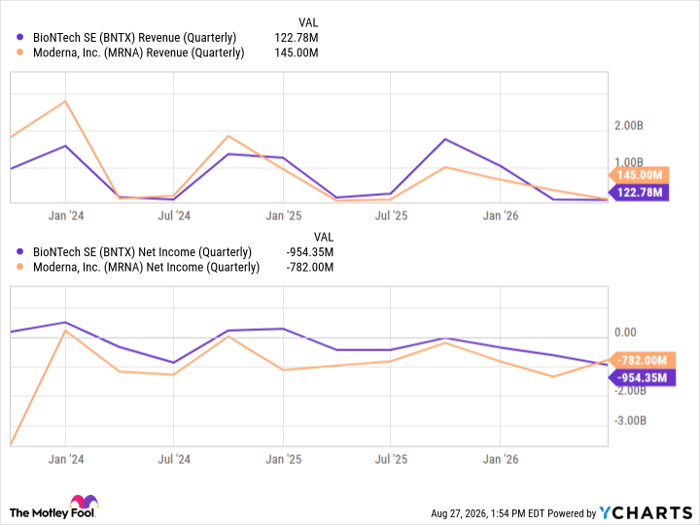
BNTX Revenue (Quarterly) data by YCharts
So, the market is judging them by their pipeline progress, since that will determine future revenue and earnings growth. And on that front, Moderna has been more impressive lately. The phase 3 clinical win for intismeran autogene means it will likely launch this new product relatively soon. The company's mFLUSIVA should also start contributing soon. Some of BioNTech's late-stage candidates are promising, but they haven't yet delivered strong phase 3 clinical trial results.
That's why Moderna's market cap is about $61.2 billion as of writing, more than twice BioNTech's $26 billion. In my view, even at current levels, Moderna is still the better pick. Moderna's pipeline, aside from products that have already completed phase 3 studies or earned approval, is not significantly weaker than BioNTech's, and the former's late-stage candidates that have aced clinical trials decisively tilt the balance in its favor.
Should you buy stock in BioNTech Se right now?
Before you buy stock in BioNTech Se, consider this:
The Motley Fool Stock Advisor analyst team just identified what they believe are the 10 best stocks for investors to buy now… and BioNTech Se wasn’t one of them. The 10 stocks that made the cut could produce monster returns in the coming years.
Consider when Netflix made this list on December 17, 2004... if you invested $1,000 at the time of our recommendation, you’d have $446,157!* Or when Nvidia made this list on April 15, 2005... if you invested $1,000 at the time of our recommendation, you’d have $1,377,357!*
Now, it’s worth noting Stock Advisor’s total average return is 983% — a market-crushing outperformance compared to 212% for the S&P 500. Don't miss the latest top 10 list, available with Stock Advisor, and join an investing community built by individual investors for individual investors.
See the 10 stocks »
*Stock Advisor returns as of September 3, 2026.
Prosper Junior Bakiny has no position in any of the stocks mentioned. The Motley Fool has positions in and recommends BioNTech Se, Bristol Myers Squibb, Merck, and Moderna. The Motley Fool has a disclosure policy.
Recommended Articles


