


Amazon vs. Microsoft: 1 Key Metric Identifies the Superior Artificial Intelligence (AI) Cloud Stock
Key Points
Microsoft Azure likely has a lower operating margin than Microsoft as a whole.
Amazon Web Services is boosting Amazon's overall operating margin.
- These 10 stocks could mint the next wave of millionaires ›
Amazon (NASDAQ: AMZN) and Microsoft (NASDAQ: MSFT) are two of the largest cloud computing providers. But which one of these hyperscalers makes for the better buy? I think there's one key metric that separates the two firms, and once you recognize it, it will be hard to consider investing in the other.

Image source: Getty Images.
Missed Nvidia in 2009? This Rare Signal Is Flashing Again. In 2009, a "Double Down" signal flashed for a little-known chipmaker called Nvidia. For the first time in years, that same "Total Conviction" signal is flashing for a company 1/100th the size of Nvidia. Continue »
The growth rates look similar, but are they?
In terms of market share, Amazon Web Services (AWS) is the largest cloud computing provider in the world, with Microsoft Azure coming in second. That makes both firms very important, but of the two, it's pretty clear Amazon is growing at a faster pace.
At first glance, that analysis seems wrong. In their latest quarters, Azure grew by 43%, while AWS grew by 37%. But that's not what I'm talking about.
I'm looking more at the trend lines, and it's clear that AWS' growth is accelerating rapidly. During Q1, AWS's growth rate was 28%. In Q4 2025, its growth rate was 24%. Rewinding to Q3 2025, its growth rate was 20%. That's some rapid acceleration over the past year, and considering Amazon is still pouring hundreds of billions of dollars into expanding its cloud computing capacity, I won't be surprised to see AWS' growth rate continue to accelerate over the next few quarters.
Microsoft Azure's growth rate has remained fairly constant, despite being rapid. While it grew Azure revenue by 43% during the company's fiscal 2026 Q4 (which ended June 30), its fiscal Q3 growth rate was 40%. In fiscal Q2 and fiscal Q1, it was 39% and 40%, respectively. That's not much growth acceleration, especially considering how much money Microsoft has been laying out on capital expenditures for this division.
So, even though Amazon is technically growing more slowly than Microsoft, I still think its cloud computing business is more attractive because its revenue growth rate is rapidly accelerating. I expect this trend will continue, knowing there's even more growth ahead coming from the infrastructure investments it's making.
I think this key point makes Amazon a better investment than Microsoft, but there's still one more factor to consider.
AWS' operating margin is comparatively impressive
Unfortunately for investors, Microsoft doesn't break out individual segments' operating margins in its public reports, just revenue growth. However, based on other cloud computing firms' operating margins, Azure's is likely slightly less than Microsoft's as a whole.
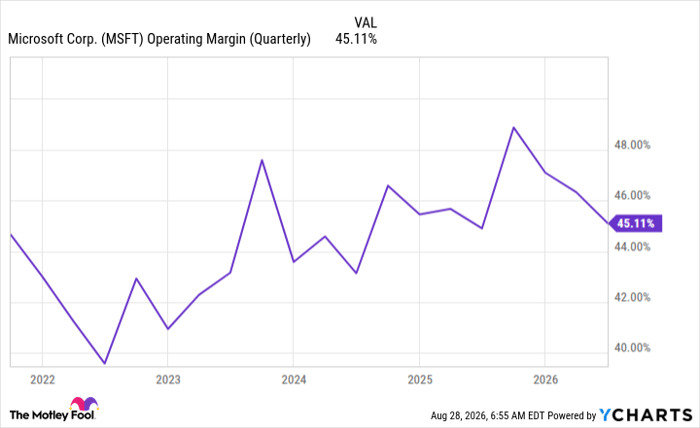
MSFT Operating Margin (Quarterly) data by YCharts.
During Q2, AWS' operating margin was 39%. So, if Azure grows faster than any other part of Microsoft's business, it will be a drag on Microsoft's results and cause profits to grow slower than revenue.
The opposite is true for Amazon.
Amazon's other core business, e-commerce, has notoriously low operating margins.
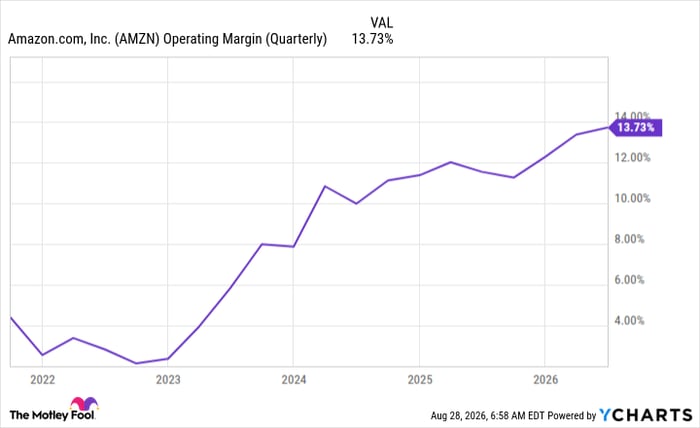
AMZN Operating Margin (Quarterly) data by YCharts.
As AWS grows faster than Amazon's other businesses, Amazon's profits will grow faster than companywide revenue. So, with AWS's growth rate accelerating, companywide profits are also expected to increase rapidly. This is a great setup for the stock to deliver incredible returns over the next few years, and makes Amazon by far the better stock to buy over Microsoft.
The key factor is that AWS' growth boosts Amazon's profits, while Azure is a relative drag on Microsoft's. With each company investing hundreds of billions of dollars into new computing capacity, it makes sense for investors to back the stock that will see greater profit growth rather than the one that will see shrinking profits for each dollar brought in.
Don’t miss this second chance at a potentially lucrative opportunity
Ever feel like you missed the boat in buying the most successful stocks? Then you’ll want to hear this.
On rare occasions, our expert team of analysts issues a “Double Down” stock recommendation for companies that they think are about to pop. If you’re worried you’ve already missed your chance to invest, now is the best time to buy before it’s too late. And the numbers speak for themselves:
- Nvidia: if you invested $1,000 when we doubled down in 2009, you’d have $582,768!*
- Apple: if you invested $1,000 when we doubled down in 2008, you’d have $61,989!*
- Netflix: if you invested $1,000 when we doubled down in 2004, you’d have $446,157!*
Right now, we’re issuing “Double Down” alerts for three incredible companies, available when you join Stock Advisor, and there may not be another chance like this anytime soon.
See the 3 stocks »
*Stock Advisor returns as of September 3, 2026.
Keithen Drury has positions in Amazon and Microsoft. The Motley Fool has positions in and recommends Amazon and Microsoft. The Motley Fool has a disclosure policy.
Recommended Articles


