


1 Magnificent Artificial Intelligence (AI) Stock to Buy With $25 Before 2026 Is Over
Key Points
SentinelOne's unique cybersecurity platform, called Singularity, uses AI to deliver highly automated protection.
Annual recurring revenue attributable to some of SentinelOne's AI products nearly tripled in its latest quarter.
The stock is much cheaper than that of its competitors, such as CrowdStrike and Palo Alto Networks.
- 10 stocks we like better than SentinelOne ›
As we approach the end of 2026, the S&P 500 index is hovering near an all-time high. However, there are still some attractive opportunities on the table, even in the red-hot artificial intelligence (AI) space.
SentinelOne (NYSE: S) is a leading cybersecurity company that relies heavily on AI to deliver highly automated protection to its enterprise customers. Its stock has soared by 47% so far this year, but it's still much cheaper than its top competitors CrowdStrike and Palo Alto Networks.
Missed Nvidia in 2009? This Rare Signal Is Flashing Again. In 2009, a "Double Down" signal flashed for a little-known chipmaker called Nvidia. For the first time in years, that same "Total Conviction" signal is flashing for a company 1/100th the size of Nvidia. Continue »
Investors can scoop up a single share in SentinelOne for under $25. Here's why it could be a great addition to a diversified portfolio before this year is over.

Image source: The Motley Fool.
AI is transforming the threat landscape
AI can be a powerful tool for enterprises, but it also broadens the attack surface for hackers. Every time a business deploys an AI chatbot or agent, it compromises the safety of its sensitive data and valuable digital assets, which is why businesses need state-of-the-art protection.
SentinelOne's Singularity platform is a holistic solution designed to secure endpoints (computers and devices), cloud networks, employee identities, AI applications, and more. It not only protects against breaches but also offers powerful remediation features to help enterprises restore their networks after a successful attack, minimizing downtime.
On the AI security front, SentinelOne has developed critical new tools, such as Prompt Security. It's designed to protect against new-age attacks like prompt injection, where hackers try to manipulate chatbots and agents into handing over sensitive data by disguising malicious commands as legitimate prompts. Prompt Security also inventories every chatbot and agent deployed by the enterprise, so it immediately knows if an unauthorized application is trying to orchestrate a breach.
Then there is Purple AI, an agentic assistant embedded into the Singularity platform. SentinelOne knows human analysis is no match for modern attack speed, so it designed Purple AI with advanced reasoning to autonomously investigate and take action when threats arise.
AI-related revenue is surging
SentinelOne had $1.2 billion in annual recurring revenue (ARR) at the conclusion of its recent fiscal 2027 second quarter (ended July 31), an increase of 22% compared to the year-ago period. However, the company said the ARR attributable to AI products such as Purple AI and Prompt Security nearly tripled, so it's clear that enterprises are prioritizing this new-age protection.
Those results are impressive, given that SentinelOne reduced its marketing spending during the first half of fiscal 2027, a move that would typically hinder its growth potential. The company redirected those savings into research and development spending, which increased by 27% year over year as it aims to accelerate innovation.
Unfortunately, SentinelOne's overall increase in operating expenses led to a generally accepted accounting principles (GAAP) net loss of $169.5 million during the first half of fiscal 2027. But on a positive note, that was a 39% reduction from its loss in the year-ago period.
Plus, after excluding one-off and non-cash expenses like stock-based compensation, SentinelOne was actually profitable to the tune of $40.7 million. Revenue growth is important, but the company also needs to make money to build a self-sustaining business over the long term.
SentinelOne stock is cheap compared to its peers
Based on SentinelOne's trailing 12-month revenue, its stock is trading at a price-to-sales (P/S) ratio of just 6.6, so it's drastically cheaper than its main rivals CrowdStrike and Palo Alto Networks, which have P/S ratios of 41.6 and 25.6, respectively.
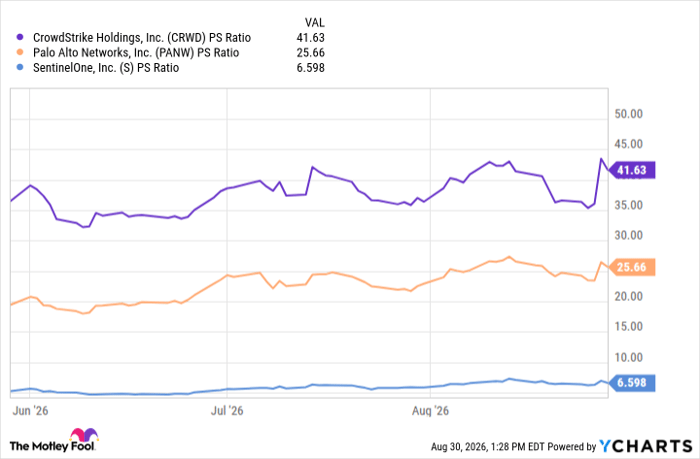
CRWD PS Ratio data by YCharts
CrowdStrike reported over $5.8 billion in ARR at the end of its most recent quarter, which grew by 25% year over year. Therefore, not only is the company bringing in more money than SentinelOne, but it's also growing faster, so it absolutely deserves a premium valuation. However, I would argue the valuation gap is a little too wide, particularly given the blistering ARR growth in SentinelOne's AI products.
I'm not suggesting SentinelOne stock will ever trade at over 40 times sales, but I think there is certainly room for upside to its current valuation. Cybersecurity will only become more important as AI adoption ramps up, which is why the company values its addressable market at over $100 billion. It has barely scratched the surface of that opportunity, so now might be a great time for investors to add this stock to their portfolio.
Should you buy stock in SentinelOne right now?
Before you buy stock in SentinelOne, consider this:
The Motley Fool Stock Advisor analyst team just identified what they believe are the 10 best stocks for investors to buy now… and SentinelOne wasn’t one of them. The 10 stocks that made the cut could produce monster returns in the coming years.
Consider when Netflix made this list on December 17, 2004... if you invested $1,000 at the time of our recommendation, you’d have $437,097!* Or when Nvidia made this list on April 15, 2005... if you invested $1,000 at the time of our recommendation, you’d have $1,355,077!*
Now, it’s worth noting Stock Advisor’s total average return is 978% — a market-crushing outperformance compared to 213% for the S&P 500. Don't miss the latest top 10 list, available with Stock Advisor, and join an investing community built by individual investors for individual investors.
See the 10 stocks »
*Stock Advisor returns as of September 1, 2026.
Anthony Di Pizio has no position in any of the stocks mentioned. The Motley Fool has positions in and recommends CrowdStrike. The Motley Fool recommends Palo Alto Networks. The Motley Fool has a disclosure policy.
Recommended Articles


