


How Much More Power Do AI Data Centers Need Right Now? Morgan Stanley Says 38 Gigawatts. Here Are 3 Stocks Cashing In on That Opportunity.
Key Points
Natural gas power turbine maker GE Vernova remains the top investment prospect of the movement simply because its solution is proven and readily available.
Fuel cells are quickly moving into the mainstream as a bring-your-own-power (or BYOP) solution for data centers. Bloom Energy's fuel cell technology offers incredible flexibility.
NuScale Power's tech won't be able to help meet the initial surge in electricity demand, but it's a fantastic way to capitalize on the long-term growth in AI data centers' power consumption.
- 10 stocks we like better than GE Vernova ›
It's no secret that artificial intelligence data centers need more power than the electric utility industry will be able to effectively offer them anytime soon. Morgan Stanley equity strategist Michelle Weaver recently quantified the problem, suggesting earlier this month that "there's a potential shortfall of around 38 gigawatts needed through 2028." That's enough electricity to power a couple of dozen major metropolitan cities, for perspective, or perhaps a few dozen AI data centers (depending on their size).
This is why so many artificial intelligence data center owners/operators are taking matters into their own hands, setting up their own power production solutions alongside their facilities. That spells opportunity for investors.
Missed Nvidia in 2009? This Rare Signal Is Flashing Again. In 2009, a "Double Down" signal flashed for a little-known chipmaker called Nvidia. For the first time in years, that same "Total Conviction" signal is flashing for a company 1/100th the size of Nvidia. Continue »
To this end, here's a closer look at three industrial names offering the stand-alone power-generation solutions the artificial intelligence industry so desperately needs.
GE Vernova
GE Vernova (NYSE: GEV) remains arguably the top way of plugging into AI data centers' so-called BYOP (bring-your-own-power) movement for one simple reason. That is, its natural gas power turbines are proven and accessible. The company took orders for a few dozen of these massive, on-site power-production machines last quarter alone, accounting for the bulk of this division's $16.7 billion in orders during the three months ending in June, up 134% year over year. For perspective on that figure, GE Vernova is now looking for total revenue of about $46 million for the entirety of 2026 versus last year's companywide top line of $38 billion, with natural gas power equipment driving most of this growth.
This is still only the beginning, though. An outlook from Global Market Insights suggests that the worldwide natural gas power turbine market, which GE Vernova currently leads, is poised to grow by more than 11% per year through 2035, when it should be worth nearly $65 billion annually.
That being said, don't dismiss the potential of this company's other profit centers. While gas turbines will be its breadwinner for the foreseeable future, the proliferation of power-hungry data centers is also underscoring the inadequacy of the United States' (not to mention the rest of the world's) electrical grids. Analysts with J.P. Morgan expect $5.8 trillion worth of upgrades to be made to the planet's power grids between now and 2035, with $1 trillion of that to be made within the United States alone. That brings GE Vernova's other businesses, like nuclear power, energy storage, and power grid technologies, into the picture as well.
Simply put, GE Vernova is very much in the right place at the right time, and will be for a while.
Bloom Energy
Bloom Energy (NYSE: BE) CEO KR Sridhar's recent comment that his company's equipment is "now a standard for AI onsite power" may be somewhat overstated. But his bigger philosophical point still stands -- the company did a record-breaking $1.06 billion in business last quarter (up 166% year over year), the bulk of which was product sales.
That product is fuel cells, and in Bloom's specific case, proprietary solid-oxide fuel cells.
In simplest terms, fuel cells convert a gas like hydrogen or natural gas into electricity through an electrochemical process rather than a combustion-powered mechanical one. Specifically, when the gas-based fuel passes through the fuel cell's electrolyte membrane, which only allows positively charged ions through it, that equipment effectively becomes a conventional -- albeit enormous -- battery with a negatively charged anode on one side and a positively charged cathode on the other. The only byproducts are water and heat.
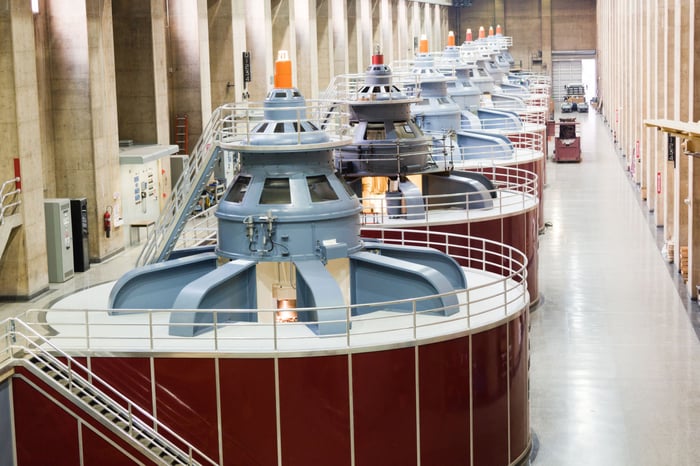
Image source: Getty Images.
This low-emissions footprint is clearly something AI data center owners appreciate, but it's not necessarily why the artificial intelligence industry is suddenly embracing Bloom Energy's tech. It's the flexibility of Bloom's solution. Whereas most commercialized fuel cells thus far have been built to use hydrogen fuel that isn't exactly cheap or abundant, Bloom Energy's solutions are capable of utilizing hydrogen or natural gas, the latter of which is readily available.
And as was the case with GE Vernova, Bloom Energy's second quarter was just a taste of what lies ahead. A projection from Precedence Research suggests the global fuel cell industry is set to grow at an average annualized pace of more than 25% between now and 2035, when it could be worth more than $73 billion per year. On-site power for AI data centers will account for a huge piece of that growth.
NuScale Power
Finally, add NuScale Power (NYSE: SMR) to your list of stocks that are poised to perform well as artificial intelligence data centers seek out their own power-generation solutions.
The idea of using small-scale nuclear reactor power plants to produce electricity at the very same facility where it's being used was unthinkable several years ago. Now it's not only possible, but likely. NuScale Power's small modular reactor (SMR) designs have already been approved for use within the United States by the U.S. Nuclear Regulatory Commission, with its second, higher-output (77 megawatt) design approved in May last year.
That doesn't mean pre-profit NuScale Power's small-scale nuclear power plants will be generating electricity anytime soon, or even by 2028. It still takes years to plan, permit, and then construct such a facility, even with an approved design. That's what makes NuScale's stock the riskiest and most difficult to value among the three names in focus here.
Nevertheless, there's no denying that small modular reactors feature prominently in the AI data center industry's longer-term future. The International Energy Agency predicts that total electricity output from SMRs like the ones NuScale builds will start to soar beginning in 2030 as the first SMRs come online, growing from roughly 1.5 gigawatts then to over 100 gigawatts' worth of power production capacity by 2050.
This might help in the meantime: The analyst community's current 12-month price target of $12.59 is more than 30% above NuScale stock's current price. That's not a bad way to start out a new position.
Should you buy stock in GE Vernova right now?
Before you buy stock in GE Vernova, consider this:
The Motley Fool Stock Advisor analyst team just identified what they believe are the 10 best stocks for investors to buy now… and GE Vernova wasn’t one of them. The 10 stocks that made the cut could produce monster returns in the coming years.
Consider when Netflix made this list on December 17, 2004... if you invested $1,000 at the time of our recommendation, you’d have $443,461!* Or when Nvidia made this list on April 15, 2005... if you invested $1,000 at the time of our recommendation, you’d have $1,307,633!*
Now, it’s worth noting Stock Advisor’s total average return is 973% — a market-crushing outperformance compared to 213% for the S&P 500. Don't miss the latest top 10 list, available with Stock Advisor, and join an investing community built by individual investors for individual investors.
See the 10 stocks »
*Stock Advisor returns as of August 26, 2026.
JPMorgan Chase is an advertising partner of Motley Fool Money. James Brumley has no position in any of the stocks mentioned. The Motley Fool has positions in and recommends Bloom Energy, GE Vernova, and JPMorgan Chase. The Motley Fool recommends NuScale Power. The Motley Fool has a disclosure policy.
Recommended Articles


