


Alibaba (BABA) Stock Forecast: Qwen AI, Profitability Recovery, and August 17 Earnings at $128
TradingKey - As of August 3, Alibaba Holdings (NYSE: BABA) is at $127.82, up 4.46% during early trading, and 7.01% up in Hong Kong. The cost efficiency of Qwen AI is attracting investors. The stock is up about 39% from the 52-week low of $91.99 on June 26. It has decisively broken the $121.41 resistance and has reclaimed the 50 and 100-day EMAs ($115.85 and $116.16). The stock has been sharply up and is therefore overbought with the RSI above 80. The stock has $128.04 resistance. The company reports earnings next on August 17 before the market opens. It is expected that the company reports revenue of RMB268.86 billion (+8.6% YoY), but the adjusted EPS is expected to be down 29% to RMB10.46 per ADS as the company adds to its losses from AI investments and instant commerce. The average target for $BABA is $189.81.
What Is Driving Today's Move
There are two reasons for the gain on Monday's 4.46% ADR and 7.01% Hong Kong surge. First, Alibaba announced that it is releasing its Qwen3.8-Max AI Model globally before the open-weights release next week. Qwen has the 5th ranking in Text Arena and the 2nd in Vision Arena. Second, Alibaba is combining its different enterprise AI agent tools (QoderWork, Wukong, and MuleRun) into a single DingTalk platform led by Chen Yusen. Qwen's efficiency (with 14.3% fewer parameters and 8.7% lower active work load) is very appealing for enterprises that are cost sensitive.
Second, the move captures enthusiastic trading starting July 8. This followed news that profits had become less volatile and losses from instant commerce had begun to decline. This was after a quarter that saw the company’s adjusted EBITA drop by 84% year-on-year to 740 million dollars as a result of expensive on-demand delivery. Also, the previously mentioned market move, from South Korean and Taiwanese chip makers to Chinese Internet companies (Baidu, JD, PDD Holdings) Northbound, helped. Also, Alibaba is still the largest AI company in China, and the most widely used AI application is Qwen.
The Profitability Story Before August 17
Since the beginning of 2026, Alibaba has struggled with pressure on its margin due to high capital expenditures in AI and losses from instant commerce due to competition with Meituan. In the March quarter, adjusted EBITA was very close to 740 million dollars, and the company nearly broke even, adjusted for net profit. On the positive side, Cloud Intelligence Group grew by 38% with AI constituting 30% of external cloud sales. Qwen, lower delivery losses, and the Qwen application are the basis of the positive trend in the stock price.
The August 17 earnings will either affirm or contradict this explanation of the recent positive trend in the stock price. In the upcoming quarter, the consensus total revenues are expected to be 268.86 billion Chinese Renminbi, representing an 8.6% year over year increase, and reported adjusted earnings per share are expected to be 10.46, reflecting a decline of 29% year over year. The market will react positively if the results support the assertion that the losses from instant commerce have bottomed and the Cloud AI revenue is related to an increase in business. Interest in the Qwen ecosystem is evidenced by the recent business collaboratives with Apple (for the China iPhone), BMW, and SAP.
The Geopolitical Overhang
Two of BABA's unresolved structural headwinds have driven BABA's 22%+ year-to-date underperformance, contracting its valuation to 19.2 times GAAP EPS, with an upside of 48% based on an average target price of $189.81. First, the Pentagon's designation of Alibaba as a Chinese military company has created uncertainty for many US institutional investors and government contractors. Second, US lawmakers have threatened to create legislation against AI model distillation — referring to training smaller, more efficient models using the outputs of larger models — which could limit Qwen's learning and distillative capabilities based on US models. While these risks are more structural than front-loaded, they nonetheless are part of the reason BABA is undervalued.
BABA Technical Setup
From the rise seen on the charts, BABA at $127.82 appears to have broken out from the rising channel, headed above the $121.41 resistance and reclaimed both EMAs. The RSI is above 80 and is considered as “overbought” after the large movements that have happened from the June lows.
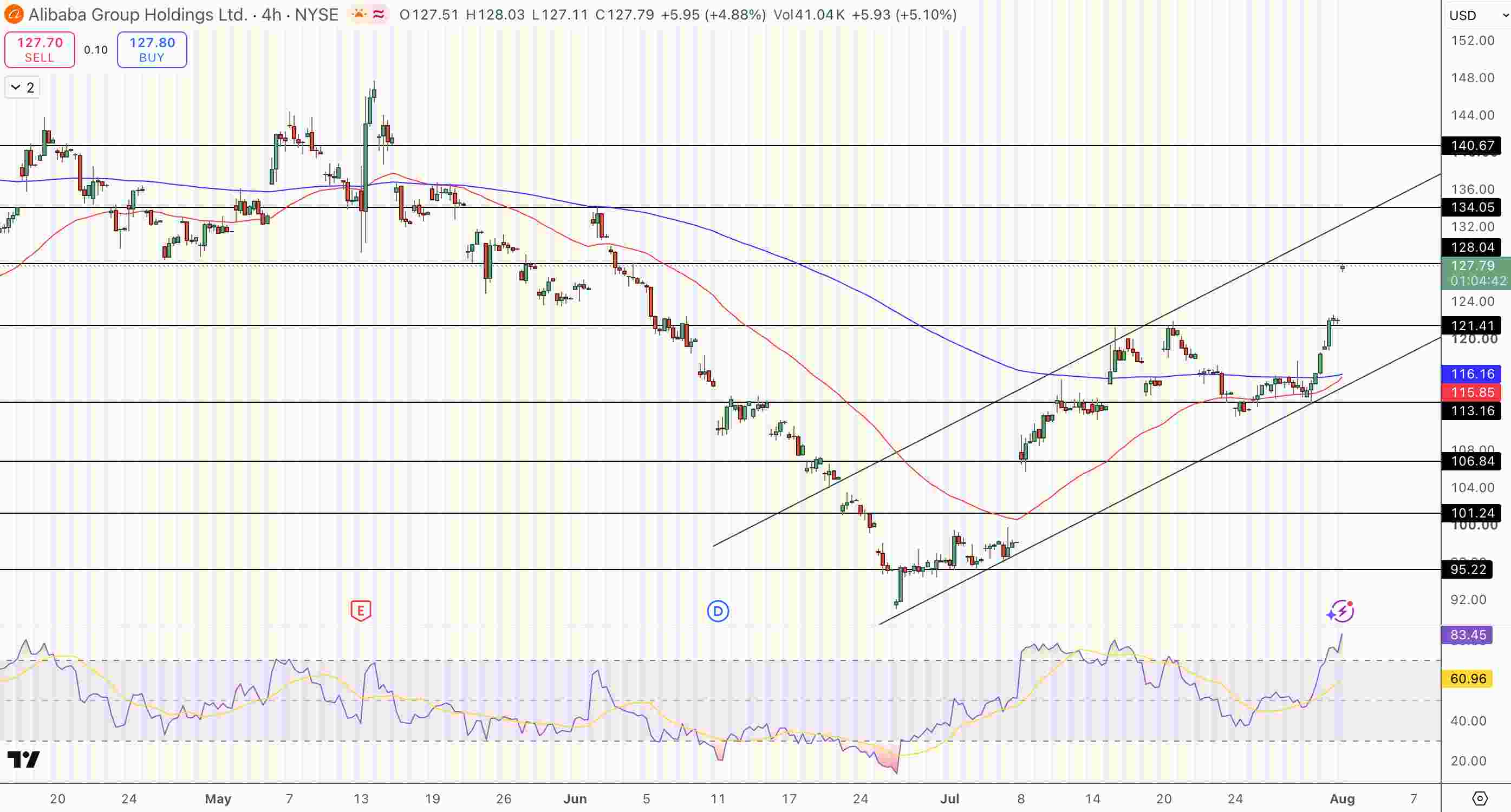
Alibaba (BABA) Stock Price Chart - Source: Tradingview
The next immediate resistance is seen at $128.04 and closing above that will target the resistance at $134.05 and subsequently $140.67. The previous breakout at $121.41 is the first support. The 50 and 100 EMAs which sit between $115 and $116 are also structural support. A pullback to $121 would be a healthy test of the breakout, and if the fundamentals support it on August 17, it would set up the next leg.
Key Levels
Today: $127.82 (+4.46% ADR, +7.01% HK). 52-week range: $91.99 to $145.09.
Recovery: 39% from $91.99 June 26 low. July 8 catalyst: profitability stable, losses narrowing.
Qwen today: Qwen3.8-Max available globally. Open-weights release next week. 5th Text, 2nd Vision Arena.
Cloud: Revenue: +38% last quarter. AI-related revenue accounted for 30% of external cloud sales.
Earnings: August 17, before open. Consensus: RMB268.86B revenue (+8.6%). EPS down 29% YoY.
Headwinds: Pentagon 'Chinese military company' designation. US AI model distillation legislation.
Analyst target: $189.81 average. 48% upside from $128. Current valuation 19.2x FY2026 GAAP EPS.
Resistance: $128.04 (immediate), $134.05, $140.67.
Support: $121.41 (breakout level), $116.16/$115.85 (EMAs).
Why Has Alibaba Fallen 22% YTD Despite 38% Cloud Growth?
The 22% drop in Alibaba stock this year has several points of concern: increasing AI capital expenditure, severe instant commerce losses (with EBITA down 84% March quarter), pentagon's military designation decreasing institutional interest in the US, and worries regarding the US AI model distillation and regulation. While the 38% growth in Cloud and AI making up 30% of external Cloud sales support an AI narrative, the large delivery losses and continuing geopolitical concerns depress stock value.
What Is Qwen and Why Does It Matter?
Our assessment of Qwen as Alibaba Cloud Intelligence Group's proprietary large language model (LLM) family, indicates that it ranks in 5th place globally in the Text Arena and 2nd place in the Vision Arena, significantly outperforming proprietary models of many U.S. startups with the exception of advanced GPTs and Geminis. Its structural efficiency (14.3% fewer parameters, 8.7% less active workload) lowers enterprise clients' inference costs.
As enterprise clients adopt Qwen, it increases Alibaba's API revenue and enhances the stickiness of its platform, while promoting cross-service development. The Qwen 3.8-Max release today and the Open Weights release next week are expected to build even more momentum before the August 17 earnings.
Bottom Line
Qwen's momentum and the forecasting stabilization of Alibaba's profitability announced in the pre-earnings guidance, has contributed to the 39% increase from the June low of $91.99 to the current price of $127.82. It has broken through the $121.41 resistance level. The service has been rated as overbought, with immediate target prices of $128.04, $134.05, and $140.67, while the support threshold is $121.41. The August 17 earnings will indicate the stabilization of losses from Alibaba's instant commerce and the profitability of Cloud AI. The average target price from analysts of $189.81 indicates an upside of 48%. The losses from the Pentagon and U.S. threats legislation are the structural overhangs as to why the stock is down 22% despite Alibaba's Cloud growing 38% year over year.
Recommended Articles


